


By Oweyegha-Afunaduula
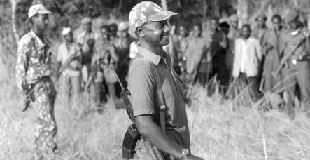
The combatants of Luwero called their rebellion liberation of Uganda and Ugandans. They also called it a revolution. However, it was an insurrection, orchestrated violence against the government in Kampala between 1981-1986.
It was a very successful insurrection because on 25 January 1986, it resulted in the capture of the instruments of power by the combatants, but not without leaving some 500,000 skeltons or skulls scattered, or temporary buried, in the soil of Luwero (Dr Kiiza Besigye, pers.comm.). There were claims by survivors that whole families of Uganda Peoples’ Congress (UPC) leaders in the Luwero Triangle, which was then made of 22 districts, were wiped, frequently by hacking their heads off with axes.
According to the then Kahinda Otafiire (now General), one of the combatants, they would wear UPC shirts to access their victims homes and then kill them. He revealed this during the burial of a UPC stalwart, Prof. Adoniya Tiberondwa, in Bushenyi on 24 December 2004.
My interest in this article is to analyse why Rwandese Tutsi refugees prominently participated (and actually commanded) the insurrection of what was called National Resistance Movement/Army (NRM/A in a country – Uganda – to which they did not belong and was their safe refuge they were abusing.
To begin the article, let me state that the refugees included so many people who are now citizens of Uganda by virtue of power and the Uganda Constitution 1995, which they made for country and concealed themselves under a supposedly new constitutional category of “indigenous people” it characterized as “Banyarwanda”.
By constitutionally creating this category of indigenous “nomadic pastoralists” in the Constitution of Uganda 1995, the designers of the constitution made them a natural identity with a natural belonging in Uganda just like the natural indigenous groups all of which have natural identity and natural belonging to the area that came to be known as Uganda.
They could, therefore, compete or share resources, jobs and opportunities with the natural indigenous people in the various indigenous groups that were recognized by the independence Uganda Constitution of 1962. However with decision-making power by virtue holding the highest office in the land it meant they could decide who could share and by how much. We know that repeatedly the President those who did not support the NRM/A would not access the national cake at all.
It also meant that every Rwandese Tutsi in the Great Lakes Region could easily claim to be a Ugandan, be citizenized and access a Ugandan Passport and/or a National Identity Card, or even seek elective office in any part of the country. Many Ugandans fear all these are already happening. For example, many people with extraneous origin are being fielded by the NRM to represent the indigenous Ugandans in the Parliament of Uganda.
This was not surprising. Cross-border nomadic pastoralists neither recognize the physical international boundaries between countries (e.g., Rwanda/Uganda or DRC/Uganda), or have boundaries in their brains. It explains why they can easily move to areas where they have no historical, biological, ecological or cultural ties and claim identity, belonging and property, including land, at the expense of the natural owners – the indigenous peoples.
The NRM/A includes many people who saw themselves as nothing but Rwandese of Rwanda or of the Mulenge area of the Eastern region of present-day Democratic Republic of Congo (DRC). They had previously organized themselves as the Front for National Salvation (FRONASA) of Uganda, and later the Patriotic Resistance Army (PRA) of Uganda.
They had only one interest: using the physical space and resources (money, guns, etc) of Uganda to go back to where they came from (i.e., Rwanda and Mulenge in DRC. Among the prominent combatants were Fred Rwigyema and Paul Kagame. They composed from within the NRM/A what they called Rwandese Patriotic Movement/Army (RPA).
Some writings show that some NRM/A rebel leader, such as Yoweri Museveni (Tibuhaburwa Museveni), originally came from Mulenge in the DRC. This could explain why Paul Kagame, who has been the President of Rwanda for the last 29 years, was categorical when he told the world that the Banyamulenge combatants of DRC, the M23, did not come from Rwanda but Uganda. It could also explain why the President of Uganda of Uganda, Yoweri Tibuhaburwa Museveni, maintains such a high level of interest in Eastern DRC. He decidedecen without first consulting the Parliament of Uganda, to construct a road a road from the border with DRC to Goma, the main town of Mulenge.
Therefore, it is easy to see why hordes of refugees joined therebel outfit, NRA, and even expectedly assume commanding positions. The rank and file of the NRA, in their thousands, were Ugandans; some of them were criminals who escaped from prisons, while others were convinced by the propaganda of the NRA that the rebel force was liberating Uganda from the Northerners, or past regimes, and that kingdoms and kings would be restored once the NRA captured the instruments of power in Kampala.
Many, in their thousands, died in the bushes of Luwero. Those who survived went on to become become the rank and file of the first army of Uganda after expelling the Uganda National Liberation Army (UNLA) of the Uganda National Liberation Front (UNLF) that removed President Idi Amin from power in 1979. Their foreign commanders became the commanders of the new army, which remained a rebel army outfit until the Uganda Constitution 1995 recognized it as the Uganda army under the label Uganda Peoples Defense Forces (UPDF).
Extremely few of the rank of the rebel NRA outfit rose through the ranks to become commanders alongside the foreign commanders. This is reflected in the UPDF where the commanders at different levels are predominantly from the immigrant population and some Bahima from the Western region of Uganda. Therefore, from the same migrant ethnic group that captured the instruments of power in 1986 continues to dominate the commanding positions of the UPDF. However, over time, even the rank and file of the UPDF became infested with large numbers of people from the immigrant group from Rwanda, Mulenge and the Bahima. There are unconfirmed reports that during the recruitment of soldiers in different parts of the country, people who cannot speak the local languages are transported there and recruited. Many think this explains the rising brutality of soldiers against Ugandans.
Today, many indigenous Ugandans believe, and are convinced, that the narrative that a revolution took place in Luwero, and that Uganda and Ugandans were liberated, was a well-crafted lie intended to ensure the NRA rebels gained foot and captured the instruments of power to empower and turn themselves into the new post-colonial rulers. There are claims that they are governing Uganda like a modern-day apartheid regime of black racists. Scientific research is needed to confirm or reject this.
Many indigenous Ugandans do not doubt anymore that the NRA rebels both captured the instruments ofpolitical power and conquered and occupied Uganda for reasons that had nothing to do with the citizens. Eventual the locals have been completely excluded from power and consigned to playing second fiddle to to the conquering and occupying group. The locals are satisfied when they serve as vice-presidents, prime ministers, ministers or heads of institutions. However, increasingly even that space of serving second fiddle is being lost to the members of the families or ethnic group of the rebels, who continue to characterize themselves as revolutionaries and liberators.
As expected, there are stillbmany Ugandans who believe the narrative of “revolutionaries and liberators”. They constitute the power base of the rebels of yesterday, although the latter claim their power base are the rural poor, whom they have manipulated for almost 40 years. Over this period, the rebels in power, who still posit themselves as the National Resistance Movement (or resistors) have captured everything conceivable. Most Ugandans now know that they (the rebels in power or the resistors) are not resisting neocolonialism, but Ugandans, and that in fact they are the new (black) neocolonialists.
They have captured all civic spaces and militarized them. They have captured all the natural resources. They have captured all state institutions They have captured the future of the country as well. Many Ugandans now understand the captors are using money, jobs, drink and their beautiful women to capture the country more firmly, even genetically. The more critical thinkers see schemes such as Operation Wealth Creation (OWC), Myooga and Parish Development Model (PDM), not as tools for conquering poverty but impoverishing communities as a long-term goal so that the people are continually conquered and the country is occupied more effectively the way the Boers did in South Africa. One school of thought believes that this is the case because the rebels and resistors in power have politically weaponized poverty against the people of Uganda, because their belief is that it is easier to rule when the people are poor. In fact the locals who become rich are made to sink into poverty as foreigners become richer and richer.
Weaponized poverty has now been institutionalized for building the selfishness and greed of the ethnic group with and in power. Weaponized poverty turns many people into brutes and makes them make irrational choices such as selling their land at dehumanizing prices. It remoulds them into willing tools in the hands of the desperate.Weaponized poverty Isa concealed tool of genocide capable of killing people in greater numbers than guns can.
One strong school of thought believes that the laws that the liberators or revolutionaries, as they call themselves, have enacted over the years, contain no quality of liberation but the vices of oppression, repression and suppression of the indigenous Ugandans. Such laws include the Anti-Sectarianism Law, the Anti-Terrorism Act 2002, the Political and Other Organizations Law 2005 and the UPDF Act 2025.
The Anti- Sectarianism Bill was first tabled before the National Resistance Council (NRC), which was the legislative body of the NRM/A, in 1986, immediately after it captured the instruments of power, ostensibly, to combat tribalism. However, over the years, the NRM/A itself showed seeds of discrimination based more on ethnicity than tribalism. For example, when it retrenched many Ugandans from their jobs in the early 1990s, arguing that they were dead wood, the emptied jobs were immediately almost exclusively by people belonging to the dominant ethnic group of the leading combatants. One writer, Eric Kashambuzi, wrote in 2009, that the Anti-Sectarianism Law was conceived, not to combat sectarianism but to protect it. Indeed over the years, sectarianism has become the mainstay in governance and leadership of the country and it’s state institutions. One school of thought believes sectarianism now characterizes everything in which the former rebels are involved, and is being used as a tool to marginalize the indigenous Ugandans.
One school of thought believes the Anti-Terrorism Act, the Political and Other Organizations Act and the UPDF Act we’re innovated to generate fear and silence among the alternative leaders in particular and the general population in general so that the rebels in power are not adequately challenged while the perennially hold onto power in Uganda.
One thing is true. The sociopolitical environment the rebels in power have created in Uganda over the last nearly 40 years is very debilitating for the indigenous Ugandans and very disempowering in the medium and long term. It has made foreigners in Uganda manifest as if the country is theirs, while the indigenous people now manifest as if they are the foreigners in their own country. This is an affront, which may be reflected in future electoral processes.
There is a strong school of thought, which holds that the rebels in power in Uganda are using their advantageous vantage point they have created for themselves in the country to influence what takes place, or does not take place, in East Africa or the Great Lakes Region. According to the school, they have already influenced the expansion of the East African Community (EAC) from three countries ( Kenya, Tanzania and Uganda) to six or so countries (including Burundi, DRC, Rwanda, Somalia and South Sudan. The school insists that they want to include all the countries of the Great Lakes region in one Economic Block and go as far as including the countries of the Horn of Africa. However, the fear among the Bantu ethnic group is that the resulting entity would be numerically dominated by nomadic pastoralists, who are already in power in their countries. The more perturbed think, believe and are convinced the expanded economic region would be politically dominated by Rwandese nomadic pastoralists in the same fashion they dominated their ancient Kitara Kingdom that spread over Kenya, Tanzania, Uganda, Malawi and parts of Zambia before the emergence of the Bunyoro Kitara Kingdom of the Babito.
For God and My Country.
Prof. Oweyegha-Afunaduula
Center for Critical Thinking and Alternative Analysis