


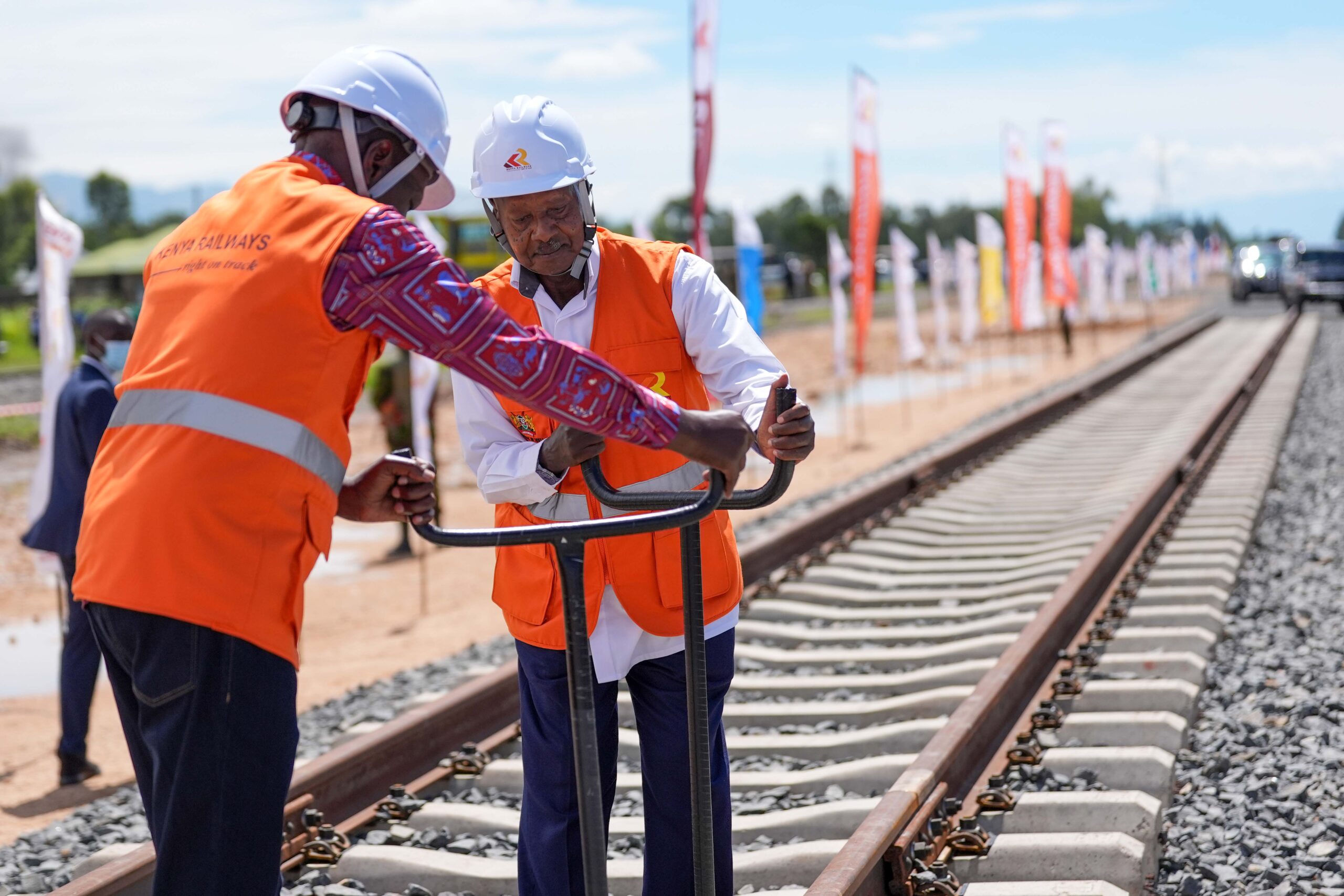
Presidents Yoweri Kaguta Museveni, of Uganda, and William Ruto, of Kenya, jointly officiated the launch of the Kisumu–Malaba Standard Gauge Railway (SGR) Extension (Phase II), a major infrastructure project expected to enhance trade and transport efficiency across East Africa.
Prior to the ceremony, President Museveni held a closed-door meeting with President Ruto, discussing bilateral relations, regional trade, and infrastructure development between the two countries. The launch was marked symbolically as the two leaders tightened a bolt on the railway line to signify the commencement of construction works.
“This is a very important function of launching the Naivasha–Kisumu to Malaba Standard Gauge Railway,” President Museveni said, describing the milestone as a key step in regional infrastructure development. He highlighted that the railway forms part of a broader plan to rationalise transport systems, particularly in Uganda, where over-reliance on road transport increases costs and inefficiencies.
“The railway is part of the rationalisation of our transport system, especially on the Ugandan side, which is irrational and wasteful because passengers, light cargo, heavy cargo, and petroleum products are all concentrated on the roads,” Museveni explained. He added that Uganda plans to move heavy cargo to rail, petroleum products to pipelines and water transport, and reserve roads mainly for passengers and light cargo, a strategy expected to reduce congestion and improve competitiveness.
The Ugandan President also underscored the importance of producing high-quality, affordable goods to remain globally competitive. “If Africa does not address these cost pushers—high transport costs, expensive electricity, and high financing costs—we shall be outpriced and our goods will not be competitive even within Africa,” he warned.
President Ruto praised Museveni’s commitment to regional integration and East African unity, noting that the SGR from Suswa through Kisumu to Malaba will unlock Kenya’s economic potential while benefiting the wider East African region. The project is expected to strengthen connectivity to the Port of Mombasa and facilitate trade with landlocked countries including Uganda, Rwanda, Burundi, South Sudan, and the Democratic Republic of Congo.
Ruto highlighted the need for efficient transport, noting that cargo volumes through the Port of Mombasa reached 7.37 million tonnes in just six months of 2025, with nearly 70 percent destined for Uganda. He warned that slow logistics corridors—currently taking up to 80 hours from Mombasa to Malaba and over 100 hours to Kampala—undermine competitiveness.
“The railway extension will significantly improve the Northern Corridor by reducing transport time, lowering freight costs, and improving the movement of goods between Uganda and the Kenyan coast,” he said.
The Kisumu–Malaba SGR extension is also expected to boost key economic sectors including agriculture and fisheries around the Lake Victoria basin, while forming part of a broader regional railway network connecting Mombasa, Nairobi, Naivasha, Kisumu, Malaba, and ultimately Kampala.
Both Presidents expressed optimism that the project will accelerate regional integration, enhance trade efficiency, and strengthen economic cooperation between Kenya and Uganda.