


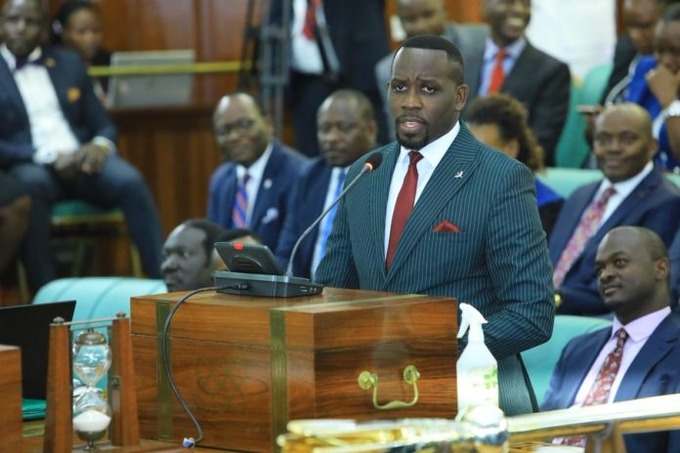
A fresh battle over the leadership and structure of Uganda’s parliamentary opposition may be brewing after Buyaga West County MP Dennis Namara announced plans to introduce a Private Member’s Bill seeking sweeping amendments to the Administration of Parliament Act.
The proposed legislation, which Namara says he will seek Parliament’s leave to introduce, seeks to redefine how the Leader of Opposition (LoP) is selected, how opposition Members of Parliament are deployed to parliamentary committees, and the circumstances under which an LoP may cease to hold office.
The move comes at a time of growing political debate over the office currently held by National Unity Platform (NUP) legislator Joel Ssenyonyi and is likely to reignite discussions about opposition politics, parliamentary representation, and party democracy in Uganda.
A New Formula for Choosing the LoP
Speaking in an interview with Parliament Watch, Namara argued that the process of selecting the Leader of Opposition should be broadened beyond the current arrangement, where the position is effectively determined by the opposition party with the largest numerical strength in Parliament.
According to Namara, all opposition Members of Parliament, including independents, should have a say in electing the holder of the office.
“That has to be an election where the opposition Members of Parliament, all of them participate, including the independent Members of Parliament,” Namara said.
If adopted, the proposal would represent a fundamental shift from the current system, under which the largest opposition party nominates the Leader of Opposition and the Speaker merely announces the nominee to the House.
Political Undercurrents
While Namara has framed his proposal as a governance reform initiative, the timing of the Bill is likely to attract political scrutiny.
The proposal comes amid growing pressure from figures associated with the Patriotic League of Uganda (PLU), a political movement led by Chief of Defence Forces Gen. Muhoozi Kainerugaba, who has publicly criticized Ssenyonyi’s performance as Leader of Opposition.
Recently, Gen. Muhoozi took to X and announced that he had tasked PLU Secretary General David Kabanda, the Member of Parliament for Kasambya County, with finding lawful means of removing Ssenyonyi from the opposition’s top parliamentary office.
Kabanda embraced the assignment and publicly pledged to deliver a new Leader of Opposition within two weeks.
Following Namara’s announcement, Kabanda returned to X and suggested that efforts to replace Ssenyonyi were already underway.
“The process of getting a new Leader of Opposition has officially commenced. Don’t ask me how; just know we will achieve it and we will do it legally,” Kabanda posted.
Although no direct link has been established between Namara’s proposed Bill and the PLU campaign against Ssenyonyi, the developments are likely to fuel speculation about a coordinated push to alter the current opposition leadership framework.
Revisiting a Failed Reform Effort
Namara’s proposal revives a debate that Parliament appeared to settle only months ago.
The last major attempt to amend the Administration of Parliament Act was undertaken by Mityana South MP Richard Lumu through his Administration of Parliament (Amendment) Bill, 2024.
Lumu’s Bill sought to alter the manner in which the Leader of Opposition and other opposition leadership positions are selected.
However, the proposal faced widespread resistance from political parties, civil society actors, legal experts, and the Attorney General’s chambers before it was eventually withdrawn on March 12, 2026.
During debate on the matter, the Speaker of Parliament revealed that nearly all stakeholders who appeared before the committee, including the Attorney General, found the Bill to be inconsistent with the principles of the Westminster parliamentary system upon which Uganda’s parliamentary structure is largely based.
The Speaker further advised that any future amendments to the Administration of Parliament Act should be comprehensive rather than piecemeal.
Opposition Parties Reject Similar Proposals
Several opposition political parties strongly opposed Lumu’s proposals.
The Forum for Democratic Change (FDC), Uganda People’s Congress (UPC), and Alliance for National Transformation (ANT) argued that the Bill undermined multiparty democracy and threatened the integrity of the opposition.
Parliament reported that the parties described the proposals as being made in bad faith and warned that they could weaken opposition political parties.
ANT President Gregory Mugisha Muntu cautioned that allowing Parliament to elect a Leader of Opposition different from the choice of the largest opposition party would create competing centres of authority.
According to Muntu, such an arrangement would generate confusion and potentially weaken opposition cohesion within Parliament.
The Legal Reality Facing Efforts to Remove Ssenyonyi
Despite the growing political debate, constitutional and legal provisions present significant hurdles to any attempt to remove the current Leader of Opposition.
Article 82A of the Constitution establishes the office of the Leader of Opposition, while the Administration of Parliament Act provides that the holder is nominated by the opposition party with the greatest numerical strength in Parliament.
In the current Parliament, that party is the National Unity Platform.
As a result, Joel Ssenyonyi occupies the office because he was nominated by NUP—not because he was elected by Parliament.
The Speaker’s role is limited to formally announcing the nominee to the House.
Under existing law, the office may only fall vacant if the nominating party replaces the holder, if the holder resigns, ceases to belong to the nominating party, loses his parliamentary seat, or if another opposition party overtakes the nominating party in numerical strength.
Parliament itself has no direct mechanism for removing a sitting Leader of Opposition.
This means that under the current legal framework, the most straightforward route to removing Ssenyonyi would have to originate from within NUP itself.
A Debate with Wider Political Implications
Whether Namara’s proposal ultimately gains parliamentary support remains uncertain, particularly given the resistance that greeted similar reforms in the past.
Nevertheless, the initiative signals growing interest among some legislators in revisiting the governance framework that shapes opposition leadership in Parliament.
If formally introduced, the Bill could emerge as one of the most consequential parliamentary reform proposals of the 12th Parliament, carrying significant implications not only for opposition parties but also for the future evolution of Uganda’s multiparty political system.
For now, the proposal has reopened a debate that many believed had been settled: who should choose Uganda’s Leader of opposition—and who should have the power to remove them?