


By Oweyegha-Afunaduula
Conservation Biologist and member of Center for Critical Thinking and Alternative Analysis
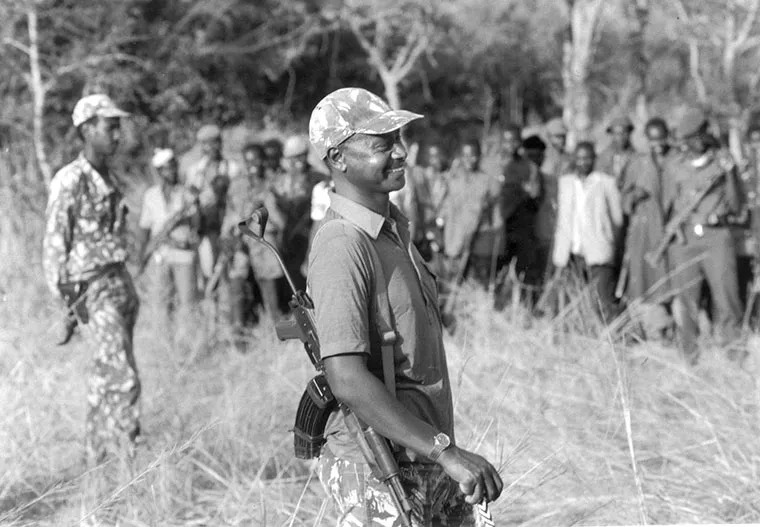
For four decades, the narrative of Uganda’s liberation has been dominated by a single, powerful story: the coming to power of the National Resistance Movement/Army (NRM/A) in 1986. This period has been celebrated, memorialized, and projected as the definitive liberation of the nation. But as we stand at the crossroads of the 21st Century, hurtling towards the 22nd, we must ask a fundamental and uncomfortable question: Is military liberation the ultimate liberation?
The answer, when examined through the lens of human potential and national progress, is a resounding no. While the capture of State House and the cessation of active hostilities are significant milestones, they represent only the most rudimentary form of freedom: the physical liberation of the body. True, holistic liberation—the kind that builds a prosperous, innovative, and just society—must go further. It must liberate the mind.
The Physical Liberation and Its Foundational Flaw
Military liberation is, by its very nature, a liberation of the body. It is an operation designed to remove a physical threat, to free territory from armed control, and to place new individuals in positions of power. It is based on the premise that the citizenry is under physical threat, a premise that, once addressed, is assumed to solve the nation’s ills.
However, this narrative often rests on a foundation of convenient myth. The “Ugandan” liberation war of 1981-86, projected as a purely internal affair to free Ugandans from tyranny, had a far more complex and regional character. A critical truth is that this struggle was inextricably linked to the interests of Tutsi refugees in Uganda. Their participation was not merely altruistic; it was a strategic move to secure resources and a power base, which would later be instrumental in the capture of power in Kigali from the Hutu regime. This revelation does not erase the Ugandan experience, but it forces us to see that the “liberation” was, in part, a means to an end beyond Uganda’s borders. It underscores that physical liberation, achieved through a coalition of diverse and sometimes self-interested parties, is a compromised and incomplete form of freedom.
The Interlinked Trinity: Body, Spirit, and Mind
Human beings are not merely physical entities. We are a complex trinity of body, spirit, and mind. These three dimensions are not separate; they are profoundly interlinked and interactive. You cannot claim to have liberated a person if you have freed their body from physical bondage but have shackled their spirit with fear and their mind with propaganda.
· The body yearns for physical safety and sustenance.
· The spirit craves meaning, hope, and a connection to something larger than itself.
· The mind seeks understanding, truth, and the capacity to imagine and create.
Every great human achievement, every “light” that has illuminated the world, began as a thought in a single mind. Conversely, every evil—from corruption and tribalism to genocide and authoritarianism—also begins as an idea in the mind before it manifests to harm the body and crush the spirit of a nation. Therefore, to build a healthy body politic and a vibrant national spirit, we must prioritize the liberation of the mind.
The Enslaved Mind: The Walking Coffin
The greatest tool of oppression is not the gun, but the narrative that justifies the gun. Propaganda is the enemy of mind liberation. It does not inform; it enslaves. It locks the mind into a stagnant, pre-approved reality, making it a servant to power rather than a sovereign entity. A mind subjected to decades of unchallenged propaganda is a mind that has been retarded in its development. It loses the ability to see beyond the system that created it. It cannot critically analyze, question, or innovate.
When such a mind is forced to think critically, it breaks; it is overstretched. This leads to what can only be described as Intellectual Death. This is a state where an individual, regardless of their academic credentials or the height of the leadership position they hold, is incapable of original, critical thought. They become, in essence, a walking coffin—a physically present human being whose intellectual and creative life has ended, imposing their stagnant ideas on a living, dynamic populace. A nation filled with such minds is a nation that cannot grow.
The Multi-Dimensional Mind and the Tyranny of “No Change”
The human mind is not a monolithic entity to be filled with slogans. It is a complex ecosystem with an infinite number of interlinked and interactive dimensions: the technical, the spiritual, the economic, the academic, the cultural, the political, the intellectual, the moral, the ethical, the psychological, the ecological, and the social.
Any meaningful liberation must target this mind-complex in all its dimensions. It must nurture a technically skilled populace with a strong moral compass, an economically productive citizenry with a deep ecological awareness. To focus solely on the political narrative of a 40-year-old military victory is to ignore 99% of what makes a human being and a nation thrive.
This brings us to the core obstacle to mind liberation in Uganda: the unwritten but fiercely protected “guiding principle” of governance: “No Change.” What is “No Change” if not a policy of stagnancy? To govern for stagnancy in a century defined by the exponential velocity of change driven by social media, the Internet, and Artificial Intelligence (AI) is not just to stand still. It is to go backwards. It is de-development. It is retrogression. It is forcing a nation to remain in the 20th Century while the rest of the world races into the 22nd.
A New Liberation: The Blueprint for a Digital Nation
We must urgently rethink the very concept of liberation. We must shift our immense national energy, time, and resources from celebrating a physical victory of the past to engineering a mental victory for the future. We must stop the primitive practice of digital authoritarianism—using the tools of the 21st Century to enforce a 20th Century mindset. If we fail, we risk being remembered as the generation that blocked Uganda from becoming a digital nation, a prosperous and innovative leader in the AI era.
To achieve this Mind Liberation, we must embark on a radical transformation of our intellectual and educational foundations:
1. Unify All Knowledge: We must dismantle the artificial silos between disciplines. We must learn and accept that all science is one, with three interdependent dimensions—the Arts (Humanities), the Social Sciences, and the Natural Sciences. To devalue the arts and social sciences, as we have been doing, is to demonstrate a profound ignorance of how human society actually functions. A physicist without ethics is a danger; an economist without culture is a tyrant.
2. Embrace New Knowledge Production: The future belongs not to narrow specialization but to integration. We must champion:
· Interdisciplinarity: Combining two or more disciplines to create new understanding.
· Crossdisciplinarity: Viewing one discipline from the perspective of another.
· Transdisciplinarity: Creating a unity of knowledge beyond the confines of any single discipline.
· Extradisciplinarity: Generating knowledge that lies completely outside the current structures of institutionalized learning.
3. Restore Public Intellectualism: We must urgently reconnect the academic space with the public square. We have allowed a culture of sterile academicism (publishing for the sake of promotion), scholasticism (debating trivialities), and careerism (pursuing personal advancement at the expense of truth) to replace the vital role of the public intellectual. We need thinkers who can translate complex ideas for the masses, challenge power, and guide public discourse. We need to rebuild the public intellectual space so that ideas can flow freely and challenge the stagnant waters of propaganda.
Conclusion: The Future Might of Humanity
The future might of any nation will not be judged by the size of its army, the longevity of its ruling regime, or the volume of its liberation songs. It will be judged by its mind power—its collective capacity to innovate, to adapt, to think critically, and to solve complex problems with wisdom and foresight.
The gun can only capture the capital; it can never capture the future. Only a liberated mind can do that. For Uganda to truly take its place as a digital nation marching triumphantly into the 22nd Century, we must lay down the mental weapons of propaganda and pick up the tools of critical thought. We must declare that the ultimate liberation—the liberation of the Ugandan mind—has finally begun.
For God and My Country