


By Oweyegha-Afunaduula
I don’t usually argue with my children whose ages range from 35 to 54. We exchange ideas. I occasionally I continue reaching them and they continue learning in an andragogical way, in which we are all learners and teachers. However, the other day an exchange between one of my sons and myself turned into a healthy argument, but I don’t remember convincing each other on the difference between a riot and protest
My argument was that a protest is not the same as a riot. I was drawing from my experience at Makerere University in the late 1990s when, as Secretary General of the Makerere University Academic a staff Association (MUASA) I would organise sit down protests, together with my Chairman, Dr Moses Mukiibi and other members of the MUASA Committee, which at one time included Mrs Mary Okurut who was Vice-Chairman before she was snatched away by President Tibuhaburwa Museveni to serve in his government as a Minister.
Our protests arose whenever the academic staff failed to reach agreement with the university administration, university Council on how to resolve our grievances. Those days talking and listening were balanced, but when listening resulted in no compromise academic staff had no choice but to protest by withdrawing their academic tools and engaging in sit-down protest, sometimes called sit-down strikes.
The Government would send in spies and security operatives, but they would never start violence, which is the case today. One time, in 1997, we sustained one of our protests for 28 days. However, government, in collusion with University administration and University Council, was able to undermine the protest by dividing MUASA into two -professors and non- professors, and taking two of the professors – Prof. Nsibambi and Prof. Kidhu Makubuya – away to serve in his government. There was no physical state violence on the academic staff, although the unity and integrity of MUASA was violated and harmed.
It has never been the same since then. Academic staff are not as free and independent minded as they were then. They are filled with fear and silence is their tool of protection since every office has been captured by the State, there by distorting academic freedom. Intellectual discourse is almost absent in the academia. Protest as as a show of disillusionment, discontented and dissent is almost erased or if it takes place it is not effective. It is of course worse in private universities.
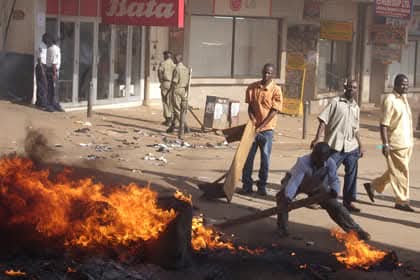
My son, said he did not see any difference between riots and protests. He said that ever since he came of age, he has seen that when people and institutions in Uganda stage protests they almost without contradiction develop into riots. People’s businesses are looted and some people are killed. Although I tried to explain to him that protests develop into riots when others that have nothing to do with them infiltrate the protests, and when government applies force to quell them, and also infiltrates then, he was not convinced. He even added that under those circumstances he cannot support protests. I imagined there are many elites who think like my son about protests. Besides, my son said, “Right now I have to work to make money. Whenever there are protests it means I don’t work and earn, and businesses will close”.
Even if I tried to explain that if intruders, including government security organs, did not infiltrate protests,they would be peaceful he was not convinced.
Yet government has made “protecting businesses” the cornerstone of quelling any kind of protest, despite the fact that the Uganda Constitution 1995 protects protests constitutionally. With this stance of the government, protests and riots are indistinguishable. However, when protest are by National Resistance Movement (NRM) or pro-NRM Institutions, they are extremely peaceful. The same is true if political rallies are staged by NRM people.
This implies that the governance of Uganda is apartheid-like as if the country was invaded, conquered and occupied. Ugandans are not allowed to dissent or display any discontent but are driven to subscribe to their situation as if it is normal; negotiated between the rulers and the people.
The truth is that most governments are fearful of gatherings of any kind because their “captors” believe the gatherings can easily result in challenge, even change, of power. The citizens are collectively perceived as enemy number one of the State, especially in Africa, where governments frequently arm themselves to the teeth against the citizens. In Uganda, the citizens are simultaneously being denationalised and decitizenised!
But what really is the difference between a riot and a protest?
Therefore, in Uganda the rulers disagree with the Constitution and cast riot and protest as one and the same to control the thinking, movements and actions of the citizens so that there is no threat to power. However, in this article I take riot and protest as different phenomena.
Generally speaking a protest is usually organised public demonstration of disapproval of a law, policy, strategy, idea, actionor state of affairs that harms the public interest. If there was no herding of Ugandans, things like corruption, building roads in the Democratic Republic of Congo (DRC) or the UPDF Act 2025 would have evoked public demonstrations.
I agree with the definition of “riot” by the US government that “a riot is a disturbance of the peace by an assemblage of usually three of more people acting with a common purpose and in tumultuous manner to the terror of the public (see also Merriam’s Dictionary of Law).
As I have explained elsewhere in this article the boundary between riot and protest is erased by the vested actions of the government and others in pursuit of their interests that have nothing to do with the intent and purpose of the protest. This explains why well-intentioned protests are violated a and they relapse into riots.
Otherwise a protest becomes a riot when those who organised it lose control, either to some errant overzealous participants or to government security organs ordered from above to frustrate the demonstration,the same way the rallies of the Opposition are in the interest of power.
Once demonstrations (protests) are discouraged, a government goes in to claim that the citizens are happy with what it is doing. It draws the public and international community attention away from its failures, such as inability to provide social goods and services and to assure the people of minimum wage, humanising salaries, employment, humanising prices for crops, access to their natural resources, protection of their natural belonging and identity, democracy, freedom, justice, equity, development, transformation and progress.
Let me end the article by giving examples of protests that were violently suppressed by the colonial government and the neocolonial NRM regime in Uganda in the fashion of a country invaded, conquered and occupied without the will of the people.
*Mabira Rainforest protest (2007): Protests against the government’s decision to give away 7100 hectares of the Mabira Rain Forest to SCOL, a sugar company, turned violent, with police using tear gas and live bullets to disperse protesters.
* April 1949 Buganda Kingdom riots: Protests in Buganda Kingdom demanding democracy and resignation of the Katikkiro (prime minister) Kawalya’s government turned violent, resulting in loss of lives and property.
*July 2024 anti-corruption protests: Protests against alleged graft by elected leaders were met with police brutality, with over 104 people arrested and charged with public order offences.
*July 23, 2024 March to Parliament protest: Anti-corruption demonstrations were violently dispersed by police, with reports of arrests, intimidation, and sexual assault of protesters.
*2020 protests*: Protests against the arrest of opposition leader, Bobi Wine, resulted in the deaths of at least 54 people in my district, Luuka District, and many more disappearances.
*Kabaka Riots (2009): Protests triggered by the government’s ban on the Buganda King, Ronald Muwenda Mutebi, from visiting Kayings, resulted in fatalities, injuries and arrests.
*Walk to Work protest (2011): Protests led by opposition leader Kizza Besigye against rising costs of living were met with police brutality.Kizza Besigye was brutally assaulted
*Togikwatako campaign (2017): Protests against the amendment of the Constitution were violently suppressed by police.
These protests highlight the ongoing struggles for democracy,, freedom, justice, human rights, and accountability in Uganda.
They have helped the government to generate a lot of fear and silence in the country, which are key of its governance and leadership. Indeed fear and silence have also characterised elections since 1996 when President Tibuhaburwa Museveni offered himself for elections. During the forth coming elections we have seen how Bobi Wine, a presidential candidate, has been treated to doses of state-inspired violence., confirming that however many times elections will be held the ballot paper cannot change government because the country is under siege – invaded, conquered and occupied.
For God and My Country.