


The Uganda Bureau of Statistics (UBOS) on Thursday unveiled the Multidimensional Poverty Index (MPI) Census Monograph 2024 – Volume 5 at Statistics House, Kampala, providing the most comprehensive snapshot yet of poverty across the country.
The report shows that 27% of Ugandans are multidimensionally poor, facing simultaneous deprivations in education, health, living standards, and access to basic services.
Regional Poverty Trends
At the regional level, Kampala topped the list with the lowest MPI of 0.088, reflecting strong access to services, infrastructure, and economic opportunities associated with urbanisation. It is followed by Buganda (0.182), Teso (0.242), Lango (0.256), Ankole (0.258), and Busoga (0.259). These sub-regions perform better than the national average of 0.270, indicating relatively improved household welfare.
Sub-regions slightly above the national average include Kigezi (0.286), Madi (0.291), Bugisu (0.298), Bunyoro (0.301), Bukedi (0.309), Tooro (0.313), Rwenzori (0.322), and Acholi (0.323). The highest poverty levels are recorded in Sebei (0.335), West Nile (0.390), with Karamoja being the worst performer at 0.569, highlighting deep structural challenges including food insecurity and limited infrastructure.
Busoga District Performance
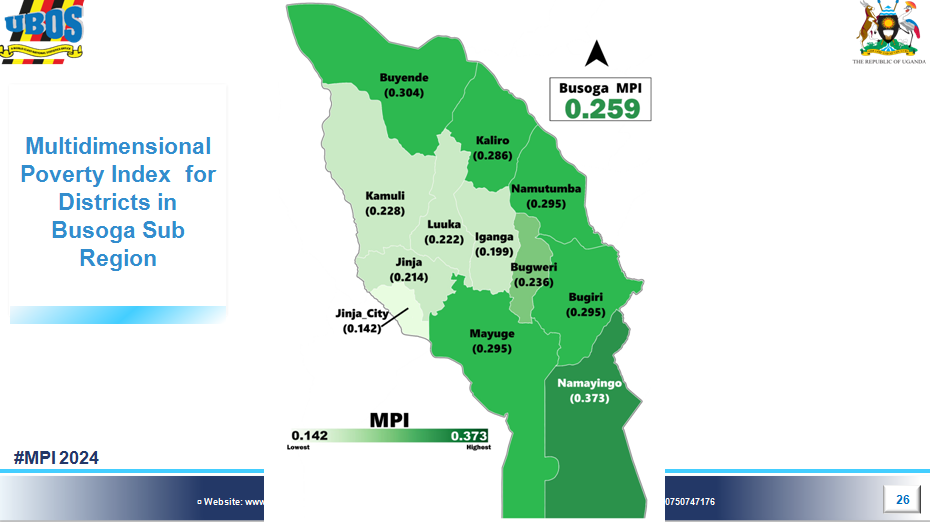
Within Busoga, sharp disparities emerged between urban and rural districts. Jinja City emerged as the best performing district with an MPI of 0.142, benefiting from better infrastructure, services, and economic opportunities. It is followed by Iganga District (0.199) and Jinja District (0.214).
Districts performing below the regional average but showing moderate poverty include Luuka (0.222), Kamuli (0.228), and Bugweri (0.236).
Mid-level performers around or slightly above the Busoga average are Kaliro (0.286), Bugiri (0.295), Mayuge (0.295), and Buyende (0.304). These districts show some progress but continue to face gaps in essential services, education, and living standards.
At the bottom of the ranking is Namayingo District (0.373), followed by Buyende District (0.304), despite both being rich in natural resources, including agriculture, fishing, and minerals. Namayingo’s high MPI underscores persistent challenges such as limited social services and high vulnerability among fishing communities.
Full ranking (best to worst):
- Jinja City – 0.142
- Iganga – 0.199
- Jinja District – 0.214
- Luuka – 0.222
- Kamuli – 0.228
- Bugweri – 0.236
- Kaliro – 0.286
- Bugiri – 0.295
- Mayuge – 0.295
- Buyende – 0.304
- Namayingo – 0.373
The data highlights a clear urban–rural divide, with Jinja City significantly outperforming rural districts due to concentrated employment, infrastructure, and service delivery.
Implications and Government Response
The MPI measures poverty beyond income, capturing multidimensional deprivations in health, education, and living standards. Dr. Chris N. Mukiza, UBOS Executive Director, emphasized that the Monograph provides critical indicators for progress towards SDG 1 on eliminating poverty in all its forms, urging policymakers to adopt targeted, district-specific strategies.
Officials including Geoffrey Ekanya, MP Tororo North County, and Faith Nakut, MP for Napak District, stressed the need for more effective interventions, citing persistent poverty in regions like Karamoja, Bukedi, and West Nile. Amos Lugoloobi, Minister of State for Planning, called for stronger utilisation of UBOS data to guide development planning and address gaps in sanitation, education, and access to essential services.
The findings underscore the urgency for targeted, region-specific interventions, particularly in high-poverty districts like Namayingo and Buyende, where resource wealth has not translated into improved living standards.