


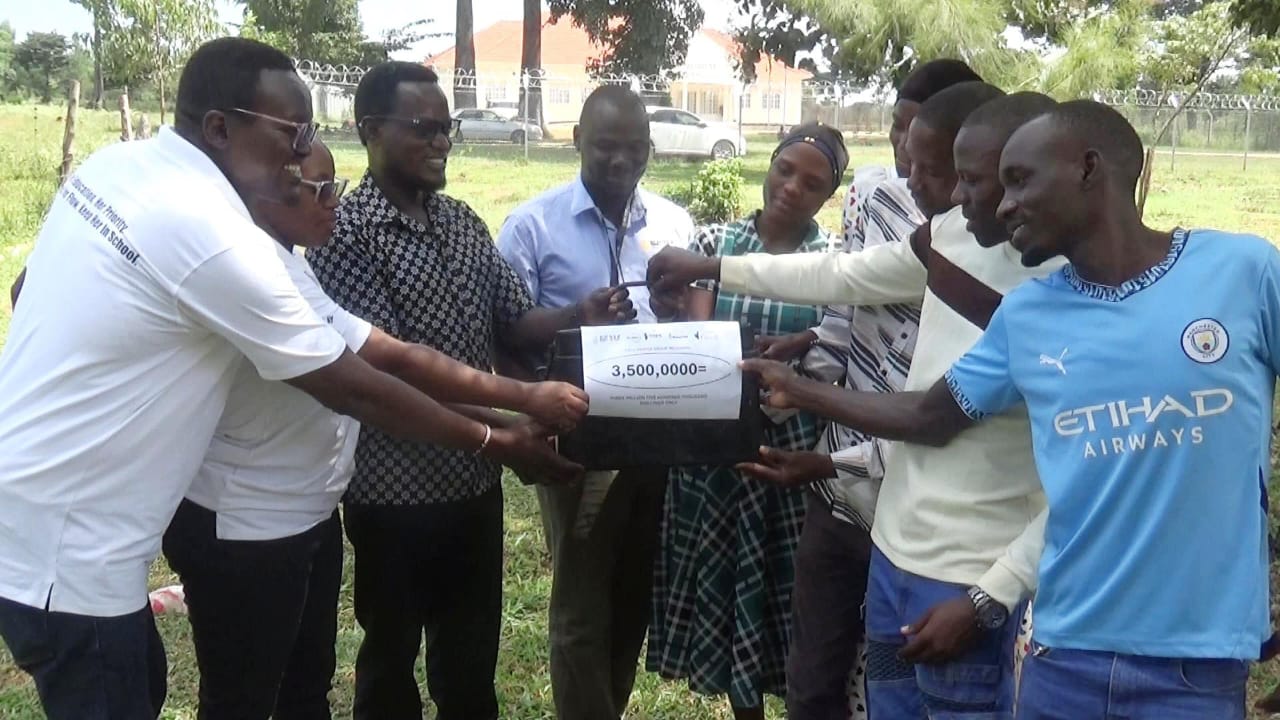
Over 30 youth groups and networks of young mothers in Buyende District have received a Sh105 million financial boost from Right to Play Uganda, in a bid to strengthen their savings and credit associations and foster economic empowerment.
The handover ceremony, held yesterday at Buyende District headquarters, marked a significant milestone in efforts to combat rising social vices and promote sustainable livelihoods among vulnerable youth and adolescent mothers.
The funding, facilitated under the SHARE Project and supported by Global Affairs Canada, is designed to promote a saving culture, improve financial literacy, and redirect youth energy toward productive ventures. Brenda Aber, SHARE Project Manager, handed over the funds and urged recipients to use the money wisely to transform their lives and communities.
“We are happy to contribute to youth economic empowerment in response to their request during community mentorship activities,” Aber said. “This support should boost your livelihoods and enable you to access sexual and reproductive health services and information—critical tools for building a brighter future.”
Buyende District has long struggled with high rates of child marriage, defilement, and school dropouts—challenges that have plagued the region for years. However, district leaders say targeted interventions by development partners are beginning to turn the tide.
Michael Kanaku, the Buyende District Chairperson (LCV), acknowledged the district’s grim statistics but expressed optimism, citing ongoing community dialogues and youth-focused programs. “Unfortunately, Buyende tops the list in defilement, child marriage, and school dropouts. But we are slowly coming out of these vices through community talks, outreach programs, and partnerships with organizations like Right to Play, SHARE, and Plan International,” Kanaku said.
He emphasized that empowering youth economically gives them hope and alternatives to crime and despair. “When youth groups are supported, it brings mindset change and life-changing opportunities. This not only reduces social vices but also complements government poverty alleviation programs,” Kanaku added.
Titus Tumusiime, Country Director of Right to Play Uganda, stressed the importance of equipping young people with financial literacy, business skills, and life-saving knowledge.
“When youth and young mothers are supported to meet their basic needs, re-enroll in school, and access correct health information, they gain the confidence to make positive life decisions,” Tumusiime said. “We want them to stop being manipulated and instead invest their youthful energy in productive ventures.”
The intervention is already yielding results. Brenda Kitimbo, leader of the Mirembe Youth Group—a collective of child mothers and out-of-school adolescent girls—shared how the program has completely transformed lives.
“We were once subjects of public ridicule and exploitation,” Kitimbo revealed. “But with counselling, business training, and financial support, many young mothers have regained hope. Most are now back in school, supporting their children, and making informed choices.”
Another success story emerged from Bugaya Sub-county, where Dison Muzaaya, a village champion in Ngole Community, recounted the journey of a youth group formed after fishermen were evicted from Lake Kyoga.
“At first, many youth turned to crime—snatching bags, smoking weed, gambling,” Muzaaya said. “But one day, a few of us attended a workshop to get free food… and ended up starting a savings group with just Sh2,000 each week.”
Three years later, the group has accumulated Sh10 million in savings. With an additional Sh3.5 million from Right to Play, they plan to venture into modern goat and local poultry farming. “This is our way out of poverty,” Muzaaya declared.
While celebrating the progress, Kitimbo raised concerns about limited access to government empowerment programs. “We appreciate government initiatives like Emyooga, Youth Livelihood Enterprise Funds, and the Parish Development Model (PDM), but the requirements are too stringent for groups like ours,” she said. “Many young mothers and out-of-school girls are being excluded. We urge authorities to adapt these programs to be more inclusive.”
The LCV echoed this call, urging youth to leverage existing national programs to diversify income and become self-reliant. “Tap into Emyooga, YLEF, and PDM,” Kanaku advised. “Stay productively engaged, create jobs, and contribute to national development instead of remaining idle and hopeless.”
As Buyende continues its journey from despair to resilience, stakeholders agree that sustained investment in youth and young mothers is key to breaking cycles of poverty, violence, and exclusion. With renewed hope, skills, and capital, the next generation is stepping forward—not as victims, but as changemakers.