


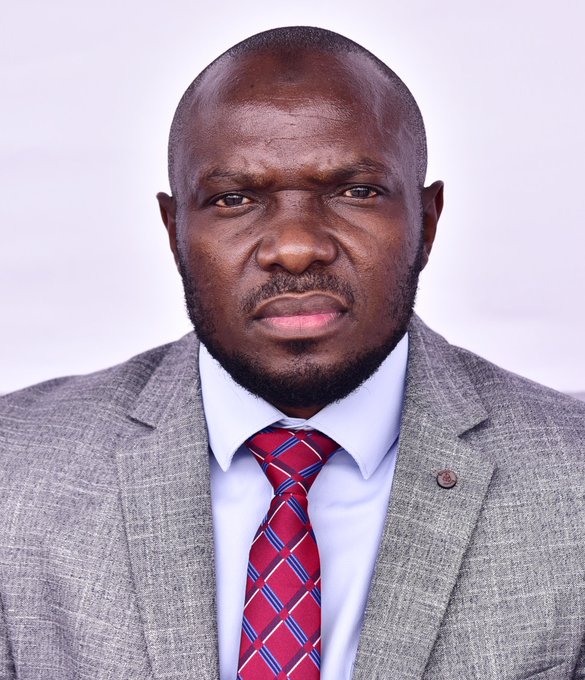
The quiet fishing communities and trading centers of Bukooli South County in Namayingo District are now at the center of a high stakes legal battle that could redefine the outcome of the January 2026 parliamentary elections, and raise deeper questions about electoral integrity in Uganda.
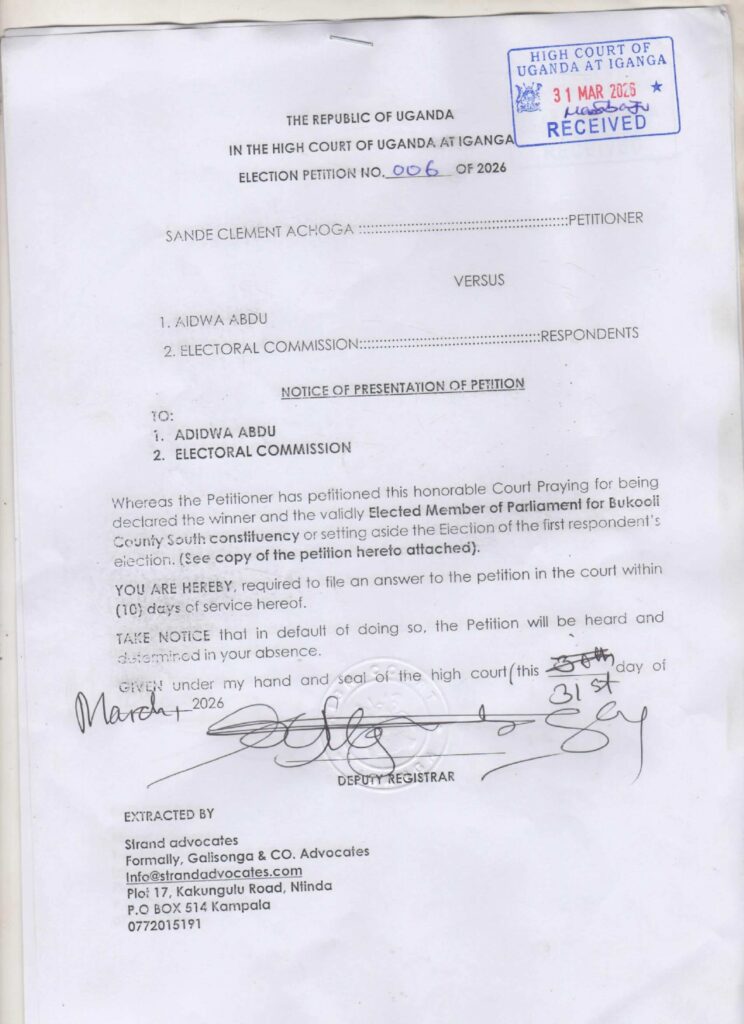
At the High Court of Uganda sitting in Iganga, a petition filed by National Resistance Movement (NRM) flag bearer Sande Clement Achoga, through his lawyer Muhussein Kyotaite of Strand Advocates, formerly Galisonga & CO. Advocates, challenges the victory of his rival, Adidwa Abdu.
The case, registered as Election Petition No. 006 of 2026, is shaping into one of the most closely watched post-election disputes in eastern Uganda.
Achoga, who emerged runner-up in the January 15 polls, is asking the court to either declare him the duly elected Member of Parliament or nullify the election of Abdu altogether. His petition accuses the MP-elect of fraudulent identity practices and lack of the minimum academic qualifications required to contest for Parliament.
Under Uganda’s electoral laws, particularly the Parliamentary Elections Act, a parliamentary candidate must possess an Advanced Level (A-Level) certificate or its equivalent. It is this requirement that now sits at the heart of the dispute.
In a detailed affidavit, Achoga alleges that Abdu used multiple identities to qualify for nomination. According to the petition, the respondent is said to have previously gone by the name “Barasa Ongeso Godfrey” before changing to “Adidwa Abdu” through a deed poll registered with the Uganda Registration Services Bureau in August 2020.
Barely a month later, the affidavit claims, another name change was registered, from “Namaani Grace” to “Adidwa Abdu”, raising what the petitioner describes as “fraudulent manipulation” intended to conceal the respondent’s true identity and academic background.
Further complicating the matter, Achoga cites correspondence from the National Identification and Registration Authority (NIRA), which allegedly confirms that “Namaani Grace” and “Adidwa Abdu” are two distinct individuals with different National Identification Numbers.
“These successive name changes were not innocent administrative actions,” the petition argues. “They were calculated moves to bypass legal requirements and mislead electoral authorities.”
Questions Over Academic Qualifications
The controversy extends to Abdu’s academic credentials. The petitioner claims that the MP-elect obtained a certificate of equivalence through a mature-age entry scheme administered by the Islamic University in Uganda and accredited by the National Council for Higher Education in May 2025.
However, Achoga contends that the certificate was acquired using a fraudulent identity and is therefore invalid.
He further references a 2021 report by the Criminal Investigations Directorate (CID), which allegedly concluded that Abdu had not attained education beyond Senior Two—far below the constitutional threshold for parliamentary candidates.
If proven, legal experts say, such findings could invalidate not only the respondent’s nomination but the entire election outcome.
Electoral Commission in the Spotlight
The petition also names the Electoral Commission of Uganda as the second respondent, accusing it of failing to conduct adequate due diligence before clearing and gazetting Abdu as the elected MP.
According to court documents, the Commission officially published Abdu’s victory in March 2026. Achoga now argues that this action effectively legitimized an ineligible candidate, thereby disenfranchising voters.
“This case is not just about one constituency,” says a Kampala-based election law analyst. “It raises broader concerns about the verification systems used by the Electoral Commission and whether they are robust enough to detect identity fraud.”
Election petitions in Uganda are often tightly contested and time-bound, with respondents required to file their defense within ten days of service. Failure to do so allows the court to proceed in their absence.
Beyond Bukooli South, the case reflects a growing trend of post-election litigation in Uganda, where candidates increasingly turn to courts to challenge outcomes rather than rely solely on political processes.
The dispute also touches on sensitive issues of identity, documentation, and access to education—factors that can significantly influence political participation in rural constituencies.
As the case unfolds, the High Court in Iganga will be tasked with examining documentary evidence, witness testimony, and the legal thresholds governing electoral disputes.
At stake is not only the parliamentary seat for Bukooli South but also public confidence in Uganda’s democratic processes.