Kampala – Namilyango College Senior Two student, Magogo Lucky Bagio, has been called up to the Uganda U17 national team, the Uganda Cubs, for the first time.
The young forward expressed his excitement and gratitude for the opportunity, saying it was “wonderful” to receive the call-up. Bagio acknowledged that he feels lucky to have been selected, considering the many other talented players who have not yet received a call-up.
Bagio is eager to make a significant impact in the upcoming CECAFA U17 AFCON 2025 qualifier, which will take place in Uganda from 14th to 28th this month. The tournament will be hosted at the Hamz War Nakivubo Memorial Stadium and the Mary’s Stadium Kitende.
As a forward, Bagio has set his sights on scoring goals and creating opportunities for his teammates. He is confident that the Uganda Cubs will put on a strong performance in the tournament.
Bagio also took the opportunity to encourage his fellow youths to continue working hard and developing their talents. “I want to encourage all the young players out there to keep pushing and never give up on their dreams,” he said.
The Uganda Cubs are in Group A alongside Ethiopia, Tanzania, Burundi, while Group B consists of Somalia, South Sudan, Sudan, and Kenya.
Children should be involved in key decision making processes to ensure their ideas and voices are captured when arriving at solutions to challenges they face, Joyce Abaliwano, the Busoga Kingdom Minister for Children and Women Affairs, recently said a regional consultation meeting at Busoga Lukiko Hall in Jinja City.
The minister emphasized the importance of active child participation noting that there is a need for a balanced empowerment approach.
“While focusing on girls’ empowerment is crucial, we must not neglect boys. An empowered girl alongside a less empowered boy creates an imbalance that may lead to gender-based violence,” she said.
In the same spirit, Busoga Kingdom, in collaboration with child rights organizations under the ‘She Leads’ programme, plans to set up a Children’s Parliament to amplify the voices of children.
The idea is to address challenges in the region like teenage pregnancies, child marriages, school dropouts, children’s rights, among other issues.
Betty Habene, President of the Busoga Girls and Young Women Alliance, reinforced the She Leads program’s goal of increasing the influence of girls and young women in decision-making.
Paul Mudoba, Project Manager for the Multi-Community Based Development Initiative (MUCOBADI), reported significant progress in empowering girls and young women.
The three-day, long-awaited Busoga Yaiffe 2024 Busoga Olwekobaano and Energy Expo will take place at the Taxi Park Yard & Green Belt area in Kaliro Town, Kaliro district, between the 5th and 7th of December 2024.
This year’s theme is taking access to affordable, reliable, and clean energy to more places and people using strategic partnerships to generate socio-economic change and to ensure sustainable development in Eastern Uganda.
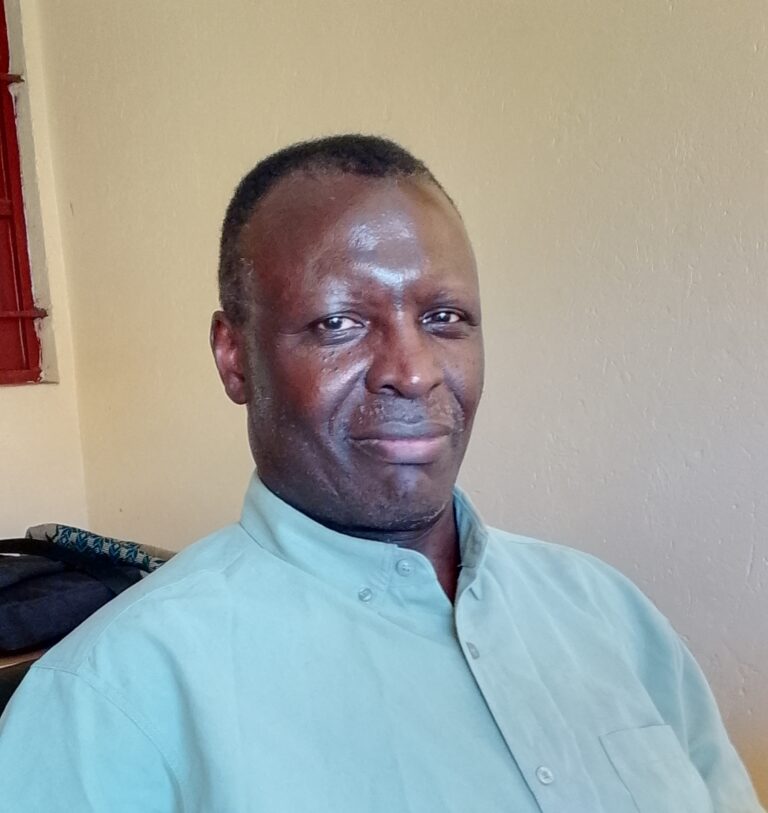
In this interview, Busoga Times’ editor Baz Waiswa sat down with Dr Charles Mbalyohere, the president of Busoga Yaiffe, the organization organizing the event, to talk about the Olwekobaano, the energy expo, and the renewable energy potential in Busoga.
Below are the excerpts from the interview conducted in Kaliro ahead of the anticipated event.
Please tell our readers what the Busoga Olwekobaano Energy Expo is all about and what people coming should expect at this year’s expo.
The Olwekobaano has been there for some time. There is an organization called Busoga Yaiffe that started the idea of having an event that brings us together in Busoga, those on the ground, but also in the Diaspora, to meet at least once a year or twice and discuss Busoga’s development.
The Olwekobaano has been held for a number of years on different themes. We’ve held events on investment, health, education, and other topics in Jinja, Iganga, and other places. So we’ve been trying to rotate this event. Now we are in Kaliro on the topic of energy.
It’s a way of sensitizing people about different things, forming partnerships, filling knowledge gaps based on the topic you are discussing, and together, exploring possibilities for solving problems, again, depending on the topic that you have.
This idea of the Olwekobaano, over the years, we’ve felt it’s a good thing to do, to bring people together and see how, as the region, as the people, we can go forward.
That is basically what the Olwekobaano is all about. Specifically, this Olwekobaano in Kaliro has been focusing on energy questions. We held Olwekobaano last year on the same topic of the transition to renewable energy for the first time, and like I said, we keep changing the themes.
We think that as the world is facing a major climate change crisis, as the weather is changing, we have to do something about how we use energy. It was a timely topic, even for us here in Busoga.
We thought we should follow up in the second year and consolidate what we did last year. It’s important for not only the region but also the country and the global community.
What should people coming to this year’s energy expo at the Olwekobaano expect?
We have three things happening.
First of all, we have a conference where we have invited various speakers from various organizations to come and talk about different aspects around energy. There are local people who we work with here in the region. So we’ve tried to mix it up.
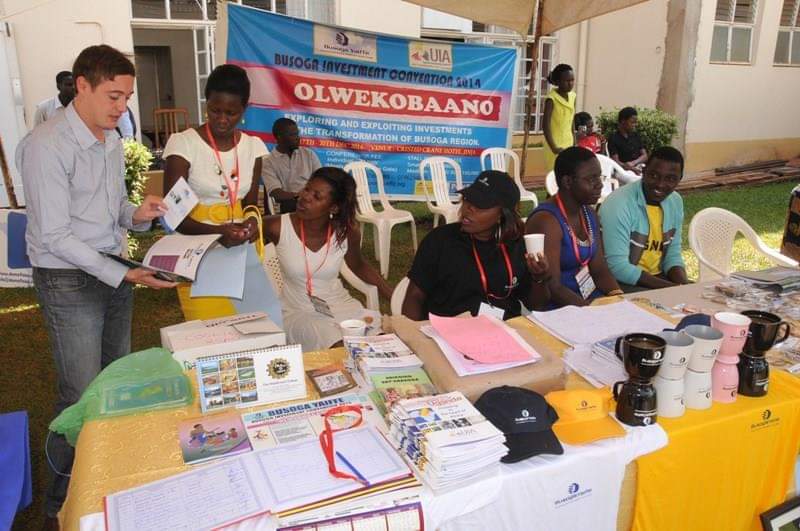
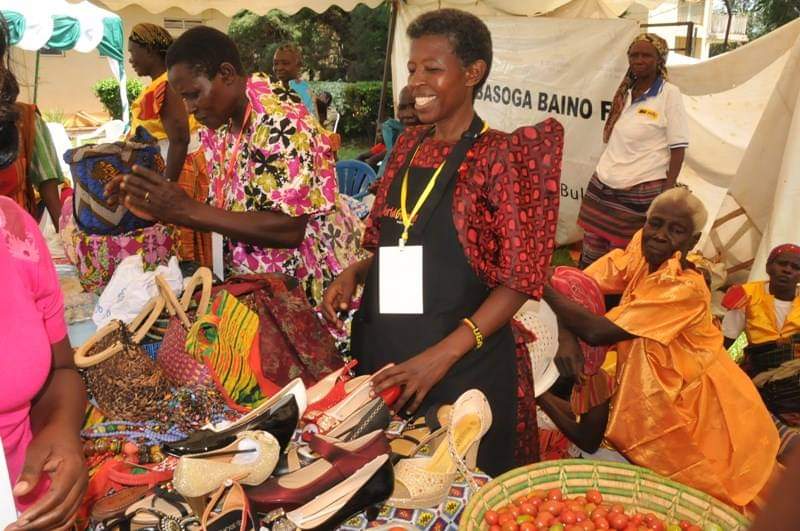
Then we have, of course, the exhibition, where we have different companies and organizations demonstrating what they are doing in the area of renewable energy. We have partners we worked with last year coming again. We also have new partners.
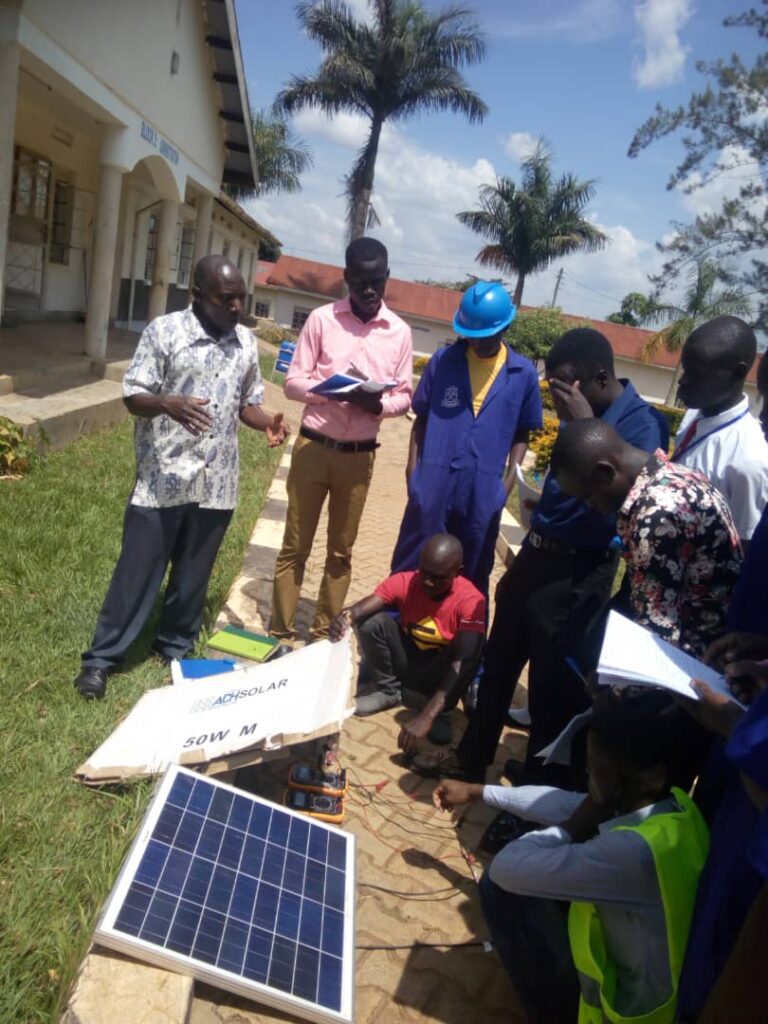
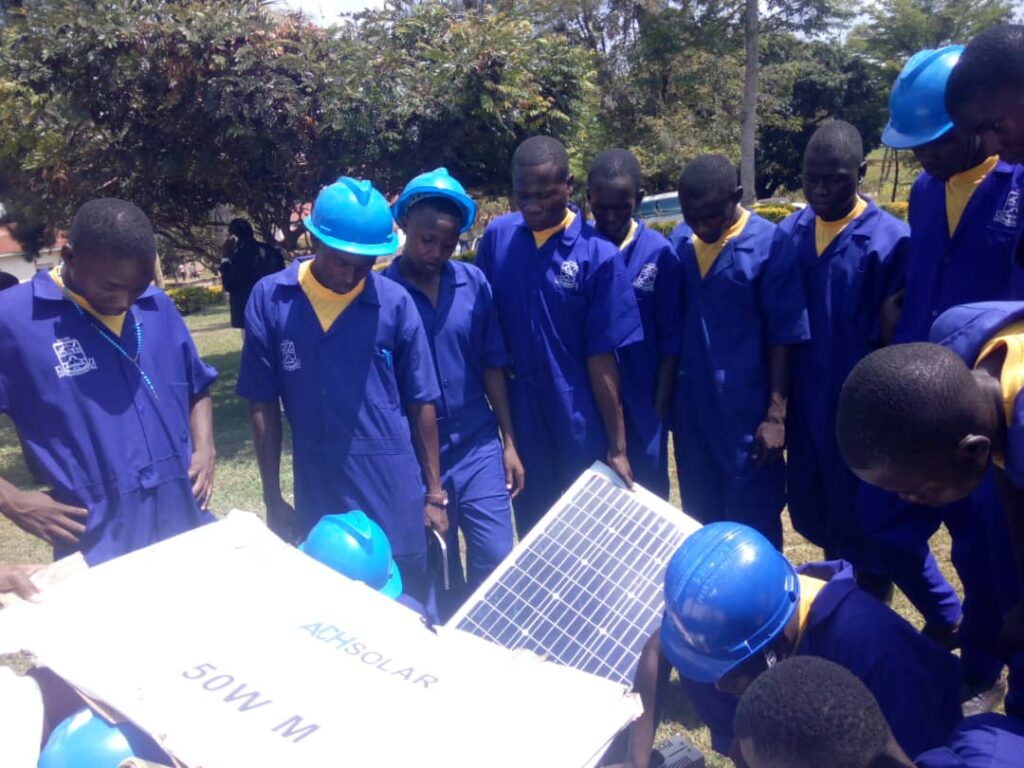
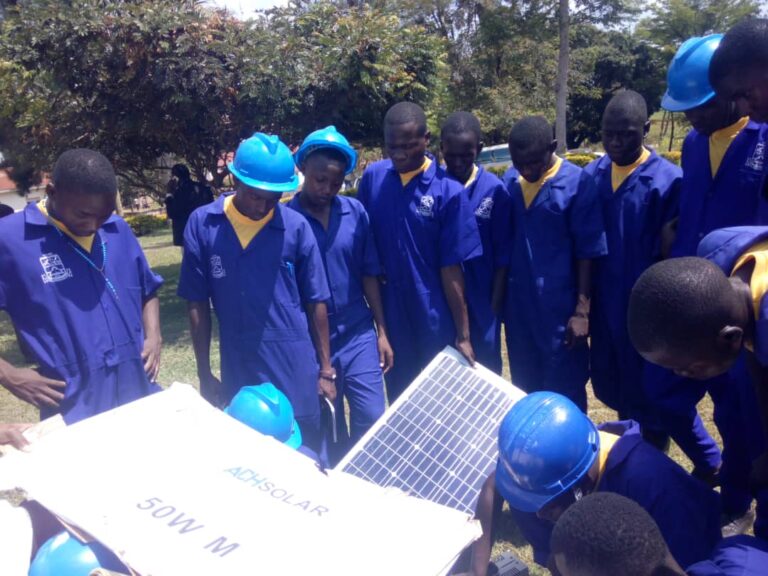
Exhibitors will showcase various things on solar technology, biomass, clean cooking, and education. We have a technical institute joining us to introduce courses on renewable energy. Stakeholders will showcase and teach people what they are doing around renewable energy.
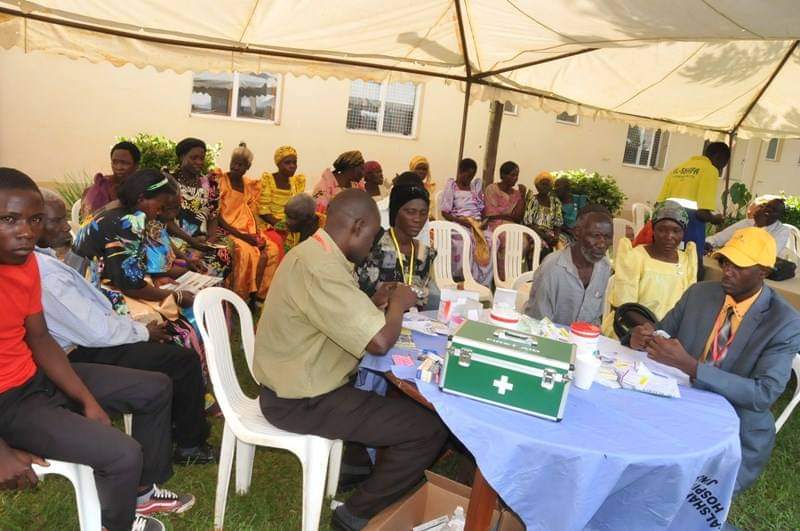
And then we have a third element, which for us is more of a Corporate Social Responsibility – a healthy camp. Over the years, this has been a success because our people are still struggling even at the basic level. The services at the health camp will be free, including consultations.
This time, we have partners like Rays of Hope, Hospice Jinja for cancer screening, especially for women, Musana Healthcare Services, World Vision, and the Kaliro District Health Office coming to support.
So, those are the three elements happening over the three days at the Lwekobaano.
What inspired you to start this expo, and what do the organizers intend to achieve?
This event is a foundation to sensitize people about this important transition that is happening: the transition to using renewable energy and slowly getting away from fossil fuels. Many people need to understand what this means.
So there’s a lot of explanation, especially to everyday people. And I think we all have a responsibility in our different capacities to support the transition. The Olwekobaano, for us, is the possibility we have to contribute to the transition.
We know that it can make a practical change if people start using, for example, solar pumps for irrigation. If it is affordable, and people can use solar pumps to irrigate their farms throughout the year, even in the dry season, that can make a difference to their livelihoods.
Not only will we be helping the environment, we will also be helping people economically. I think those are good reasons for us to be inspired to start something.
What can you say are the leading energy challenges in Busoga, and what solutions does the expo offer?
I think, of course, we are still, like many other areas, dependent on fossil fuels. This is not sustainable if you look at where the world is going. We need to start educating our people and sensitizing them about the need to change.
We also know that many of these new technologies are not yet affordable for many people, especially at the grassroots. That is a challenge, but things are starting to change. These things are becoming cheaper. There are finance models coming up to help people be able to purchase.
I think people still think that, for example, solar is only for charging phones or lighting, but there’s more to it. I gave the example of irrigation. You can use solar for drying farm produce like maize, groundnuts, and others.
You can even have a small microprocessing plant at home to grind your products. You can make juice using solar. So there’s a lot that you can do that is of economic value. But people need to be sensitized. People need to see things demonstrated to them by our exhibitors.
In a region barely covered by electricity, fossil energy like firewood is widely used. What other alternative energy sources and technology will be on showcase at the expo?
The most affordable and accessible is, of course, solar, because we have a lot of sun. If there’s anything we have, it is the sun. If we can make these technologies available, and people can afford them, I think that can make a huge difference.
It is already making a difference as far as lighting is concerned. The other time I went deep into the village, I saw people using very small panels on their grass houses. People are starting to see that it’s less expensive.
There’s also biogas. We still have a lot of waste, like, for example, the market here. When people peel their things, they just throw away the peels, but you can use that to produce biogas on the farms. It’s not as popular as solar, but it can also be used potentially.
We have clean cooking stoves that don’t use firewood or charcoal. If you have those becoming more common, then people don’t have to go for charcoal or firewood. People don’t have to cut trees, and this helps conserve the environment.
Here in Kaliro, I was talking to an expert who was saying that over 80% of trees have been cut in the last 10 years. That shows how dramatic things have happened, and if we don’t change our ways, I think we have a big problem.
We can now think of how to grow more trees to recover what we have lost.
How do these alternative energy sources and technologies help in conserving the environment and the ecosystem already constrained by the depletion of forests as people look for firewood?
I think they can play a very important role. I think the key problem is still that, like we said, things are still too expensive for the most common people.
If we can get prices down without damaging quality, that you can buy something and it can stay for some time, and people can afford it, I think that can help with energy poverty.
Exhibitors showcasing some of the solar technologies available on the market at the 2023 energy expo in Kaliro.
We still have a distance to go, but there are models that are coming up, for example, that you can pay in small installments. Over time, kerosene is more expensive and poses health challenges. If you use kerosene, the health of your children, even your own health, is affected.
So these are things that we need to sensitize people about. But sometimes it’s difficult to change behaviors. Some people think that that change is too expensive for them. You have to educate people about that perspective.
Renewable energy is being touted as the cleaner and environmentally friendly energy option. What’s Busoga’s renewable energy potential like?
From what I’ve gathered interacting with various people, the potential is high; people are starting to buy solar systems. Like I said, I went to a village, and I was impressed to see small panels.
I believe the potential is high, and in our communities, once people see that something is good, they are historically very good at taking it on. I’m very confident that the potential can be exploited here in Busoga, especially if it goes beyond just lighting and charging.
The cost of electricity has been looked at as a hindrance, failing the government to connect citizens to the main grid. How does renewable energy compare?
In the early years, renewable energy was too expensive for most people, but over the years it has become more affordable. That’s why you see more people buying solar home systems.
You can argue about quality, and that’s another thing we need to consider, but in terms of cost, it’s becoming more affordable. There’s still a percentage that is still struggling with even this low cost, but the products are going down.
I think the costs of these systems are now competitive with the national grid, if not less expensive. If I look ahead, I think these systems will be certainly less expensive than electricity.
However, that doesn’t mean that hydroelectricity has no role to play because it is also a renewable energy source, though they use a bit of fossil fuel to run the turbines.
President Yoweri Museveni, speaking during the World AIDS Day commemoration that was held at Bukungu Primary School, Bukungu Town Council, Buyende District, implored the people of Busoga to create wealth through commercial agriculture with “ekibaro”.
“From 1996, we talked about the four acres model. That time we advised you that if you have four acres, put one acre under coffee, in the second acre grow fruits, third acre for pasture for dairy farming, then in the fourth acre grow food crops. In the backyard do piggery and poultry and those near the swamps, do fish farming,” the President noted.
“Fish farming can give you more money than rice farming which you are doing now. These seven activities are the ones we recommended to you in the 1996 Manifesto of the NRM. Recently, the Busoga MPs led by Rt. Hon. Kadaga and Kyakulaga Bwino, learning from the good example from Kalagala, recommended that we add palm oil to the seven activities.”
President Museveni also warned the locals against misusing and underutilizing land.
“The problem is that you are now misusing and underutilizing the land. On the dry land, people are growing food but there’s no irrigation. In 1967, when I was going to University in Dares-Salaam, I used to pass via Madhvani and he had already started irrigating the sugarcane. Now you don’t see any irrigation anywhere. That means that dry land is underutilized,” he said.
“Then when you go into the wetlands, you plant rice. You get very little from rice. The analysis we have done in Limoto a farmer can get Shs80m from an acre accommodating fishponds. We should use the wetlands in a proper way.”
Indiscipline causing HIV
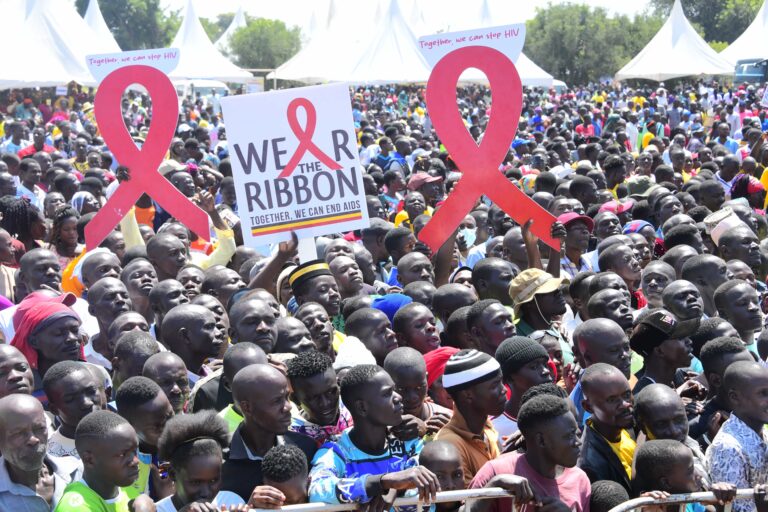
The World AIDS Day commemoration ran under the theme: “Accelerating Interventions to End HIV/AIDS by 2030”. The President explained that AIDS is really a problem caused by indiscipline.
The President further cautioned Ugandans against prostitution, saying that it’s the main cause of HIV/AIDS infections.
Furthermore, the President advised that when someone tests HIV positive, he/she should start taking drugs as prescribed by health practitioners so that they are able to stay alive and healthy.
The President also lauded the Ugandan researchers who are moving in the right direction to make a vaccine for HIV/AIDS.
“There are even our children who are threatening to treat AIDS completely by killing the virus. I’m going to support and fund them fully,” he said.
“As we are still struggling with the ARVs, our people have found a medicine where you take one injection every two months instead of taking tablets every day. I want to thank our scientists for really doing a good job.”
Dr. Musoba also revealed that overall, there has been a reduction in new HIV infections by 45 percent from 68,000 infections annually in 2017 to 38,000 by December 2023.
“15,000 of these were young people between the age of 15 to 24 years. We have 4700 children between the ages of 0-14. While we have the technology to stop babies from getting HIV, we still have quite a number that is still getting the virus.”
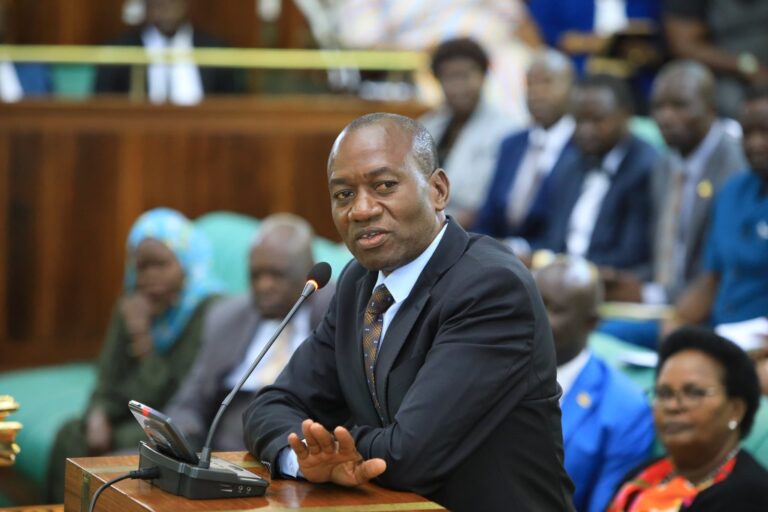
The Member of Parliament for Bugabula South Maurice Kibalya has expressed doubts about the explanations being given about the UGX500m fake bank notes that were discovered inside Post Bank branch in Mbale and the UGX62bn was stolen from Bank of Uganda.
Kibalya, who was speaking during the training of MPs of the Uganda Parliamentary Network on Illicit Financial Flow, organized by SEATINI) Uganda, Tax Justice Network, Africa held at Onomo Hotel in Kampala, questioned why the two sagas have only been recorded amongst government financial institutions.
He said that this points to an insider scheme within government. “There is no Ugandan who can be convinced that money disappeared from the Central Bank, which has all the safety valves and all mechanisms of controlling money, protecting money and whatever it requires,” remarked Kibalya.
Kibalya further accused government of playing ping pong games with taxpayers’ money, saying “There is no Ugandan who is so stupid that can be convinced that money disappeared without a plot, move, syndicate, without a racket that involves government officials and whoever is involved.
That one can’t be. You can’t tell me that money can disappear from the Central Bank when the Governor isn’t part of the racket, when the Minister isn’t part of the racket, and when those in charge of the country aren’t part of the racket.”
“If the Ugandan currency can disappear, what of the foreign reserves we are supposed to keep in the Central Bank? If what we see can disappear, now, think about what we don’t see. It is just that Government is playing ping pong, they know what is happening.
No Ugandan is stupid to that level that they can be told, of all places where money can disappear, it can be the central Bank. Money was taken, officially, directly, but they are just hiding under the stealing,” Maurice Kibalya (Bugabula South).
Who will protect the public?
The Tororo district Woman Member of Parliament, Sarah Opendi, wondered that “If banks now have fake money, what mechanism do I have to detect fake money from the genuine money? Because we expect banks to be giving us genuine notes, now if this has been discovered in Post Bank, how sure are we that other banks haven’t been doing it?
Should we now carry currency detectors to these banks? That if I have been given money, I should use something or my phone to detect before I walk out of the bank. I am sure that very many people have received fake money and actually, it is in circulation,” asked Opendi.
MPs to take action
Moses Aleper (Chekwii County), also Vice Chairperson, Parliament’s Finance Committee revealed plans by the Committee to summon the Ministry of Finance and Financial Intelligence Authority (FIA) to explain circumstances under which, accounts of Bank of Uganda were hacked, leading to the siphoning of UGX62Bn.
“We are going to summon them, especially Ministry of Finance. We are also going to summon Financial Intelligence Authority and then the Central Bank so that they give us an explanation. It is just good because we represent the people so that we have an answer whenever we meet people.
Like if you ask me now, I can’t give you an answer. So we shall call them to give us an explanation, while we wait for the report. It is just like how we do our oversight role, we don’t have to wait for the report, we shall be asking them a few questions,” said Aleper.
“The recent happening, especially at the top chain of the financial sector is actually throwing the citizens into panic and also undermining the credibility of our financial institution and definitely indicates there is a problem in the architecture and also the management.
As we advance in technology, we are living with people who are also thinking quite fast. As long as there is collusion in anything, there are no internal controls you can be make that are airtight and this is what must have happened,” explained Aleper.
President Yoweri Museveni has reiterated his call to Ugandans to prevent themselves from getting infected with HIV/AIDS by ending prostitution which he said was main cause of HIV/AIDS infections.
The President made the remarks during the World AIDS Day commemoration held at Bukungu Primary School, Bukungu Town Council, Buyende District on Sunday.
The commemoration ran under the theme: “Accelerating Interventions to End HIV/AIDS by 2030”. The President explained that AIDS is really a problem caused by indiscipline.
“You people please don’t keep playing around with this problem. Yes, the drugs are there to suppress the virus, but it’s not eliminated. But the advantage we are looking for in suppressing the virus is that when it is much suppressed, the virus doesn’t spread so much,” he advised.
“Please stop this indiscipline. All Ugandans should stop living a risky life. You hear the statistics that in the whole world there are 39 million people with the virus. People in the whole world are like 7 billion. Now out of the 39 million, 1.4 million are in Uganda, that is a high figure. Why should this be the case?” he wondered.
Furthermore, the President advised that when someone tests HIV positive, he/she should start taking drugs as prescribed by health practitioners so that they are able to stay alive and healthy.
“Although it’s not what I prefer for you, it’s better than dying because if you live longer, you will be able to look after your children so by the time you leave this world, they are in a better position. You can work, make a contribution and as you have heard, you are less infectious if the viral load is suppressed. Therefore, from a national point of view, it’s good because it will stop you from spreading the virus more aggressively.”
President Museveni also lauded the Ugandan researchers who are moving in the right direction to make a vaccine for HIV/AIDS.
“There are even our children who are threatening to treat AIDS completely by killing the virus. I’m going to support and fund them fully,” he said.
“As we are still struggling with the ARVs, our people have found a medicine where you take one injection every two months instead of taking tablets every day. I want to thank our scientists for really doing a good job.”
For the second year running, Busoga Yaiffe will be organizing the Busoga Olwekobaano and Energy Expo in Kaliro district. The three-day event will kick off on 5th November 2024 and climax on 7th November 2024 at the Taxi Park Yard & Green Belt area in Kaliro Town.
This theme for this year’s event is taking access to affordable, reliable, and clean energy to more places and people using strategic partnerships to generate socio-economic change and to ensure sustainable development in Eastern Uganda.
Dr Charles Mbalyohere, the President of Busoga Yaiffe, told Busoga Yaiffe in an interview that they are building on the successes of last year event to further sensitize the people of Busoga about the need to embrace the use of renewable energies like solar and biomass.
“We think that as the world is facing a major climate change crisis, as the weather is changing, we have to do something about how we use energy. It was a timely topic, even for us here in Busoga,” Mbalyohere said, adding: “We thought we should follow up in the second year and consolidate what we did last year. It’s important for not only the region but also the country and the global community.”
A conference discussing business ideas and opportunities, an exhibition showing the latest renewable energy products and technologies and a health camp to manage different health issues have been lined up to address the various energy needs of the 3000 people who are expected to turn up.
Mbalyohere revealed that various speakers, energy experts and industry regulators have been invited to speak at the conference while exhibitors showcasing solar, biomass and clean cooking technologies have booked their spaces waiting to interact with potential customers.
He said that services at the health camp, a Corporate Social Responsibility arm of Busoga Yaiffe, will be free. “We have partners like Rays of Hope, Hospice Jinja for cancer screening, especially for women, Musana Healthcare Services, World Vision, and the Kaliro District Health Office will come to support,” he noted.
Why the energy expo?
Mbalyohere explained the expo is a foundation to sensitize people about energy transition that is happening: the transition to using renewable energy and slowly getting away from fossil fuels. Many people need to understand what this means, he said.
“So there’s a lot of explanation, especially to everyday people. And I think we all have a responsibility in our different capacities to support the transition. The Olwekobaano, for us, is the possibility we have to contribute to the transition.”
“We know that it can make a practical change if people start using, for example, solar pumps for irrigation. If it is affordable, and people can use solar pumps to irrigate their farms throughout the year, even in the dry season, that can make a difference to their livelihoods.”
“Not only will we be helping the environment, we will also be helping people economically. I think those are good reasons for us to be inspired to start something.”
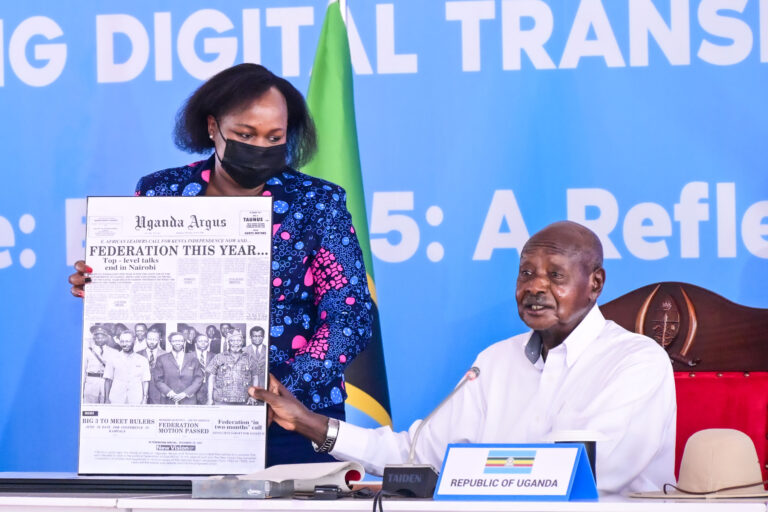
President Yoweri Museveni is known for describing the past presidents of Uganda, especially Milton Obote and Idi Amin Dada, with superlatives that are not kind and abusive in nature. He belittles them at every opportune moment and is quick to blame them for all that has gone wrong not only in Uganda but East Africa as a region and Africa as a continent.
It was therefore unusual when the son of Kaguta praised Obote for bearing the vision of starting the East African Community. Obote, alongside Jomo Kenyatta (former president of Kenya), Mwalimu Julius Nyerere (former president of Tanzania, on June 3, 1963, laid the foundation for the East African Community.
“Their bold decision to establish the EAC was a significant step, even though the political federation they envisioned was not fully realized,” he said. He stressed that integration of the community is essential for both economic prosperity and strategic security.
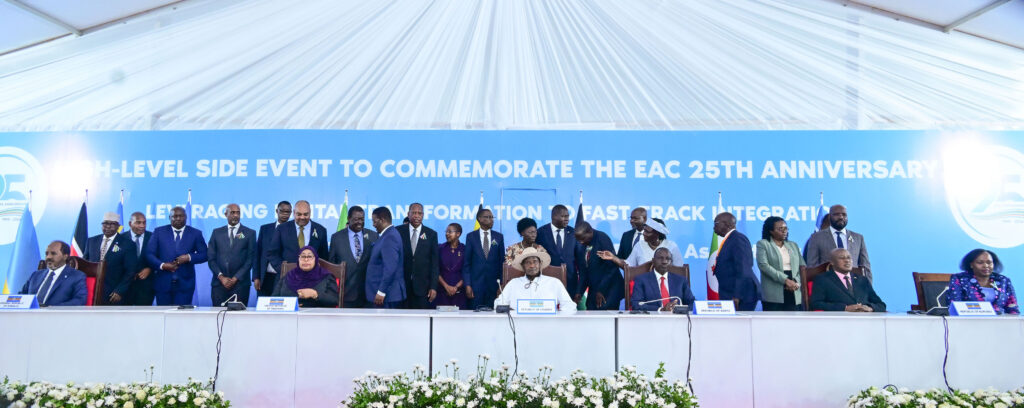
The president Friday made the remarks in Arusha, Tanzania, where he joined fellow regional leaders to celebrate the 25th Anniversary of the East African Community.
From (L-R) Somalia Presifdent Hassan Sheikh Mohamud, Tanzania’s Samia Suluhu, Uganda’s Yoweri Museveni, Kenya’s William Ruto and other leaders pose for a photo during the EAC 25th anniversary in Arusha.
The East African Community is marking a significant milestone as it celebrates 25 years of regional integration and cooperation during the ongoing 24th Ordinary Summit of Heads of State and Government in Arusha, Tanzania.
Held under the theme, “Promoting Trade, Sustainable Development, Peace and Security for Improved Livelihoods”, the high-profile event brought together leaders from across the region to reflect on the EAC’s achievements and strategize for the future.
The summit began on November 29th, and will conclude, November 30th, 2024, at Arusha International Conference Center.
Originally a three-member bloc, the community has grown to include eight member states; Burundi, Democratic Republic of Congo, Kenya, Rwanda, South Sudan, Tanzania, Uganda, and Somalia representing a combined population of over 300 million people.
During the high level side meeting, Museveni called for EAC to build on its 25-year journey of integration by embracing a broader historical perspective and advancing the cause of regional unity.
He praised Tanzania for leading by example when Tanganyika and Zanzibar united to form the United Republic of Tanzania, calling it a testament to the possibility of deeper regional integration.
“If that spirit had been embraced by all, we could have avoided many of the challenges that plagued our region, such as the Idi Amin era and conflicts in Rwanda and Burundi,” President Museveni observed.
At the Summit, the Heads of State discussed pressing issues shaping the region, focusing on strengthening economic resilience, enhancing peace and security and fostering initiatives to promote intra-regional trade and sustainable development.
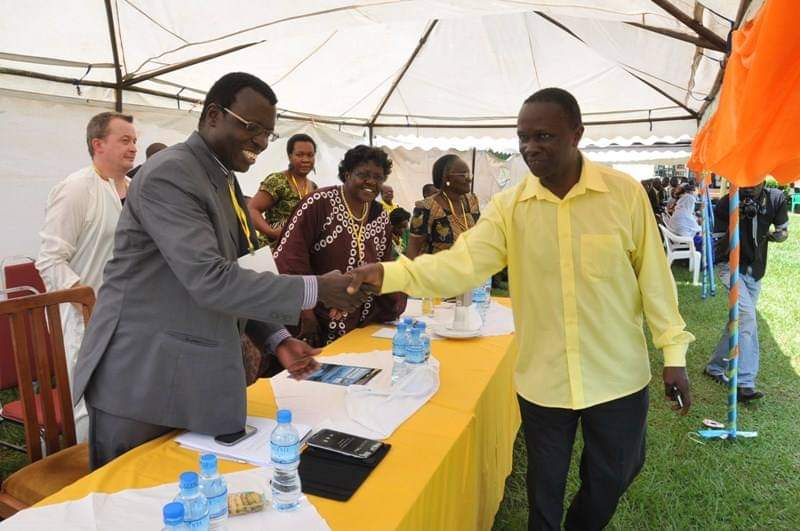
Standard Chartered Bank Uganda Friday made a donation of UGX50,000,000 to the National Union of Disabled Persons of Uganda (NUDIPU) during an event held at its Head Office.
The event was presided over by the Executive Director and Head, Corporate at Standard Chartered Bank, Charles Katongole and the CEO, NUDIPU, Esther Kyozira.
The event that had participants from Kalangala district started off with a business mentorship session that was led by John Baptist Yawe, the Head of Business Banking at Standard Chartered before the ceremonial handover of the cheque.
The funds aim to promote the socio-economic empowerment of youth with disabilities in Kalangala district through entrepreneurship and business skills development as well as their participation in livelihood programmes and processes that lead to increased access to employment, income generation and social security Services in 2025.
The project will target young persons with disabilities of different impairments, aged 18-35 years who are out of school and interested or involved in entrepreneurship and business management.
Sixty percent of beneficiaries will be females with disabilities. Overall, 250 young persons will benefit directly and indirectly 750 household members will benefit indirectly through the different activities of the project.
The project is expected to achieve 3 outcomes: increased incomes and asset acquisitions for youth with disabilities, Increased employment opportunities for both self and waged and increased access to financial and social services.
These three outcomes shall lead to socio economic empowerment of Youth with disabilities and hence reduce vulnerabilities and poverty amongst them.
While delivering his remarks, Charles Katongole said this partnership and donation to NUDIPU comes off the back of years of consistently promoting greater economic inclusion for persons with disabilities through their Futuremakers programmes.
“Our EmployABLE programme helps to create job-ready Persons with Disabilities by providing them with knowledge and soft-skills training, career mentoring and job placements. We have also previously empowered them by organising career-fairs where we linked over 100 people with disabilities to potential employers, renovated schools, donated braille machines and computers as well as planted trees at Salaama school for the blind located at Kisoga – Mukono.”
On her part, the Chief Executive Officer, NUDIPU, Esther Kyozera thanked standard Chartered for this generous donation stating: “The Bank is one of the major partners of PWDs in the country and is always inviting us for various engagements as well as offering employment to our people and for that we are very grateful and remain hopeful.
“As NUDIP we chose Kalangala as the district in which to make an intervention because we want to address challenges facing youth with disabilities. According to the 2014 population census there were 2,964 young persons aged 2-30 years in Kalangala out of a population of 7,260 persons with disabilities while youths aged 18-30 years were 1,998 (12.4%).
11% of youths were out of school and 38.6% were household heads. The socio-economic hardships persons with disabilities face in Kalangala district are severe given there are 84 scattered islands leading to challenges of mobility and access to socio economic services.\
Furthermore, it is also reported that women with disabilities are involved in prostitution to earn a living, there is a high incidence of human trafficking, child defilement and Gender Based Violence especially taking advantage of their vulnerability due to impairment and poverty.
This project therefore seeks to address challenge of limited incomes, unemployment and limited access to socio economic services facing youth with disabilities in Kalangala island,” she concluded.
With the UGX50 million donation the youth with disabilities running MSEs will be linked to disability and Business networks and value chains that will ensure continued inclusion into the programmes of stakeholders.
The training manuals developed and used to provide Business development services shall be the tools used in scaling up the project deliverables long after funding phase out. The lessons, data and knowledge generated and documented shall be used to source out more resources to sustain the MSEs.
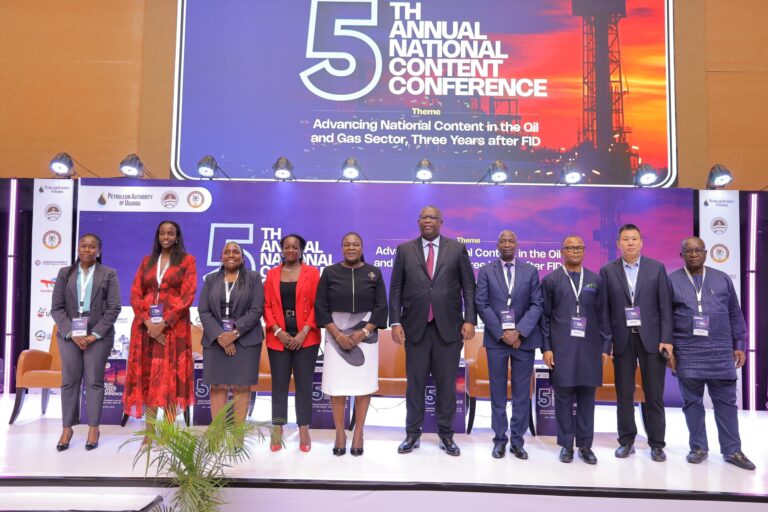
Ugandans continue to take the lion’s share of employment opportunities in the country’s oil and gas sector, with 90% of the workforce comprising locals. This was highlighted by Hon. Ruth Nankabirwa, Minister for Energy and Mineral Development, at the 5th Annual National Content Conference opening.
The Minister emphasised that a strong legislative framework has been implemented to prioritize the employment of Ugandans at all levels, with particular attention given to communities hosting oil and gas operations.
“As of June 2024, 15,451 individuals were directly employed by licensed oil companies, their contractors, and sub-contractors. Of these, 13,048 (90%) are Ugandans, including 4,483 employees from communities directly hosting oil and gas activities,” said Hon. Nankabirwa.
Looking ahead, the sector anticipates a peak workforce of approximately 160,000. The implementation of oil and gas projects is seen as a transformative opportunity to fast-track Uganda’s development, largely through the active participation of Ugandans and enterprises in providing goods and services—key aspects of what is termed “National Content.”
This year’s National Content Conference, themed “Advancing National Content in the Oil and Gas Sector, Three Years After FID,” aimed to review achievements in the sector, particularly in capacity building and upcoming opportunities during the operational phase.
Mr. Ernest Rubondo, Executive Director of the Petroleum Authority of Uganda (PAU), noted Uganda’s extensive preparations for national participation in the oil and gas development phase.
“These efforts included conducting studies, setting up training centres, obtaining international accreditations, and establishing business incubators. While preparations for the operational phase are ongoing, initiatives like the Tilenga and EACOP(East African Crude Oil pipeline) academies are equipping the required workforce for future demands,” Rubondo explained.
He also highlighted the conference as a platform to explore requirements for the operational phase and foster the formation of joint ventures for the upcoming phase.
Keynote speaker Mr. Egbert Faibille Jnr., Chief Executive Officer of Ghana’s Petroleum Commission, stressed the importance of unbundling large contracts to enhance the involvement of local entities in upstream and midstream operations.
“While large contracts—averaging US$50 million to US$100 million—dominate the upstream petroleum industry, breaking down scopes can create efficiency and value. Small firms, with their lower overhead costs and ability to respond swiftly, are essential to modern supply chain management,” Faibille stated.
Ms. Peninah Aheebwa, Director for Economics and National Content at PAU, underscored Uganda’s strides in promoting local participation. She revealed that since 2017, the industry has executed 5,280 procurements worth $5.3 billion. Of these, 4,511 procurements (40%) valued at $2.1 billion went to Ugandan companies, with $19 million directly benefiting community-based enterprises.
Additionally, 35 joint ventures have secured contracts worth $300 million out of 64 approved, and over $200,000 in software licenses have been distributed to universities to foster technology transfer and capacity building.
The 2024 conference identified key priorities, including employment of Ugandans, capacity building, enterprise development, use of locally produced goods and services, and knowledge and technology transfer.
The government is collaborating with the private sector and development partners to ensure inclusive growth and enhanced national content strategies. As Uganda continues to develop its oil and gas sector, the focus remains on ensuring that the benefits are shared equitably, with Ugandans playing a central role in the sector’s growth.
Websites store cookies to enhance functionality and personalise your experience. You can manage your preferences, but blocking some cookies may impact site performance and services.
Essential cookies enable basic functions and are necessary for the proper function of the website.
Name
Description
Duration
Cookie Preferences
This cookie is used to store the user's cookie consent preferences.