Tuesday, March 17, 2026
Home Blog Page 46

PUNITIVE MEASURE: FUFA heavily punishes BUL, Kitara players, coach over indiscipline during Uganda Cup match

0

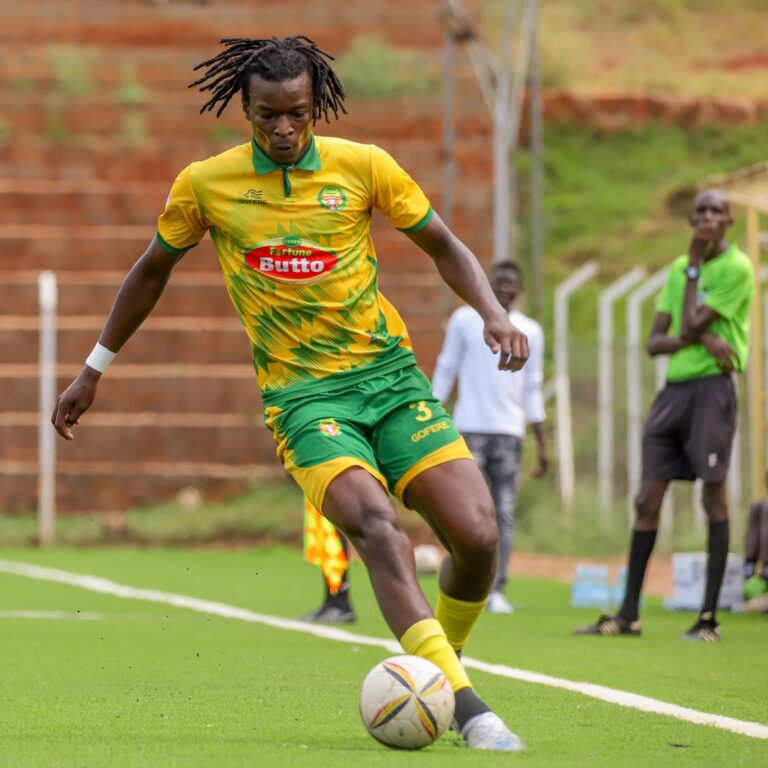
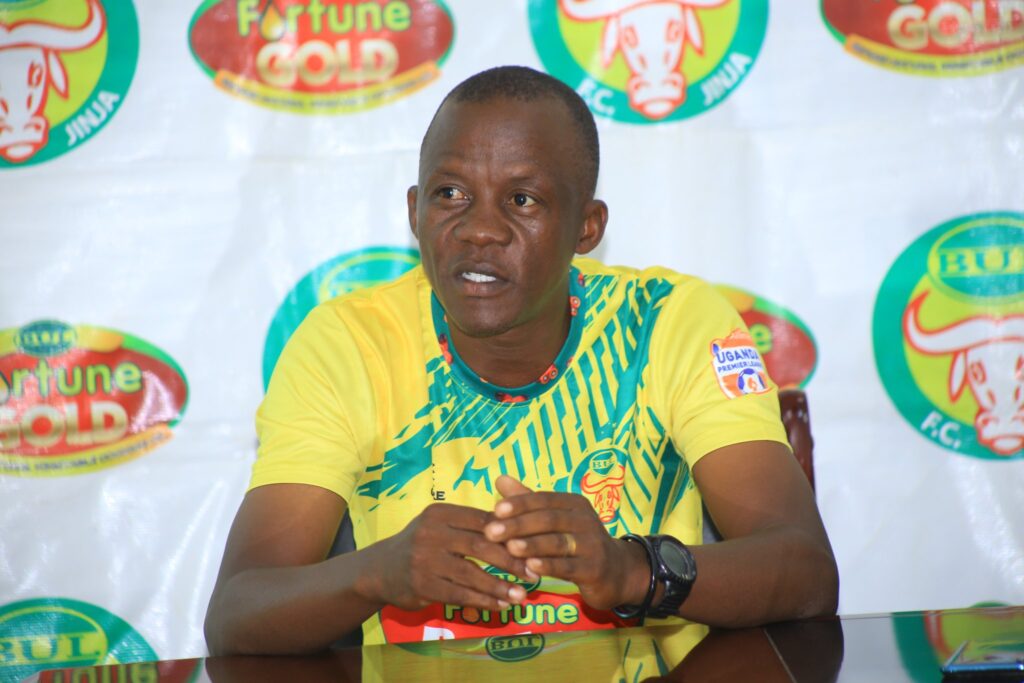
The FUFA Disciplinary Panel has imposed an immediate six-month suspension from all football-related activities on BUL FC Coach Kikomeko Abbey for his violent conduct towards a steward as well as the violent and threatening conduct towards match officials during the Stanbic Uganda Cup match between Kitara FC and BUL FC. He has also been fined UGX 5,000,000.

The Panel has also imposed a 10-match suspension from all FUFA-organised competitions, UGX 1,000,000 fine on BUL FC player Mwere Nicholas for pushing referee Musisi Henry during the Stanbic Uganda Cup match between Kitara FC Vs BUL FC.

However, as credit for acceptance of the charge, apology and being remorseful, the FDP suspended two of the 10 matches meaning Mwere will serve an immediate 8-match suspension in addition to the suspension for the red card received in the match.

In the same spirit, FUFA has imposed a 10-match suspension from all FUFA-organised competitions, UGX 1,000,000 fine on BUL FC player Walter Ochora for pushing referee Musisi Henry during the same match. The sanctions take immediate effect.

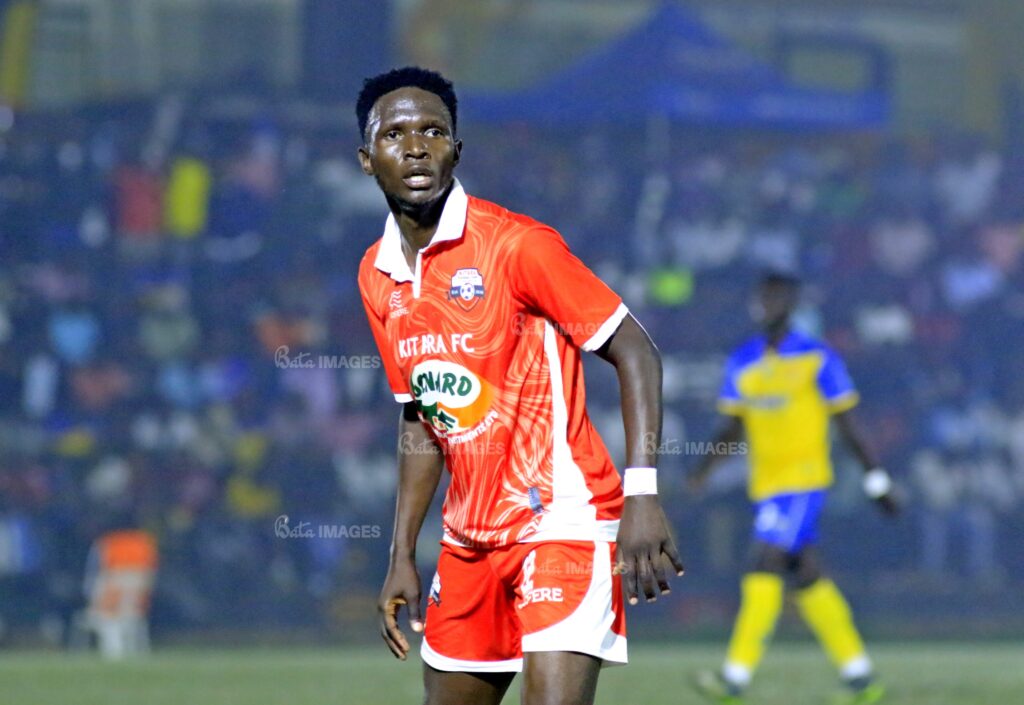
The FUFA Disciplinary Panel has also sanctioned 3 Kitara FC players Titus Ssematimba, Henry Kaddu Patrick and George Senkaaba with two match suspensions each from all FUFA-organised competitions after finding them guilty of improper conduct contrary to section 43(3) of the FUFA Competition Rules relating to their conduct around the 60th minute of the Kitara Vs BUL FC match in the Uganda Cup.

The FDP has also sanctioned each of the three players with a suspended fine of UGX 500,000 to be imposed if they commit another disciplinary violation.

The Panel has also sanctioned Kataka FC for breach of Article 14 of the FUFA Ethics and Disciplinary Code for incidents in which match officials were physically attacked during their FUFA Big League match against Blacks Power FC.

The FDP sanctioned Kataka FC with a suspended two points and two goals deduction to be imposed if the sanctioned conduct is repeated. The FDP further sanctioned Kataka FC with a fine of UGX 2,000,000.

UNFINISHED BUSINESS: Dhamuzungu resigns from parliamentary job to kick Magogo out of Parliament

0

Former Member of Parliament (MP) for Budiope East, Dhamuzungu Geoffrey, has resigned as Senior Programs Officer in the department of Corporate Planning and Strategy at Parliament of Uganda to concentrate on unseating Moses Magogo, the incumbent in that constituency.

In a letter dated 22nd April 2025 and addressed to the Clerk of Parliament of Uganda, Dhamuzungu tendered his resignation ‘to be able to participate in the coming general elections of 2026.’

In a memo dated 12th February, 2025, the Clerk asked all parliamentary staff wishing to join politics to resign from their roles – this is a statutory requirement.

“Allow me [to] convey my sincere gratitude to you for the opportunity given to work with the Parliament of Uganda as a staff. It has been a great honour and [a] good experience to contribute to the department through my director and departmental team members ever since I joined,” Dhamuzungu wrote in the resignation letter.

“In reference to the current human resource manual, I hereby officially write to you and give a 30 days notice before resignation as stipulated in our laws and have 25th May, 2025 as my last day at work,” he further wrote.

I can also ably state and confirm that [I] am able and I will personally handle my external obligations after resignation without any problem since their terms and conditions are clear, discussed and signed by me,” he added before further thanking the Clerk for the opportunity to serve the country. I shall be grateful if my resignation is put into your positive consideration; Dhamuzungu stated and signed off the one-page letter.

Dhamuzungu was MP for Budiope East between 2016 and 2021. He lost the seat to Moses Magogo, the President of FUFA, in a highly contested election marred by electoral malpractice and violence.

At a public gathering in Bugaya last year, Magogo’s wife and Speaker of Parliament, Anita Annet Among, claimed she was the one who secured Dhamuzungu the Parliament job when he approached her.

Dhamuzungu denied her claim, saying it was President Yoweri Museveni who had deployed him. “I don’t work for [Anita] Among or the Speaker. I am a government of Uganda employee. President Museveni gave me this job,” Dhamuzungu retaliated at a different public gathering.

He challenged the Speaker to fire him if it was her who gave him the job. She couldn’t.

ORBITUARY: A Somber Farewell to Pope Francis

0

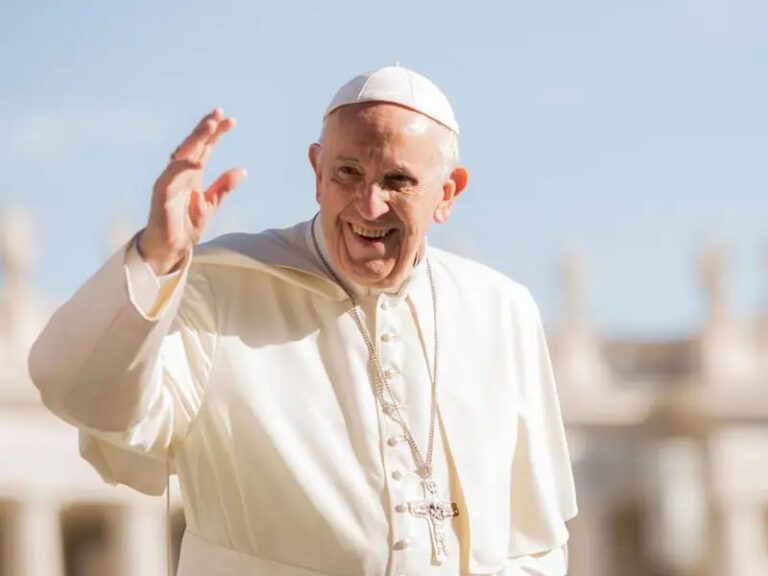
The bells of St. Peter’s, usually a vibrant chorus of celebration, now toll with a mournful cadence, their echoes reverberating through a world draped in quiet contemplation. His Holiness, Pope Francis, the 266th Pontiff of the Roman Catholic Church, has passed on.

The shepherd has returned to his flock, leaving behind a legacy etched in humility, compassion, and a relentless pursuit of a more just and merciful world.

Where were you when you first heard the news?

Perhaps you were sipping your morning coffee, the radio humming in the background, when the somber announcement broke through the mundane. Or maybe you were scrolling through your newsfeed, the stark headline flashing across your screen, momentarily halting the relentless march of the digital age.

However you received the news, it undoubtedly left an imprint, a moment of pause in the relentless rhythm of life. Because Pope Francis was not just a religious leader; he was a global figure, a moral compass, and a voice for the voiceless who touched the hearts of millions, regardless of their faith or background.

Born Jorge Mario Bergoglio in Buenos Aires, Argentina, on December 17, 1936, his early life was marked by a simplicity and connection to the everyday struggles of ordinary people that would later define his papacy. He worked as a chemical technician and even a nightclub bouncer before answering the call to priesthood.

This grounded experience, a far cry from the opulent halls of the Vatican, shaped his understanding of societal challenges and fueled his unwavering commitment to social justice.

Do you remember the day he was elected?

The world watched with bated breath as white smoke billowed from the Sistine Chapel chimney on March 13, 2013. The name “Francis” resonated with a freshness, a deliberate echo of St. Francis of Assisi, the patron saint of the poor and marginalized.

From the moment he stepped onto the balcony of St. Peter’s Basilica, his humble demeanor, his simple white cassock, and his warm, welcoming smile signaled a departure from the more formal and often austere traditions of the papacy. He was a breath of fresh air, a man who seemed genuinely comfortable in his own skin, a leader who prioritized connection and empathy over ceremony and protocol.

His pontificate was marked by a conscious effort to bridge divides, both within the Church and in the wider world. He challenged the Church to be more inclusive, more welcoming to those on the margins, including divorced and remarried Catholics, members of the LGBTQ+ community, and those struggling with their faith. He famously asked, “Who am I to judge?” a sentiment that resonated deeply with many who felt alienated or excluded by traditional religious institutions.

Can you recall a specific moment when Pope Francis’s words or actions particularly moved you?

Perhaps it was his unwavering advocacy for refugees and migrants, his impassioned pleas for peace in war-torn regions, or his consistent condemnation of economic inequality. He washed the feet of prisoners, visited refugee camps, and spoke out against human trafficking with a fervor that commanded attention. He reminded us that every human being, regardless of their background or circumstances, deserves dignity, respect, and the opportunity to live a fulfilling life.

He was a tireless advocate for interfaith dialogue, forging strong relationships with leaders of other religions, recognizing the shared humanity that binds us together. He traveled the world, meeting with political leaders, religious figures, and ordinary people, always seeking common ground and promoting understanding. He understood that the challenges facing humanity – climate change, poverty, war – require collective action and a spirit of collaboration.

Think about his efforts to reform the Vatican. He tackled long-standing issues of corruption and financial mismanagement, striving to create a more transparent and accountable institution. He appointed women to key leadership positions, recognizing their vital role in the Church. He initiated reforms to address the clergy sex abuse crisis, acknowledging the devastating impact on victims and vowing to prevent future abuses. These reforms were not always easy, and they faced resistance from within the Church, but Pope Francis remained steadfast in his commitment to creating a more just and trustworthy institution.His encyclicals, particularly “Laudato Si’,” on the environment, were groundbreaking. He eloquently articulated the moral imperative to care for our planet, connecting the exploitation of the environment with the exploitation of the poor. He challenged us to reconsider our relationship with nature and to embrace a more sustainable and just way of life.

He reminded us that we are all interconnected and that the future of humanity depends on our ability to act responsibly and with compassion.Pope Francis was not without his critics. Some accused him of diluting Church doctrine, of being too lenient on social issues, or of not moving quickly enough on reforms. But even his critics recognized his sincerity, his genuine desire to make the Church a more relevant and compassionate force in the world.

Consider the simple gestures that defined his papacy: choosing to live in the Vatican guesthouse rather than the papal apartments, carrying his own briefcase, making phone calls to ordinary people who wrote to him. These seemingly small acts spoke volumes about his humility and his commitment to staying grounded in the realities of everyday life.

What will you remember most about Pope Francis?

Perhaps it will be his warm smile, his gentle demeanor, or his unwavering commitment to social justice. Maybe it will be his powerful messages of hope and compassion, his calls for unity and understanding, or his challenge to each of us to be better versions of ourselves.Now, as the world mourns his passing, we are left to reflect on his legacy. He leaves behind a Church that is more open, more inclusive, and more engaged with the world. He leaves behind a world that is more aware of the plight of the poor and marginalized, more committed to protecting the environment, and more hopeful for a future of peace and justice.

The bells of St. Peter’s continue to toll, a somber reminder of our loss. But as we listen to their mournful cadence, let us also remember the words and actions of Pope Francis, his unwavering faith, and his boundless compassion. Let us strive to live up to the ideals he championed, to build a world that is more just, more merciful, and more filled with love.

The shepherd has returned to his flock, but his spirit will continue to guide us on our journey. May he rest in peace. And may his legacy inspire us to be better, to do better, and to create a world worthy of the love and compassion he so tirelessly preached.

BUSOGA IN PERSPECTIVE: Will the constitutionally created cultural institutions stand the test of time?

0

By Oweyegha-Afunaduula

It is true. The President of Uganda did not want to reintroduce kingdoms in whatever form. He said he did not go to the bush to reintroduce Kingdoms. There was a lot of pressure on him, especially from the Baganda, to reintroduce kingdoms. He knew what to do, and he did it. He introduced what he called cultural institutions, which was a distortion, since the kingdoms had political, spiritual, and cultural institutions. The strategy was to depoliticize the former kingdoms and make them completely dependent on the center, which wanted to use them to achieve its political ends. This strategy made the LC1 politically more powerful than “the new cultural leaders.” LC1 is the lowest level of political organization of government.

The president chose the strategy of sustaining the cultural institutions with money. The government gives a salary of 60 million shillings to every cultural institution. Only the Kabaka refused to accept the salary and instead demanded to be paid the money that his institution was demanding from the government.

There is evidence that the money given as salary to the cultural leaders is not only weakening the cultural institutions but is also dividing them.

Currently the Kyabazingaship is in crisis because money from the center is clandestinely being used to destroy the cultural institution. One school of thought is that people called mafias do not want strong leadership in Busoga because that leadership will strategize to ensure that its mineral wealth benefits Basoga and Busoga, thereby making it difficult for the mafias to exploit its mineral wealth for their own selfish interests.

For Busoga to stand the test of time as a constitutionally created cultural institution without political power will be extremely difficult. Politics is where decisions are made. Without political power, Kyabazingaship, unlike in the past, will not be able to decide how Busoga should be governed nor how and when it mineral wealth of uranium, oil, gold, diamonds, platinum, and rare earth minerals should be exploited in the interest of the area and its people.

Currently, the central government is strategizing to exploit Busoga’s oil and to use its uranium to build a nuclear plant in Buyende, but the Busoga cultural institution is not involved. Besides, Busoga’s gold, platinum, and rare earth minerals are being exploited by mafias and exported, but the cultural institution is outside the trade.

Busoga is a sleeping giant that is captured as a region and cultural institution. There is a need for Busoga leaders to rethink their current conflicts and resolve to reject divide and rule for the sake of Busoga. They must know that together they sink or rise. Our future generations are in danger of not belonging to Busoga and losing their identity because foreigners are penetrating the area not only to exploit its resources at the expense of Busoga but also to create a new belonging and a new identity that has nothing to do with Busoga.

For God and My Country.

PRIVATISING UGANDA: Indigenes lost everything and a few families own everything

0

By Oweyegha-Afunaduula

Let me begin this article with a word on globalisation. Globalization is a term used to describe how trade and technology have made the world into a more connected and interdependent place. Globalization also captures in its scope the economic and social changes that have come about as a result.With the Information Age, globalization went into overdrive.

Advances in computer and communications technology launched a new global era and redefined what it meant to be “connected. The sense that there is a global village, a worldwide “us,” has emerged. (Shnayder, 2025). We thus use the term globalisation to describe the increasing connectedness and interdependence of world cultures and economies in the global village. There are of course advantages and disadvantages of being integrated in the global village but I will not go into that.

While it is difficult to definitively declare any single country as the first to embrace globalization, Uganda did implement significant economic reforms in the 1990s that aligned with the principles of globalisation. These reforms, influenced by the Washington Consensus, included liberalisation of trade, privatization of state-owned enterprises, and deregulation of various sectors. 

In 2000 the NRM regime became the first ruling regime in Africa to embrace globalisation and declare that itwas going to be the way forward for development in and of Uganda. Some of the regime’s functionaries, such as former Vice-President Dr. Specioza Kazibwe, told Ugandans that those who would not embrace the idea of globalisation would be left in the past. It was the same functionary who said that the poor will never rule in Uganda.

That was many years before President Tibuhaburwa Museveni’s son, General Muhoozi Kainerugaba who is his Chief of Defense Forces (CDF), declared that civilians will never rule in Uganda again. It was a few years after President Tibuhaburwa Museveni declared that the ballot -a mare piece of paper – can never remove him from power; that he can never hand power to the opposition politicians because they are criminals; and that he is like a quarter pin of a bicycle which goes in by knocking and come out by knocking (meaning only death can remove him from power). Despite all this, the President, through his chain of electoral commissions, organises regular elections to create illusionary democracy.

The new rulers from the bush did not want Ugandans to remember that through their armed wing, the National Resistance Army (NRA), which they commanded, and which was full of refugees from Rwanda and Mulenge in the present-day Democratic Republic of Congo (DRC), they robbed and destroyed banks, cooperative unions, cooperative societies,railways, factories and the industries of Jinja and highjacked Uganda Transport Company (UCT) and People’s Transport Company (PTC) buses, thereby undermining the economy.

The NRM regime’ President Museveni had also declared that the economic tool for development in Uganda would be privatisation because public ownership had failed to spur Uganda’s development.Privatisation has been defined as the transfer of a business, industry, or service from public to private ownership and control. Others see privatisation as the robbery of what belongs to the poor and needy by the rich and powerful.Otherwise, privatization occurs when a government-owned business, operation, or property becomes owned by a private, nongovernment party.Privatization also may describe a transition that takes a company from being publicly traded to becoming privately held. This is referred to as corporate privatization (Marshall Hargrave,Khadija Khartit and Vikki Velasquez,2024).Proponents of privatization argue that privately owned companies run businesses more economically and efficiently because they are profit-incentivized to eliminate wasteful spending. Furthermore, private entities don’t have to contend with the bureaucratic red tape that can plague government entities (Marshall Hargrave,Khadija Khartit and Vikki Velasquez ,2024).

Uganda embarked on a large-scale privatisation programme in the early 1990s, driven by the World Bank and International Monetary Fund, to address a struggling public enterprise sector. The primary goals were to foster enterprise development and reduce government subsidies. The program initially focused on smaller commercial SOEs but later expanded to include larger, more strategic ones. 

Dr. Julius Kiiza (2015), cited by EPRC (2015), maintained that privatisation in Uganda was premature and that Uganda needed to hold onto to its parastals. He said,“Government has business in business; successful states have provided leadership in development”. Almost simultaneously, President Tibuhaburwa Museveni sought to make a U-turn on privatisation after being its advocate (Daily Monitor, 2015). After 20 years of experimenting,the President said that he should not have blindly adopted privatisation, which he said was forced down his throat by World Bank and the International Monetary Fund (IMF). He declared, “We are not going to allow more privatisation of government institutions”.

In the President’s view privatisation policy had actually failed. This surprised many since he had single-handedly touted it as the best economic development tool in modern times. Despite expert advice he had listened to World Bank, IMF and himself. Joyce Namutebi (2006) cited him in her article “Uganda: Bad Governance failed Privatisation -Museveni”in New Vision saying that privatisation had failed because of bad governance. According to Joyce Namutebi, he did not blame bad governance during his time. Instead, he cited the acts of bad governance in Africa, especially in the 1960s and 1970s, saying the problem was the interference by African governments in the private sector. However, Roger Tangri and Andrew Mwenda (2001) blamed corruption and cronyism in Uganda’s privatisation in the 1990s.

It should be remembered that despite saying that privatisation had failed, there is no evidence to suggest that President Tibuhaburwa Museveni officially recanted the policy of privatisation. It, and liberalisation, remained the official economic governance policy. The President never publicly announced that the public sector leadership of the economy was going to be revived. Never did he say that what had been grabbed from the public- by mainly the NRM/A functionaries and their fronts – the Indians – would be returned to the public.Instead, the NRM regime continued to liberalise the economy, not political governance, and to privatise Uganda, leading to a few regime families –in the first family, in families connected to the first family and other beneficiaries – to not only own the country but also every major property, including land. Some former combatants of the NRA who weaned off as Rwandese Patriotic Front (RPA) have to this day properties, including land, in Uganda.

It will be remembered that through the scheme of privatisation, the NRM regime sold off virtually all the public enterprises, including banks and the industries of especially Jinja. However, Ugandanshave never been told where the proceeds went.  However, almost simultaneously the participants in the NRA activities in the bushes of Luweero, and many connected to them, became stinkingly rich. Today, they do not only dominate power and the public sector, but also the private sector.

Thus, over the years, since 1986, Uganda has become privatised into the hands of former NRA combatants and those connected to them, either as brothers, sisters, brothers-in-law, sisters-in-law, fathers-in-law, mothers-in law or uncles or aunties. They do not only own Uganda as their private property but also Ugandans and everything in Uganda. Since their ethnic group predominates in the army, police, intelligence institutions and paramilitary groups, they are assured of their protection and the protection of their properties as well as theregime that has created opportunities for them.

Therefore, when the NRM/A celebrates, at very high cost to the taxpayer, what they call “Liberation of Uganda” they are celebrating their nearly perfect capture and ownership of Uganda, its economy, Ugandans and almost everything at the expense of the indigenes.  The financial haemorrhage the country has suffered and continues to suffer will be remembered as a tragedy that befell the country and Ugandans.

They grabbed public ranches, parts of forests, banks and residences.

They grabbed the chain of Uganda Hotels, Dr. Kiggundu’s Greenland Bank and the People’s Uganda Commercial Bank (UCB). The latter was converted into Stanbic Bank.

They also grabbed the natural resources of Uganda such as Gold, diamonds, oil and rare earth minerals, which they clandestinely export and the proceeds are never reflected in the national budget. The grabbers even don’t pay taxes.

They used and continue to use public money, under the private-public partnership, scheme to establish and sustain factories, mobile phone firms such as MTN and Airtel, hotels and the oil palm plantations in Kalangala surrounded by Lake Victoria, posing serious environmental repercussions.One school of thought holds that public money somehow flows into the privately-owned properties and is used to sustain them. The school argues that most likely the Members of Parliament who allocate money in the National budget, and even allocate money in the supplementary budgets, do not know where the money they allocate ultimately ends up.

We now know that trillions on money ends up in the so-called Classified Account directly owned and managed by the President. The President uses the Account to do anything he wants, including politics, waging wars, building roads, schools, hospitals and other infrastructures in neighbouring countries, and buying the political support of politicians and/orwhole regions of Uganda.

It is now public knowledge that recently the President gave each Member of ParliamentNRM and NRM-leaning Independents and some Opposition MPS) UGX 100 m, ostensibly to thank them for helping him to transfer Uganda Coffee Development Agency (UCDA) and promptly entice them to pass legislation requiring a change in the UPDF Act so that civilians are tried in military courts. While reacting, in a lengthy letter, to denials of the MPs said the money came from the Classified Budget. He was not bothered by ethics and morality of his action yet the country’s roads, schools, hospitals and universities are in pathetic condition.

 It is also now known that following the North declaring that he will not get votes from there the President has decided to give Acholi and Lango 50 billion shillings each, ostensibly to compensate them. That too will come from the Classified Budget. The President does not have to explain how he uses the money and why.  Since he is the substantive Minister of Finance, he only needs to submit his budgets to Parliament and have them approved. It is said It is said that the Classified Account has so far got 16.8 trillion Shillings (3.3 trillion shillings per year) in the last 5 years, according to a revelation by the Leader of Opposition (LOP) in Parliament, Hon Joel Ssenyonyi. The LOP ascribes the mushrooming poverty industry in the country to this careless allocation of money to the Classified Budget. He gives the example of how Italian-Arab Enrica Pinetti has been given 700 billion shillings to build Lubowa Hospital, which is far from being completed. Yet the same amount in Turkish money enabled a state-of-the-art hospital in Turkey.

Musevenomics may be summed up as robbery of public money, natural resources and properties and overtaxation of Ugandans by people connected to the bush war in the Luwero Tringle in Uganda from 1981 to 1986.

Below are some private enterprises that emerged after the introduction of privatisation and the sale of the public enterprises believed to be owned by a few ethnically-related individuals in the NRM/A. There is need to research and establish the owners of these enterprises, most of them hotels. I would be very happy if any researcher (academic or non-academic establishes the different owners or investors in these enterprises and how much public money has been channelled into them. When successfully done, the research will establish whether or not Uganda has been ethnically privatised, with most of the public properties now owned or erected by people belonging to one ethnic group. I take exclusion of people of other ethnicities from participating in the economy and owning property as ethnic clenansing.

NEW AND GRABBED ENTERPRISES                                         OWNER/INVESTOR           

Kampala

  1. Roofings                                                                     Dr. Sikander Lalani
  2. Aya Hotel                                                                   
  3. JM Hotel
  4. Hotel Equatoria                                                           Karim Hirji
  5. Imperial Botanical Beach Hotel                                  Sudhir Rupellaria
  6. Hilton Garden Inn Kampala
  7. Explorers Hub
  8. Kampala Serena Hotel
  9. Golf Course Hotel
  10. Kakira Sugar Works
  11. Protea Hotel by Marriott Kampala
  12. Villa Kololo
  13. Bujagali Hydropower
  14. Uganda Telecoms
  15. Garden City                                                               
  16. Kampala University                                                    Professor Badru Keteregga
  17. St Lawrence University
  18. Victoria University                                                      Sudhir Rupellaria
  19. Akamwesi Hotel                                                         Salim Saleh & Hope
  20. Warid Airtel                                                                Amelia Kyambadde
  21. Greenland Tower                                                       
  22. Kakira Sugar Works                                                    Madhivan+ Uganda Govt
  23. Malaysian Furniture                                                   
  24. Crested Towers
  25. Kampala International University                              
  26. Golden Tulip Canaan Kampala
  27. Prestige Hotel Suites
  28. Keelan Ace Villas
  29. Hotel Bougainviller
  30. Nyumbani Hotel
  31. Kampal Forest Resort
  32. Saracen
  33. WBS Television
  34. Javelin Hotel
  35. Le Petit Boutique Hotel
  36. Fairway Boutique Hotel
  37. Kampala Serena Hotel                                                                        Aga Khan
  38. Onomo Hotel Kampala
  39. Best Western Plus the Athena Hotel Kampala
  40. Mestil Hotel anf Residences
  41. Excelsis Garden Hotels Kampala
  42. Royal Victoria House LtD
  43. Hera Hotel Kampala
  44. Hotel Acacia View
  45. Medine Square
  46. Sheron Hotel Kampala
  47. Hotel Intertropics
  48. Millennium Terrace Hotel
  49. Speke Hotel 1966 LtD
  50. Victoria Mews Hotel
  51. Mt Zion Hotel Annex
  52. Royal Hotel Apartments
  53. Munyonyo Hotel                                                                    

Entebbe

  1. Entebbe Palm Hotel
  2. Umeme
  3. Cohen Tower
  4. Adma Grand Hotel
  5. Hotel Horizon Entebbe
  6. K Hotels Entebbe
  7. Best Western Premier Garden Entebbe
  8. Gorllla Guest House
  9. Karibu BB Suites
  10. Discovery Courts Hotel
  11. Frontiers Hotel and Conference
  12. Airport Side Hotel Entebbe
  13. Rosemary Courts Bed and Breakfast
  14. No 5 Boutique Hotel
  15. Pelican Lodge and Marina
  16. Airport Shoebill Hotel
  17. Gately Inn Entebbe
  18.  Entebbe Airport
  19. Uganda Airlines
  20. Imperial Royal Hotel
  21. Beach Hotel

Jinja

  1. Jinja Nile Resort Hotel
  2. Nile Front Cottages
  3. Living Water Resort
  4. Brisk Hotel Triangle
  5. Cool Breeze Hotel
  6. Nile Village Hotel and Spa
  7. Jinja Safari Hotel
  8. Pearl on the Nile Hotel
  9. HomeStayStudios62
  10. BN Private Beach & Resort
  11. Royal Parl Hotel
  12. Hotel Paradise on the Nile
  13. Source of the Nile Suites

For God and My Country

Further Reading

Daily Monitor (2015).  Why Museveni has made a U-turn on Privatisation. Daily Monitor, March 30 2015. https://www.monitor.co.ug/uganda/business/prosper/why-museveni-has-made-a-u-turn-on-privatisation-1605714 Visited on 16 April 2025 at 15:14 pm EAT

EPRC Uganda (2016). Privatisation in Uganda was a mistake -expert. EPRC Uganda, July 31 2015 https://eprcug.org/eprc-in-the-news/privatisation-in-uganda-was-a-mistake-expert/ Visited on 16 April 2025 at 15:05 pm EAT.

Marshall Hargrave,Khadija Khartit and Vikki Velasquez(2024). What it is, How it Works, and Examples. Investopedia, June 06 2024 https://www.investopedia.com/terms/p/privatization.asp Visited on 17 April 2025 at 13:06 pm EAT

Namutebi Joice (2006). Uganda: Bad Governance failed Privatisation -Museveni. New Vision, https://allafrica.com/stories/200611200984.html Visited on 16 April, 2025 at 15:28 pm EAT

Oweyegha-Afunaduula (2024). When Ugandans Lose Everything. The Kampala Report, February 2 2024.https://www.thekampalareport.com/talk-back/2024020234642/oweyegha-afunaduula-when-ugandans-lose-everything.html Visited on 17 April 2025 at 12:28 pm EAT.

Roger Tangri and Andrew Mwenda (2001). Corruption and Cronyism in Uganda’s Privatization in the 1990s. African Affairs Vol, pp. 117-133 (17 pages): Published By: Oxford University Press

Ronald Musoke (2019). Museveni reversing Privatisation after 33 years. The Independent, 20 May 2019. https://www.independent.co.ug/museveni-reversing-privatization-after-33-years/ Visited on 16 April 2025 at 14:59pm EAT.

Sharona Shnayder (2025). April 24 2025 Explorer Classroom: Learn about the global village crisis. National Geographic, https://education.nationalgeographic.org/resource/globalization/ Visited on 17 April 2025 at 12:40 pm EAT

ROGUE POLITICS: 40 acres of sugarcane plantation belonging to former MP burnt in Buyende

0

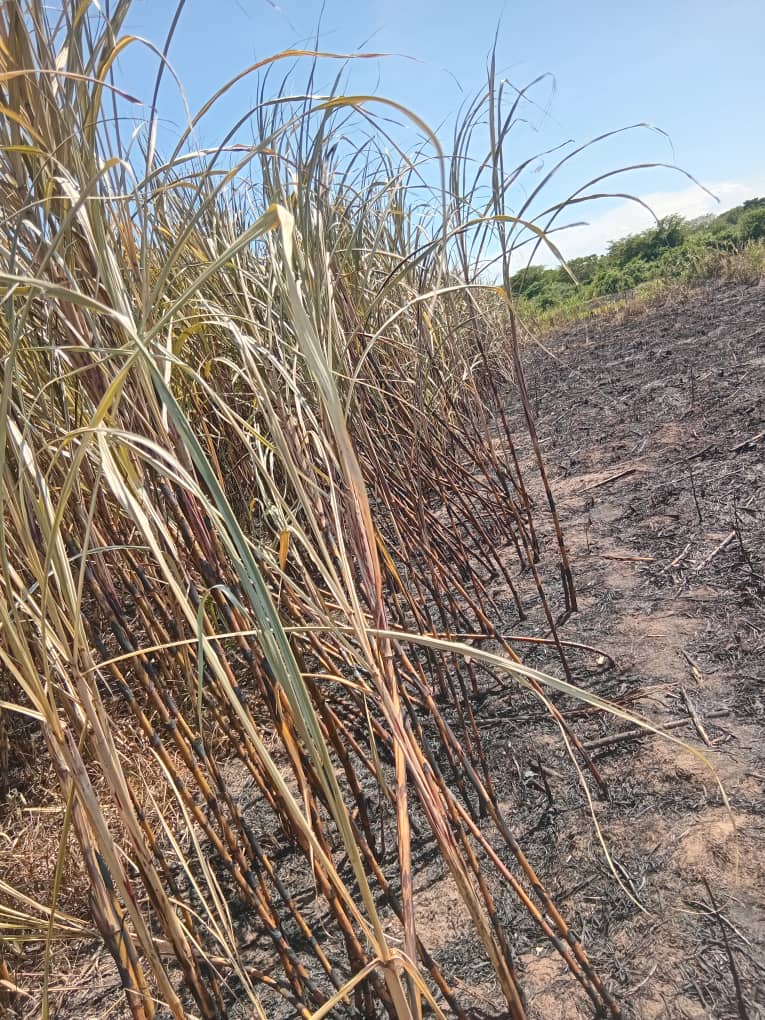
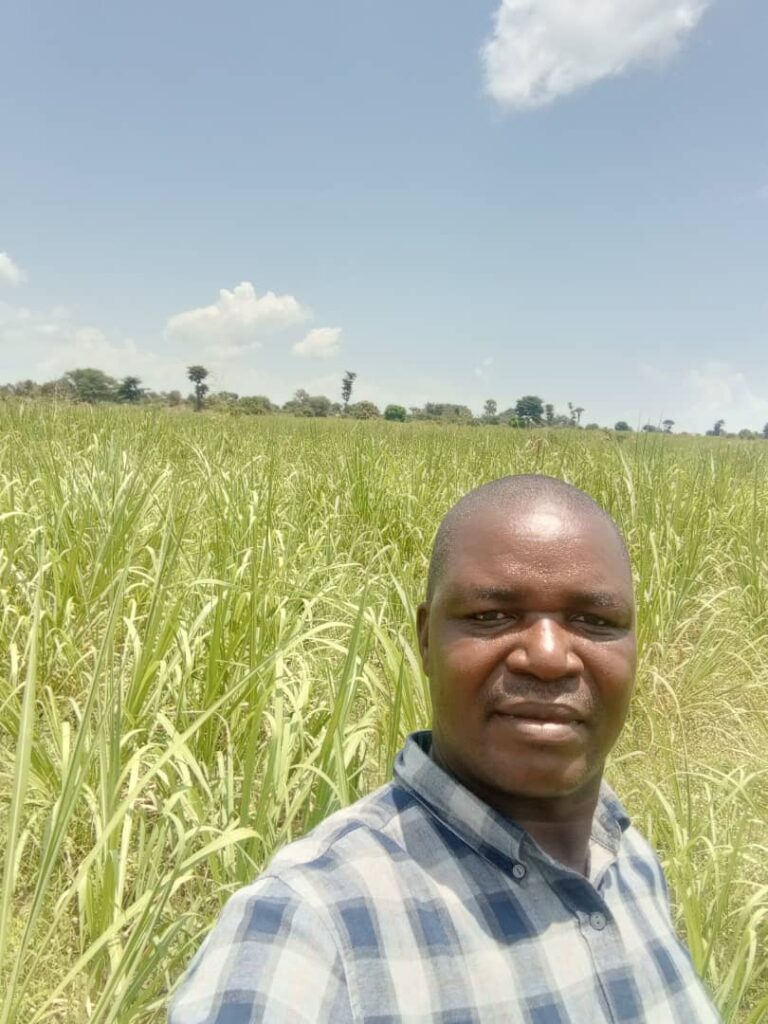
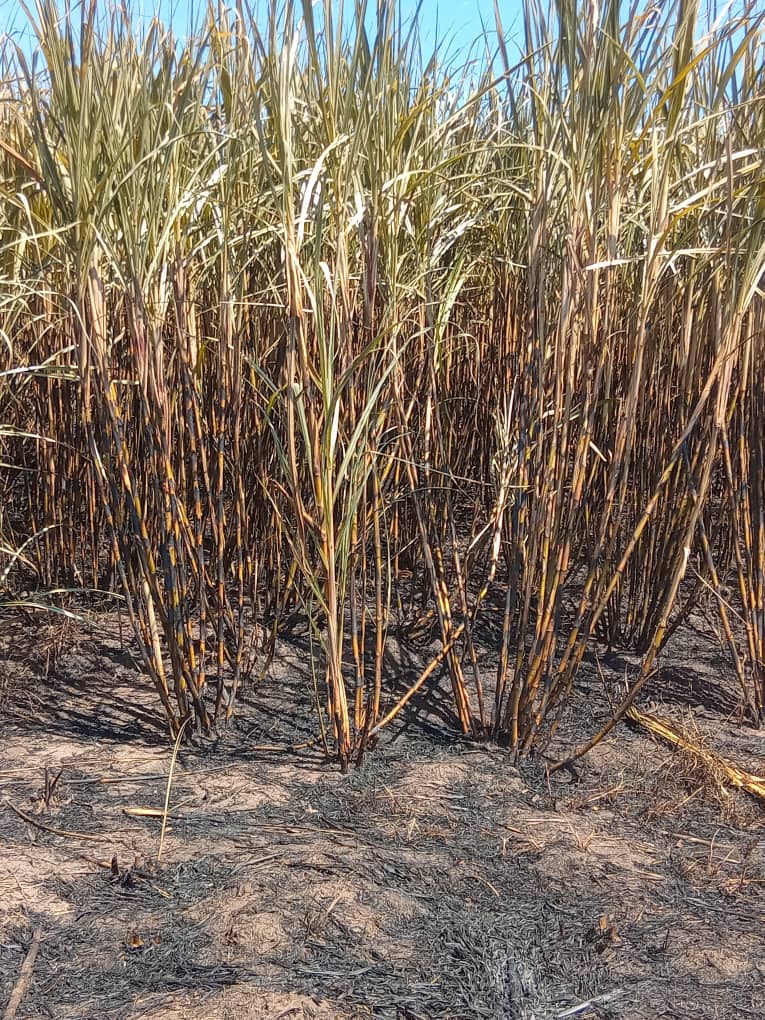
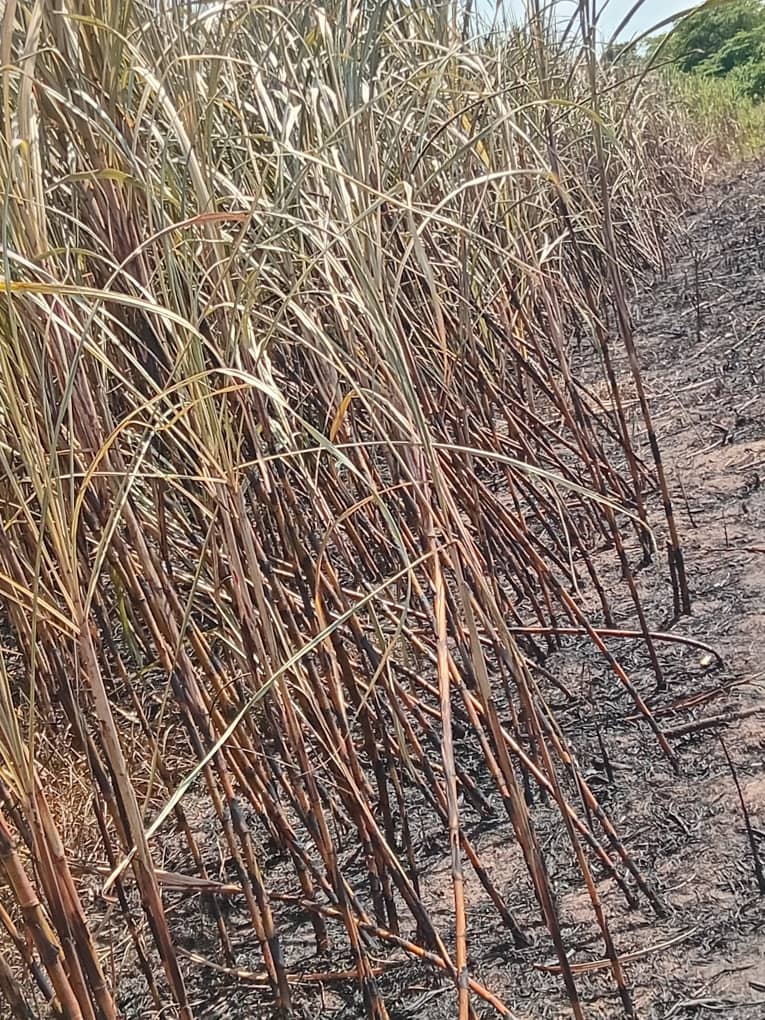
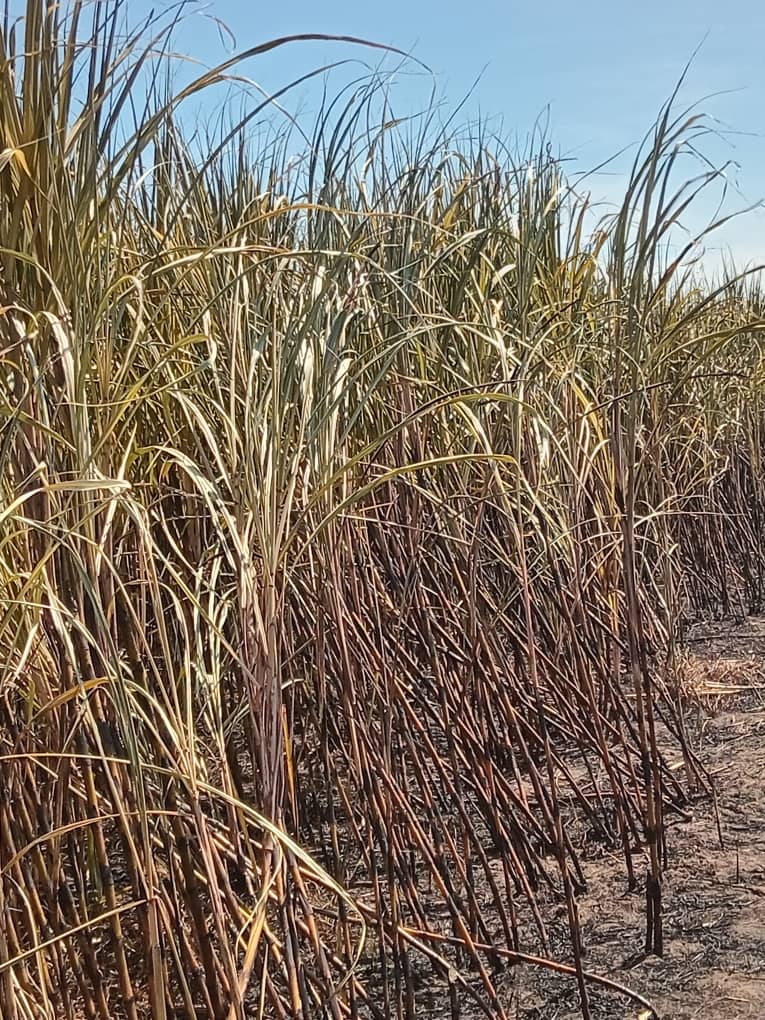
Buyende district is fast becoming a political and electoral violence hotbed in Busoga subregion if the latest news coming from there is anything to go by. A former MP for Budiope West, Robert Musoke, is in pain having lost over 40 acres of sugarcane plantation that was burnt by yet-to-be-identified people on Good Friday.  

The burnt-to-ashes plantation which was about to be harvested is located in Njwejwe zone, Ndulya parish, Nkondo sub county.

Musoke is pointing a finger at his political rivals as the architects of this heinous act. “I used to hear rumours from some political arsonists that they will burn my shambas. They want to cripple me financially so that I fail to raise money for campaigns,” Musoke said in a telephone interview with Busoga Times.

He estimates that he has lost over UGX100m in profits. He has been waiting to harvest the profiting canes with anticipation, having heavily invested in the planting of canes and caring for the plantation.

Despite this heavy loss, Musoke is yet to report the matter to the police for investigation. “What will police do?” he questioned when asked why he has refused to report the matter to the law enforcers.

“I know they can’t help me in this. If the whole office of the RDC [Resident District Commissioner] in the district has turned to be the campaigning agent of Milly Babalanda, what help should I expect?” he said questioningly. I better embark on community policing, he added.

Asked how, as local leaders, they are planning to deal with the rising political unrest in the district, Musoke opined that getting rid of nomadic politicians is the only solution. This has never happened before their invasion, he said without revealing the identity of the said political nomads.

“We have ever had peaceful campaigns. We had never witnessed such kind of malice, daily arrests and threats. But nomads tend to carry with them characters that fail them to stand in their native constituencies. But I am happy the world is watching,” he said, lamenting.

“On several occasions, I have received threatening messages that I should keep quiet, or else they will arrest me and slap any case against me. That they will make sure I am denied bail until after nominations; that they will use their offices to achieve what they want,” Musoke added.

Musoke was MP for Budiope West between 2016 and 2021, when he lost to the incumbent Kyoto Ibrahim Mululi. He has expressed interest in regaining his seat in parliament. However, the seat has attracted interest from several individuals, including Milly Babalanda, the Minister for Presidency.

Recently, fighting broke out in Budiope East, allegedly between the supporters of incumbent Moses Magogo and aspirant Daniel Muririre, commonly known among his supporters as Uncle Dan. It took the intervention of the District Police Commander, the RDC and other district authorities to quell the bloody attacks among the two rival groups.

QUESTIONABLE GOVERNANCE: Presidentialy exchanging conscience of mps and clergy for money is de-democratising Uganda

0

By Oweyegha-Afunaduula

Conscience is the sense or consciousness of the moral goodness or blameworthiness of one’s own conduct, intentions or character together with a feeling of obligation to do right or be good. Oxford Advanced Learner’s Dictionary sees conscience as the part of your mind that tells you whether your actions are right or wrong. Many times, leaders who think they are next to God tend not to be conscience-stricken (i.e., they do not feel guilty about what the have done, intend to do or failed to do).

They make impossible promises, which they can never fulfill, or make choices against the people, and the only way they see out of the quagmire is to buy theconsciences of voters or of key people of influence with money or jobs to get what they want. This is what I am calling “Exchanging Conscience for Money”.

The phrase “Exchanging Conscience for Money”, as used in this article, describes a situation where someone priotises financial or political gain over his or her moral compass, potentially engaging in unethical, immoral and harmful acts. In a way, both the buyer of conscience and seller of conscience are guilty in engaging conscience in buying and selling for political or financial gain or both.

There are cases when the seller of conscience negotiates her or his take form the buyer or when the buyer individually decides how much to pay for the conscience heor she buys. Also, there are cases when the clergy directly ask for vehicles from the buyer of their conscience. We can thus talk of trading conscience.

In this article I assume that money can buy the conscience of a morally weak individual and harm a country through de-democratisation for personal gain and end up “killing” institutions. I am assuming that the Members of Parliament and Clergy have frequently had their consciences bought by the President using money.

However, medium of exchange might be cars, jobs or supporting the construction of churches and mosques for political gain; but money is the familiar energy of exchange between the MPs and Clergy.

Therefore, to pursue my critical analysis, I link the institution of President, which is constitutionally baptised “Fountain of Honour” and the political buying of the conscience of the Members of Parliament and Clergy of Uganda in one spectrum of de-democratising Uganda.

However, it should be mentioned that the President of Uganda has consistentlyand persistently used public money to buy the conscience of people across all social strata, including youth, women and men for political gain and at the expense of institutional growth, development, stability and integrity.

We saw how he carried a sack of money for youth in Kaliro. We have also seen how money has been distributed for youth in the ghetto of Kampala. It is claimed that during the recent by-election in North Kawempe, the President released close to 4 billion Shillings intended to buy the conscience of voters in favour of the National Resistance Movement (NRM) Candidate. However, it is possible that most of the money was snatched by NRM heavy weights who were active in the by-election.

Perhaps it is better to distinguish between democratisation and de-democratisation before I go deeper in the subject matter of my article.

Democratisation

Democratisation can be seen as many things in one: free and fair elections, participation in decision-making, guaranteeing education, health, human rights, freedoms, justice, and access of people, groups of people and communities to resources, power and authority of all the citizens without discrimination or inequality. In Uganda democratisation is militarily-guided and controlled in favour of the quasi-military National Resistance Movement (NRM) government.

In the process the militarily-guided and controlled democratisation has enhanced inequalities and injustices along numerous dimensions in the sense that leadership and governance have become apartheid-like. This is detectable in agriculture, fisheries and the total economy. Many Ugandans have ended up being excluded from the economy.

De-democratisation

De-democratisation is the direct opposite democratisation. Sometimes, the opposite of democratisation is given as democratic backsliding or autocratisation. In Uganda de-democratisation is like a project that is highly valued by the powers that be. The greatest indication of the project in process is the buying of the conscience of voters, the Members of Parliament and the spiritual leaders.

Two principal tools of buying the conscience of voters, Members of Parliament and spiritual leaders are money donations and vehicle donations. These tools are playing a significant role in the de-democratisation Uganda. Instead of representing and speaking out for the public interest, the Members of Parliament and the Clergy work in the interest of the Executive. Or else they choose conspiracy of silence.

The consequence of all this is that the citizenry is losing interest in the militarily-driven and controlled democratisation process, including elections, and in the country as well. The Chairman of the Uganda Electoral Commission, Justice Byabakama, has called for a law to compel Ugandans to vote. It is possible unaware of the ethics, morality and psychology of the elections he conducts. We need studies to help the Chairman understand what is going on.

Freeman (2017) sees de-democratisation as a major process that has taken place since the 1970s, and which has increased the political representation of capital while reducing that of labour. The dynamics of de-democratisation are fundamentally global, and play out in very many states in very similar ways. Therefore, solutions surely cannot be found at the national level alone but must also be sought at the global level (Freeman, 2017). Globalisation is very much at the centre of de-democratisation.

Therefore, by becoming the first government in Africa to embrace globalisation, the national Resistance Movement (NRM in Uganda was inviting de-democratisation as well.Matthijs Bogaards (2024) does not think that de-democratisation necessarily means democratisation backwards. He wonders whether what we know about democratisation can be used to explain de-democtatisation. He also seeks to explain the difference between de-democratisation and autocratisation.

I have stated above that buying the conscience of voters, MPs and Clergy in Uganda is going on..Clergy refers to the formal leaders and officials within established religions. Members of Parliament are elected representatives of the people. When the conscience of the MPs and Clergy is bought by power, they no longer have the moral authority to represent the people in Parliament or guide the people in spiritual growth and development.

However, in Uganda, MPs have been successively used to endorse the choices of the President, such as removal of presidential term limits and age limits and transferring the coffee industry to a foreigner, by being given money, often clandestinely, but all the same the public comes to know about it.

For example, recently the President was evoked in the public space for having given 100 million shillings to each of the NRM MPs and some Opposition MPs because they supported his transfer of the Coffee industry to a foreigner and wanted them to support his wish to try civilians in military courts.  For the Clergy, top leaders are given vehicles once they rise to the leadership positions.

One school of thought says that they are given presidential money donations to construct their churches and mosques. Unfortunately, once MPs and Clergy receive presidential money or cars, they distance themselves from representing the public interest. They do not even stand up for what is right or challenge what is wrong on the part of the President. Worse still, when voters or ordinary people hear and see that their MPs and Clergy are selling their conscience, they too sell theirs, frequently at peanuts.

It is disrespectful for MPs and Clergy to sell their conscience to the Fountain of Honour. Apart from devaluing themselves, they actually end up de-valuing the Office of President when they trade their conscience for money. They also destroy our young generation that may grow up thinking, believing and convinced that selling conscience is normal and integral to societal behaviour.

It is of course also disrespectful for politicians to bring money to voters to influence them(the voters) to vote for them (e.g., Nana Konadu Agyeman and Timothy Ngnenbe, 2024).

Selling your conscience because of a bribe lowers your worth and turns you into a slave,however high you are in society. Even the giver of the bribe for someone else’s conscience ends up devaluing himself/herself and the institution he or she heads. It is a sad scenario where a leader is willing to compromise his or her values and integrity for financial gain, or to compromise the consciences of other leaders for both political and financial gain. Yet this is what is happening in Uganda.

We must revive both the conscience and consciousness of the nation by both rejecting and resisting the Presidential strategy of buying the conscience of voters and political and spiritual leaders for both political and financial gain. This way we shall also collectively restore the value and integrity of our Presidency; the Fountain of Honour.

The scarce financial resources must be invested in the social, economic and infrastructural development of Uganda, and in fighting environmental decay and collapse. at a time when inflows of money in form of loans and charity have reduced tremendously. Otherwise, buying and selling the conscience of voters and of political leaders and clergy will become the greatest threat to democratisation and the pivot for de-democratisation in Uganda this century.

For God and My Country

Further Reading

Agbovi, Simon (2020). Dont sell your Conscious for money -youth told. Modern Ghana, 2 December 2020. Accra, Ghana.

Covenanters (2022). Engaging Conscience in Buying and Selling. Reformation Scotland, 7 April 2022. https://www.reformationscotland.org/2022/04/07/engaging-conscience-in-buying-and-selling/ Visited on 11 April 2025 at 11:11 am EAT.

Charles Tilly (2003). Inequality, Democratization, and De-Democratization. Sociological Theory Vol, pp. 37-43 (7 pages): Published By: American Sociological Association

Dena Freeman (2017). De-Democratisation and Rising Inequality: The Underlying Cause of a Worrying Trend, Department of Anthropology and International Inequalities Institute, LSE. Working paper 12 May 2017. https://eprints.lse.ac.uk/101847/1/Freeman_de_democrisation_and_rising_inequality_wp12.pdf Visited on 10 April 2025 at 15:22 pm EAT.

Editor Editor1 (2023). Stop Selling Your Conscience – Candidates Implored. The Informer, November 4 2023.https://www.informer.co.ug/stop-selling-your-conscience-candidates-implored/

Lara Adejoro (2023). Don’t Sell your Conscience, NMA Charges Nigerians. Punch, 23 February 2023,https://punchng.com/dont-sell-your-conscience-nma-charges-nigerians/ Visited on 11 April 2025 at 11:23 am EAT

Linda Njoroge (2023). Oweyegha-Afunaduula: How Ethnic Nepotism Has Derailed Uganda from the Democratisation Path. Ultimate News, June 9 2023 https://ultimatenews.co.ug/2023/06/oweyegha-afunaduula-how-ethnic-nepotism-has-derailed-uganda-from-the-democratization-path/ Visited on 11 April 2025 at 14:08 pm EAT.

Linda Njoroge (2023). Oweyegha-Afunaduula: Bigmanity, Sterile Culture of Money and violence in Africa. Ultimate News, June 23 2023https://ultimatenews.co.ug/2023/06/oweyegha-afunaduula-bigmanity-the-sterile-culture-of-money-and-violence-in-africa-the-case-of-uganda/ Visited on 11 April 2025 at 14:23 pm EAT.

Matthijs Bogaards (2024).  De-democratisation is not democratisation backwards. ECPR, https://ecpr.eu/Events/Event/PaperDetails/72190 Visited on 2025 at 16:05 pm.EAT.

Nana Konadu Agyeman and Timothy Ngnenbe(2024).December polls: Don’t sell your conscience to politicians – Rev. Dr Markwei tells voters.https://www.graphic.com.gh/news/general-news/ghana-news-december-polls-dont-sell-your-conscience-to-politicians-rev-dr-markwei-tells-voters.html Visited on 11 April 2025 at 11:45 am EAT.

Oweyegha-Afunaduula (2024). The role of Pro-regime pastors in de-democratisation. Sunday Monitor, December 08 2024 https://www.monitor.co.ug/uganda/magazines/people-power/role-of-pro-political-regime-pastors-in-de-democratisation-4849938#story Visited on 11 April 2025 at 13:55 pm EAT.

Oweyegha-Afunaduula (2025). How Militarised Personalist Parties Undermine Democratisation: Uganda’s National Resistance Movement in Perspective. Charmar News, March 18 2025.https://charmarnews.com/how-militarised-personalist-parties-undermine-democratisation-ugandas-national-resistance-movement-in-perspective/ Visited on 11 April 2024 at 14:03 pm EAT

Oweyegha-Afunaduula (2025). Military politics, democratic deception and democratic disguise in Uganda. Charmar News, March 26 2025.https://charmarnews.com/military-politics-democratic-deception-and-democratic-disguise-in-uganda/ Visited on 11 April 2025 at 14:17 pm EAT.

Tilly C. Democratization and De-Democratization. In: Democracy. Cambridge University Press; 2007:51-79.

ANNOYED PRESIDENT: Museveni express frustration over failure to implement government policy of free education across the country

0

President Yoweri Museveni continues to express frustration about those failing to implement the government policy of free education across the country, calling upon leaders at all levels to ensure that the program is fully implemented.

“I don’t want to use force on this matter. Discuss the issue of free education in government schools, including the technical schools. If we need to add more money to the government schools, we shall do it,” the President said.

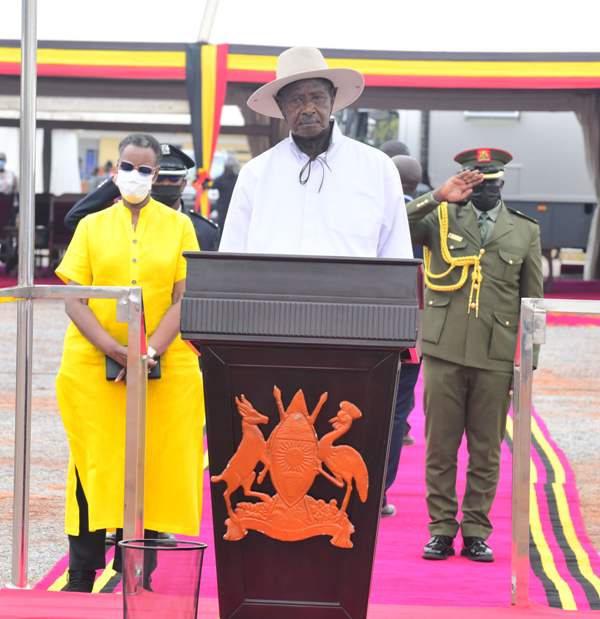
The President made the remarks while commissioning the Greater Mubende Presidential Zonal Skilling Hub in Kibuye-Vuga Village, Kitenga Sub County, Mubende District on Wednesday, April 16 2025.

Museveni, who is in the region for his routine tour on wealth creation activities and the Parish Development Model (PDM), said despite policies for Universal Primary Education (UPE) and Universal Secondary Education (USE), as per the 1996 NRM manifesto, many schools still charge fees, which have become barriers, preventing full access to education, especially for learners from poor families.

“In the 1996 NRM manifesto, we proposed to introduce free education. However, you people here refused to implement that, and up to now, there are school charges in the primary and secondary schools.

But we knew that if you did that, you would exclude the children of the poor, and that’s what is happening. Because if you check even here, you can get me the figures of the children who finish Secondary Education. From Primary seven, how many continue up to senior six?” the President wondered.

“There are seven (7) years of primary school and there are 6 years in secondary school, but the figures I have for primary schools are 11 million children, and the ones in the secondary schools are 2 million, and yet the years are almost the same. So, what happened to the 9 million? It is the refusal to implement UPE and USE,” he added.

According to the President, he decided to start free education through the skilling hubs to show the public that free education is possible and can be very productive, based on the testimonies of the youths who are self-employed after acquiring skills.

“People who introduce charges in government schools may not go to heaven. Discuss amongst yourselves and agree to have free education in government schools,” the President said, adding that although his initiative of the regional skilling hubs is yielding results, it is costly compared to implementing free education for all children in government primary, secondary, and technical schools.

“That was deliberate and cost-effective to achieve universal education cheaply. But you find five (5) districts sharing this center, and the children are coming from far away. So, I need to accommodate them and feed them and all that. But the plan of UPE is for day schools. That means a primary school per parish and a government secondary school per sub county, where children come to study and go back home rather than being at school in boarding sections,” he noted.

The President further explained that this would then enable the government to concentrate on paying the teachers, building the classrooms, laboratories, building teachers’ houses, and providing textbooks to support all children in Uganda.

In the meantime, President Museveni promised to add more courses to the skilling hub, such as plumbing, motor mechanics, weaving, and textiles.

SON OF KAGUTA: Museveni’s contradictory politics, unfulfilled campaign promises, unfulfilled pledges

0

By Oweyegha Afunaduula

Ed Finn (2004) wrote that politicians lie to get elected. For them, as for no other profession, making grandiose promises they never intend to keep – and which most voters don’t expect to be kept – remains, inexplicably, a viable strategy for electoral success. He, however, gave six other reasons why politicians make grandiose promises they never intend to keep:

  1. They can get away with it. There is no means of holding them accountable for broken promises.
  2. There’s a good chance their lies will never be exposed.
  3. They are convinced (often by their own polling) that most voters “can’t handle the truth.”
  4. Even when exposed, their lies will continue to be believed by the people who want to believe them.
  5. They can often manufacture plausible excuses for breaking their promises.
  6. If all politicians are perceived as liars, why not vote for the ones who are most photogenic, most popular, most articulate, most entertaining? The politician’s best vote-getting attribute today is charisma, not veracity.

A combination or all of these reasons explain why, in the last 40 years of his rule, President Tibuhaburwa Museveni has made so many unfulfilled promises and pledges, which some people see instead as calculated political deceit.  Quite often unfulfilled promises and pledges are accompanied by a lot of contradictions and, hence,emerge as contradictory politics in the leadership and governance of Uganda. So, if there was Joseph Conrad’s contradictory politics in Germany (Armstrong, 1985), there is also Tibuhaburwa Museveni’s contradictory politics in Uganda. Contradictory politics is unavoidable where there are so many false promises and pledges. They are driven by political deceit for electoral advantage. Indeed, President Tibuhaburwa Museveni’s sustained instabilities, militarism and contradictions have shaped the political landscape of Uganda over the last 40 years. But we can also talk of the contradictory political philosophy of the National Resistance Movement, which being a personalist politico-military organisation, reduces to one person of power: President Tibuhaburwa Museveni. The very low tolerance for political diversity or pluralism (e.g. Mutingwende, 2024) by President Tibuhaburwa Museveni, and the accompanying arrogance of some politico-military leaders in the NRM, explain the current mutation of sociopolitical crisis waiting to explode into full-scale sociopolitical decay and collapse.

We have recently been treated to the contradictory positions on the 100 million Shillings secretly given by President Tibuhaburwa Museveni to Members of Parliament (MPs), with the President who gave the money on one side and the MPs who got the money on the other. The MPs denied getting the money, with the Deputy Speaker, Tayebwa, publicly maintained it was street talk,while the President confirmed giving out the money to the MPs, with reasons. There is a suggestion that some NRM MPs from Buganda had suggested to the President that if he wanted his quest to transfer the Coffee industry from the public to Enrica Pinetti and the Uganda Coffee Development Agency (UCDA) to the Ministry of Agriculture, Animal Husbandry and Fisheries, he would have to give each MP 50 million Shillings. There was also a theory that the President wanted the MPs to support his quest and determination to have the UPDF Act changed to legalise the committal of civilians to his military courts. So, he decided to give each MP 100 million Shillings, which was of course political bribery of the MPs.

All this the President did against a pile of unfulfilled pledges to various communities in all parts of the country (e.g., Daily Monitor, 2021, 2023).He has also been dishing out billions of shillings to individuals, ostensibly to spur development, but unfortunately most of the money has gone down the drain.A 2015 report indicated that the President had not delivered on 817 pledges to Ugandans, which would cost him more than Shs12.9 trillion (Daily Monitor,2023). The President has made the false promises and pledges, sometimes as the President and sometimes as an individual to endear himself to the NRM and to voters (Kibet, 2025). The false promises and pledges have grown into a mountainous burden for the President, thereby injuring hischaracter. However, the President does not seem to be ethically and morally bothered. Many critical analysts believe that dishing out money to individuals or to preferred firms at the expense of the development, transformation and progress of Ugandans, is an abuse of the citizens of Uganda and also an abuse of power.

While explaining, on 11 April 2025, the leaked dishing out of 100 million Shillings to each MPs, the President explained that he got the money from the Classified Account – an account created to enable the military to acquire equipment and carry out its work. He justified or linked the 100 million-Shilling vivid political bribe to security concerns (Daily Monitor, 2025). Such money is what I recently wrote about in my article “Uganda: Unethical money, immoral money is used to buy indigenes off their land”.

One school of thought wonders, if money can be got from the Classified Account to pay MPs in what appears to be political bribery, why can’t money be got from the same account to improve the quality of education, health and lives of Ugandans or provide free sanitary pads to all our school-going children instead of backtracking on this commitment, citing economic constraints, when money is being wasted to buy the conscience of MPs either to thank them for endorsing presidential choices or to woo them to support forthcoming presidential choices? Contradictory politics harms the nation.

Is it true that public money is, these days,easily used just to service the interests of the President at the cost of ethical and moral integrity in our country; that instead of allowing the MPs to represent the interests, issues, problems and concerns of the citizens, MPs are set against these to serve the interests of the President? Jacky Kemigisa, in her undated article “Unfulfilled Presidential Pledges: Who keeps the President Accountable?” in Parliament Watch was, therefore, right to ask “Who will keep the President accountable if the MPs are within his armpit through presidentially exchanging the conscience of the MPs for money (e.g., Oweyegha-Afunaduula, 2025).

Not long ago, I wrote articles under the titles “Military politics, democratic deception and democratic disguise in Uganda”, which Charmer News published on March 26 2025. At the centre of military politics, democratic deceit and democratic disguise in Uganda is President Tibuhaburwa Museveni; and “How Militarised Personalist Parties Undermine Democratisation: Uganda’s National Resistance Movement in Perspective”, also published by Charmar News on 18 March 2025.  Again, at the centre of the militarised personalist ruling organisation for 40 years in Uganda is President Tibuhaburwa Museveni, the perennial Chairman of the organisation.

I have been motivated to write this particular article by Gift Mwonzora’s “Too Good to Be True: Unfulfilled campaign promises, pledges and political Deceit in Zimbabwe”. Zimbabwe was under President Robert Mugabe’s personalist rule for 38 years.

In this article I want to write on President Tibuhaburwa Museveni’s numerous unfulfilled campaign promises, pledges and instances of political deceit, which is quick to hide by repeated references to and justifications of his bush wars against the Amin and Obote regimes.

President Tibuhaburwa Museveni has ruled Uganda uninterruptedly for 40 yearsand, therefore, presents a suitable case study not only in personalist power but also in unfulfilled campaign promises, pledges and political deceit.

Long ago, former President Apollo Milton Obote of Uganda told Ugandans and the world that President Tibuhaburwa Museveni (then called Yoweri Museveni) was “a consummate, pathological liar who told the truth only by accident”. He must have closely studied the character of the President, by then a less known quantity, since he worked in the President’s office as a research assistant. However, there is also a historical account narrated by the late Lt Robert Namiti (the lawyer) when back in 1977 when he was a student at the University ofDar-es-Salaam, where he was studying Law. I met him when he had just fled Makerere University after participating in astudent strike that claimed the life of Ssemwanga. I noticed that Lt Namitiwas very comfortable in the circles of Apollo Milton Obote and Julius Kambarage Nyerere of Tanzania. In fact, one day he took me to the official residence of Kambarage Nyerere and took me around as if he was residing there. Many people -both security and non-security – knew him.

Lt Namiti told me that through Apollo Milton Obote, President Nyerere advanced Tz Shs. 750,000/to Tibuhaburwa Museveni, then called Yoweri Museveni for the purpose of executing a guerilla war against President Idi Amin Dada in the early 1970s. According to the account Lt Namiti’s account, Yoweri Museveni was then positing himself as a Member of Apollo Milton Obote’s Uganda Peoples Congress (UPC) but had other plans. Lt Namit told me Yoweri Museveni had initially secretly started his own rebel group, which he named Front for National Liberation (FRONASA). According to Lt Namiti, Yoweri Museveni never accounted for the money to Julius Nyerere or Apollo Milton Obote, but instead used it to enhance the financial muscle of his rebel group. The failure to account, according to Lt Namiti, strained the relationship between Nyerere and Museveni on the one hand and Apollo Milton Obote on the other. Both Nyerere and Obote, according to Lt. Namiti, distrusted Museveni. Although I was in Tanzania from 1972 to 1980, I never got an opportunity to confirm Namiti’s account. However, ifit was true, it meant that Yoweri Museveni was a deceitful politician in the making.

In his article, Gift Mwonzora (2023) shows how politicians use campaign pledges and promises to hoodwink voters.  According to Gift Mwonzora, this is pronounced through false, fake and unfulfilled promises and misrepresentations. Many voters then fall for the lies, empty policy and programmatic promises by political candidates, thus falling vulnerable to deception by politicians. He submits that political deceit goes contrary to the dictates of democratic representation and participatory democracy. It is, therefore, critical in the process of de-democratising a country.

 One thing is true.False, fake political campaign promises injure the political reputation of the one that parades them (Aragonès and Palfrey, 2007).

Explanations of parties’ use of strategic ambiguity are usually framed in terms of voters’ prospective evaluations of parties. If used wisely, ambiguity can enable parties to appeal more broadly to voters (Ntounias, Schneider and Thomson (2024).In countries that are highly exposed to globalisation, governing parties face significant challenges to fulfilling the promises they made to voters. At the same time, voters punish governing parties that fail to keep their campaign promises (Ntounias, Schneider and Thomson, 2024). However, in quasi-military regimes exercising elections, the rulers will often employ political buying, vote stealing and brute force to curl voters into submission to their rule and avoid calls for accountability. Or else apart from political promises, they shamelessly employ lies, damn lies to voters to glue them themselves while not providing social goods and services and diverting money to other useless ventures, including buying political support of some key members in the opposition parties.

As the Daily Monitor records, has not left behind the numerous false promises and pledges to be buried in the past. Let me just list a few unfilled promises-cum-pledges the President of Uganda, the Fountain of Honour, has made over the last 40 years.

  1. Tarmacking Jinja-Mbulamuti Road in Busoga
  2. Busoga University
  3. Public Sugar Processing Factory in Busoga
  4. Unfulfilled promises in Bukedi
  5. Unfulfilled pledges in Kisoro, includingconstructing John Kale Institute of Science and Technology 
  6. Unfulfilled pledges in Kabarole, including compensation of families affected by Allied Democratic Forces.
  7. Unfulfilled pledges in Kasese, includingupgrading Kasese Airfield to an international airport, revamping Kilembe Mines and Katwe Salt Factory, and addressing the land issues in the district.
  8. Unfulfilled pledges, particularly the tarmacking of the Muhanga-Kisizi Road. 
  9. Unfulfilled pledges in Tororo
  10. Unfulfilled pledges in Bunyangabu District
  11. Unfulfilled Promises in Arua, West Nile, includingMuseveni’s Shs350m Pledge to a SACCO made 7 Years ago.

The list is long. However, I should mention that the President at least fulfilled his promise of providing 36 motorcycles for Ghetto structures (PPU, 2024). Otherwise, we may remember the President most as the ruler of Uganda who consistently and persistently created archives of unfulfilled promises and pledges throughout the country.

While on a visit to Tororo in January 2019, however, the President told his then Minister in the President’s Office, Ester Mbayo, thus: “I know my kattala (responsibilities). You don’t have to waste time reminding me. If you total up of the kilometres we have tarmacked, they are much more than what is remaining. I have all of them in my head. So don’t waste your time reading”. He may be right but they are in their hundreds, or thousands, and time is not on his side. He has yet to implement the airports in Kanungu, Kidepo and Masindi, and to upgrade the Jinja Airport. The Standard Gauge Railway awaits to be constructed. Even the traditional schools await rehabilitation (Ochieng, 2024), which the Presidentpromised in his 2024 State of the Nation address. Unfulfilled promises and pledges undermine democratisation and delivery of services, thereby reducing public trust and confidence in the President and government. To confront the declining trust and confidence the president and the government are likely to divert money from development to buying political support to sustain the falsehood that the President and government are still popular.

For God and My Country.

Further Reading

Andrew Cohen Amvesi (2025). Museveni Unfulfilled Promise. WestNile Online, February 24 2025.https://westnileonline.com/tag/museveni-unfulfilled-promises/ Visited on 13 April 2025.

Daily Monitor (2013).  Museveni’s Unfulfilled Pledges. Daily Monitor, November 13 2013https://www.monitor.co.ug/uganda/news/national/museveni-s-unfulfilled-pledges-1558292 Visited on 12 April 2025 at 12:02 pm EAT.

Daily Monitor (2025). Museveni breaks Silence on MPs’ Cash Bonanza. Daily Monitor, April 11 2025https://www.monitor.co.ug/uganda/news/national/museveni-breaks-silence-on-shs100m-mps-cash-bonanza-4999152 Visited on 12 April 2025 at 11:49 am EAT.

Davi Ochieng (2024). Unfulfilled Presidential Pledges Leave Traditional Schools in Dilemma. Nile Post, May 18 2024 https://nilepost.co.ug/education/200300/unfulfilled-presidential-pledges-leave-traditional-schools-in-dilemma Visited on 13 2025 at 13:04 pm EAT

Ed Finn (2004). February 2004: Lies, Damn Lies and Political promises. Canadian Centre for Policy Alternatives. February 1, 2004https://www.policyalternatives.ca/news-research/february-2004-lies-damn-lies-and-political-promises/Visited on 12 April 2025 at 10:49 am EAT.

Enriqueta Aragonès and Thomas Palfrey (2007). Political Reputations and Campaign Promises, Journal of the European Economic Association June 2007 5(4):846–884 https://www.iae.csic.es/investigatorsMaterial/a9167111438archivoPdf67375.pdf Visited on 12 April 2025 at 20:06 pm EAT.

Glencross, A. (2017). The Contradictory Political Philosophy of Brexit. Political Insight8(1), 26-29. https://doi.org/10.1177/2041905817702735 (Original work published 2017).

Hakim Kanyere (2025). Museveni Repeats Old Pledges During Busoga Visit, Leaving Major Issues Unresolved. Nile Post, January 27 2025.https://nilepost.co.ug/news/239472/museveni-repeats-old-pledges-during-busoga-visit-leaving-major-issues-unresolved Visited on 13 April 2025 at 11:26 am EAT.

Isaac Imaka (2016). Uganda: Museveni recycling Pledges to woo Voters, says Analyst. The Monitor, 5 January 2016 https://allafrica.com/stories/201601050474.html Visited on 13 April 2025 at 12:04 pm EAT.

Kemigisa, Jacky (?). Unfulfilled Presidential Pledges: Who Keeps the President Accountable? Parliament Watch, https://parliamentwatch.ug/blogs/unfulfilled-presidential-pledges-who-keeps-the-president-accountable/ Visited on 13 April 2025 at 11>03 am EAT.

Kibet, Daniel (2025). 25 Years of Unfulfilled Pledges: The Plight of Teriet Ndorobos. Daily Monitor, April 9 2025.https://www.monitor.co.ug/uganda/news/national/25-years-of-unfulfilled-pledges-the-plight-of-teriet-ndorobos-4995530#story Visited on 12 April 2025 at 12:07 pm EAT

mavengano estherand mhute isaac (2024). Sub-Saharan Political Cultures of Deceit in Language, Literature, and the Media, Volume II: Across National Contexts. HOEPLI.it Published, 12 2024https://www.hoepli.it/libro/sub-saharan-political-cultures-of-deceit-in-language-literature-and-the-media-volume-ii/9783031428852.html Visited on 12 April 2025 at 20:02 pm EAT.

Mutingwende, Andrew (2024). Contradictory Politics and the Mutation of Crisis in Postcolonial Zimbabwean Urban Clean-Up Campaign. Researchgate, June 2024https://www.researchgate.net/publication/381501172_Contradictory_Politics_and_the_Mutation_of_Crisis_in_the_Postcolonial_Zimbabwean_Urban_Clean-up_Campaign Visited on 12 April 2025 at 11:34 am EAT.

Mwonzora, G. (2023). ‘Too Good to be True’: Unfulfilled Campaign Promises, Pledges, and Political Deceit in Zimbabwe. In: Mavengano, E., Mhute, I. (eds) Sub-Saharan Political Cultures of Deceit in Language, Literature, and the Media, Volume II. Palgrave Macmillan, Cham. https://doi.org/10.1007/978-3-031-42883-8_21

Mwonzora, G. (2023). ‘Too Good to be True’: Unfulfilled Campaign Promises, Pledges, and Political Deceit in Zimbabwe.  Researchgate,  December 2023, https://www.researchgate.net/publication/376464272_’Too_Good_to_be_True’_Unfulfilled_Campaign_Promises_Pledges_and_Political_Deceit_in_Zimbabwe Visited on 11 April 2025 at 1951 pm EAT

Oweyegha-Afunaduula (2025). Military politics, democratic deception and democratic disguise in Uganda. Charmar News, March 26 2025. https://charmarnews.com/military-politics-democratic-deception-and-democratic-disguise-in-uganda/ Visited on 11 April 2025 at 14:17 pm EAT.

Oweyegha-Afunaduula (2025). How Militarised Personalist Parties Undermine Democratisation: Uganda’s National Resistance Movement in Perspective. Charmar News, March 18 2025. https://charmarnews.com/how-militarised-personalist-parties-undermine-democratisation-ugandas-national-resistance-movement-in-perspective/ Visited on 11 April 2024 at 14:03 pm EAT

Paul B. Armstrong (1985). Conrad’s Contradictory Politics: The Ontology of Society in Nostromo (Winner of the 1985 TCL Prize in Literary Criticism). Twentieth Century Literature Vol, pp. 1-21 (22 pages)Published By: Duke University Press.

PPU (2024). President Museveni fulfills Pledge of 36 Motorcycles to Ghetto structures. State House, September 4, 2024,https://statehouse.go.ug/president-museveni-fulfils-pledge-of-36-motorcycles-to-ghetto-structures/ Visted on 13 April 2025 at 12:38 pm EAT.

Prisca Wanyenya (2025). Govt breaks pledge on Free Sanitary Pads. Parliament Watch, Match 7 2025 https://parliamentwatch.ug/news-amp-updates/govt-breaks-pledge-on-free-sanitary-pads/ Visited on 13 April 2025 at 12:22 pm EAT.

Rick KleinAveri Harper, and Alisa Wiersema (2021). Instabilities and Contradictions Shape political Landscapes. ABC News, December 10 2021 https://abcnews.go.com/Politics/instabilities-contradictions-shape-political-landscape-note/story?id=81657507 Visited on 12 April 2025 at 11:24 am EAT.

The Observer Team (2019). Museveni raps Tororo Leaders Over Unfulfilled Pledges. The Observer, January 27 2019https://observer.ug/news/museveni-raps-tororo-leaders-over-unfulfilled-pledges/ Visited on 13 April 2025 at 11>55 am EAT.

Theodoros Ntounias, Christina J. Schneider, and Robert Thomson (2024). Campaign Promises, Political Ambiguity, and Globalization. IGCC Working Paper No 7. escholarship.org/uc/item/0050h951https://ucigcc.org/wp-content/uploads/2024/10/2024_wp7_ntounias-schneider-thomson_v2-FINAL-1.pdf Visited on 11 April 2025 at 20:14 pm EAT.


USED AND DUMPED: Salaamu Musumba tips youths in Kamuli to use their youthful energy to be productive and self-made instead of dancing to the tunes of politicians

0

Youths in Kamuli have been cautioned against politicking because they will be used and dumped by politicians; instead, they should use their youthful energy to productively build themselves up so that they stand alone as self-made persons who value work and discipline.

This counsel was delivered by former Bugabula South Member of Parliament Proscovia Salaamu Musumba while meeting with the Magogo Sub County Youth Brigade, who paid a courtesy visit to her home in Namwendwa, Kamuli District, on Tuesday, 15th April, 2025. She encouraged the youth to live exemplary lives.  

“Reset your mindset to food security and income generation and invest your energy and resources in personal health and incomes because development is not in politics but in your mind. I have lost more than five times but continue to live better because I reset my mind to home, food, and eating healthy,” Salaamu assured the youth after touring her multiple food and health security model projects.

Salaamu regretted that despite being endowed with land, Busoga remains food insecure and the youth spend most of their time talking politics and waiting for the “season” of elections. She said the youths are misused to fight other people’s personal wars, yet they are given peanuts. She added that because they fear taking risks, the youths wait for handouts from politicians.

“My change point was when I was the district council chairman. I used to receive people crying and begging for something to buy food. Buying food—imagine! I started a local food farm on my two-acre courtyard. It now has everything my body wants.

If Uganda got, God forbid, into chaos, I could be locked in here for two months without getting out to look for food but remain healthy because all the food, fruits, and local medicine are here in the Shalom Salaam Food Security Project,” she assured and inspired.

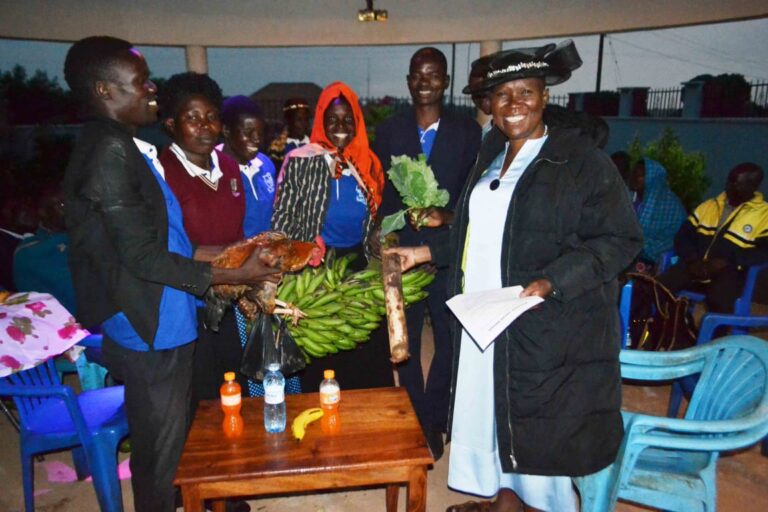
She also showed them her prized coffee plant, whose mother stock was two coffee seeds she brought from Pakistan.  

Godfrey Isota, the youth team leader, said their association, founded in March 2024 with only 30 members targeting Emyooga, now has over 100 members. He said they were inspired by radio talk shows about social change. Today, he says, they can attest that it is not politics but hands-on work through which one can survive.

The youth said that they have always been misfiring by asking for balls from politicians. Now, they are going to start small, localised projects for development.

Salaamu gifted her guests with startup packages containing the Pakistani coffee seedlings, local medicine trees, vegetable seeds, and pesticides.