


By: Bakinyumya Douglas Paapa
The temporary shutdown of Nation Media Group (NMG) Uganda has reopened one of the most fundamental debates in Uganda’s democratic journey: Can democracy survive where the press operates under fear?
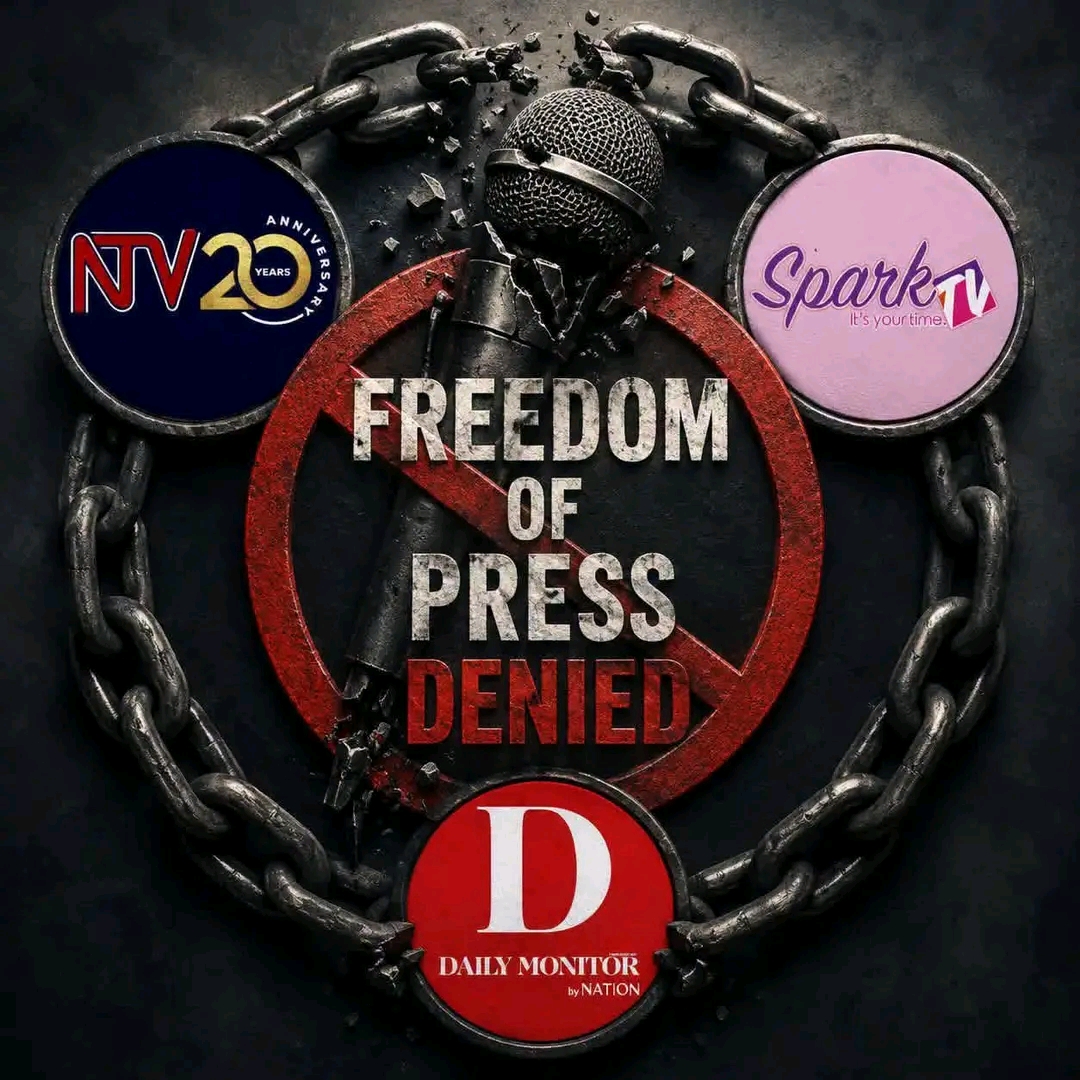
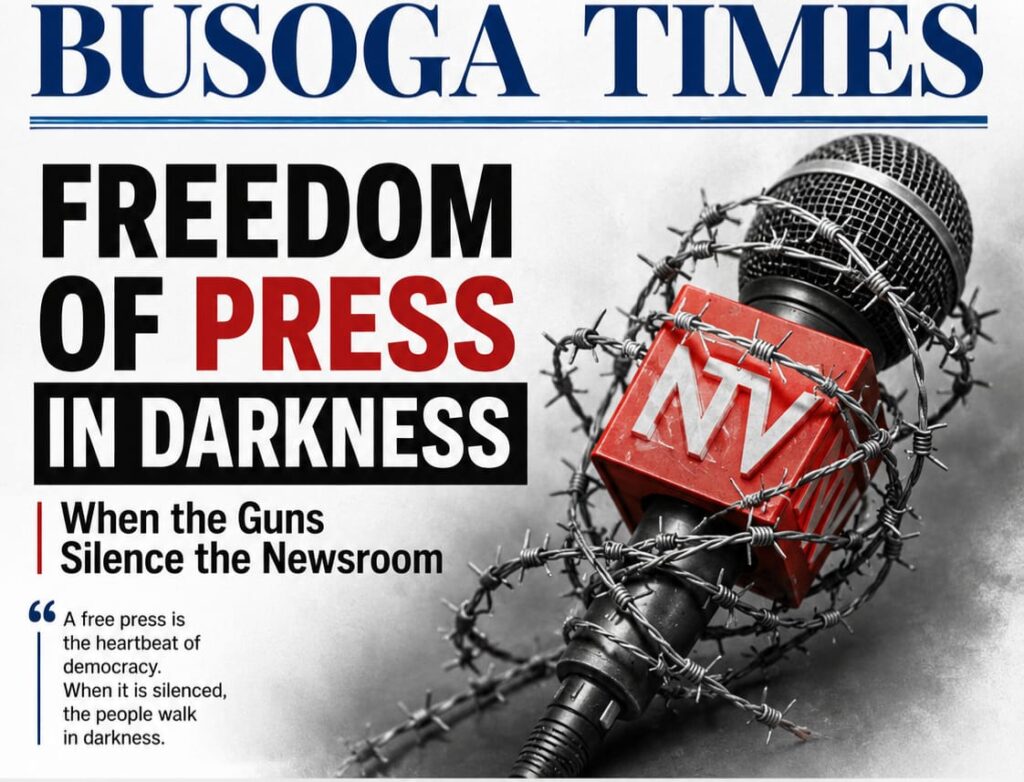
The military deployment to the premises of Daily Monitor, NTV Uganda, Spark TV, KFM, Dembe FM and other Nation Media Group outlets has become one of the most consequential media incidents in recent years. Regardless of the reasons advanced by authorities, the images of armed personnel surrounding newsrooms have raised profound questions about constitutional freedoms, the limits of military authority, and the future of independent journalism in Uganda.
The incident reportedly followed a series of public statements on social media by the Chief of Defence Forces, Gen. Muhoozi Kainerugaba, in which he announced that Daily Monitor and NTV Uganda would be shut down and asserted that he possessed the authority to close any media house in Uganda. Shortly afterwards, security personnel were deployed to Nation Media Group facilities, interrupting broadcasts and limiting newsroom operations.
Whether those statements directly constituted the legal basis for the operation remains unclear. By the time public concern intensified, neither the Uganda People’s Defence Forces (UPDF) nor other relevant government institutions had publicly outlined the legal framework upon which the shutdown was conducted. That silence has generated widespread legal and constitutional debate.
Uganda’s Constitution guarantees freedom of expression, freedom of the media, and the public’s right to receive information. While these freedoms may be regulated under laws enacted by Parliament, constitutional democracies require that any limitation be exercised through due process, lawful authority, and judicial accountability—not uncertainty or executive discretion alone.
This is precisely why the Nation Media Group incident extends far beyond one newsroom. It touches the very foundation upon which democratic governance rests.
An independent press is not an enemy of the state. It is one of democracy’s essential institutions. Journalists investigate corruption, scrutinize public expenditure, amplify citizens’ voices, and hold leaders accountable. When newsrooms are intimidated, the immediate casualty is not merely journalismit is the public’s constitutional right to know.
Uganda has experienced periodic confrontations between security agencies and sections of the independent media over the years, particularly during politically sensitive periods. Reporters have faced arrests, accreditation suspensions, confiscation of equipment, and restrictions while covering opposition activities. However, the deployment of armed security personnel to one of the country’s largest private media organisations represents a significant escalation that inevitably attracts both domestic and international attention.
Supporters of stronger regulation argue that national security must remain paramount and that irresponsible journalism should attract lawful consequences. Indeed, every democracy recognises limits where public safety or national security is genuinely threatened. Yet such actions must always be transparent, lawful, proportionate, and subject to independent oversight. Otherwise, legitimate regulation risks being perceived as political intimidation.
The timing of this development is equally significant. Uganda is gradually entering another electoral cycle, a period during which access to independent information becomes indispensable. Elections are not judged solely by the casting of ballots but also by whether citizens are free to receive diverse information, hear competing viewpoints, and evaluate those seeking public office without fear or censorship.

History demonstrates that where the press is weakened, democratic accountability weakens with it. Citizens become less informed, public institutions become less scrutinised, and rumours often replace verified facts.
The unanswered questions remain numerous.
What legal authority authorised the military deployment? Was due process followed? Were civilian regulatory institutions involved? Will the affected media houses seek judicial redress? Will Parliament exercise its oversight responsibility over the incident?
These are questions that deserve clear answers—not only for journalists but for every Ugandan who values constitutional governance.
Inconclusion: Democracy Needs Independent Journalism.
\The true measure of a democratic society is not how it treats media organisations that praise government, but how it responds to those that ask difficult questions.
A confident government should welcome scrutiny because accountability strengthens public trust rather than weakens it. Likewise, the media carries an equally important responsibility to report accurately, ethically, and responsibly.
As Uganda reflects on this latest chapter, one truth remains undeniable: a nation where journalists fear entering the newsroom cannot fully claim to enjoy the freedoms guaranteed by its Constitution.
The debate is therefore much bigger than Nation Media Group. It is about the future of constitutionalism, democratic accountability, and whether Uganda’s commitment to press freedom will remain a living principleor become words confined to the pages of the Constitution.
By: Bakinyumya Douglas Paapa – (Political TV Producer & Host – @BDouglasPaapa)



All that is so because we are trying democracy which is not ours.
Imagine trying to “run an Android software on iphone” at no point will it function accordingly. What was the type/system of leadership before colonial/democracy times?
And how were the communities being administered /led….