


Uganda has registered gradual improvements in education, household welfare, financial inclusion and agricultural transformation over the last three years, although challenges such as unemployment, persistent poverty and limited access to extension services continue to affect many households.
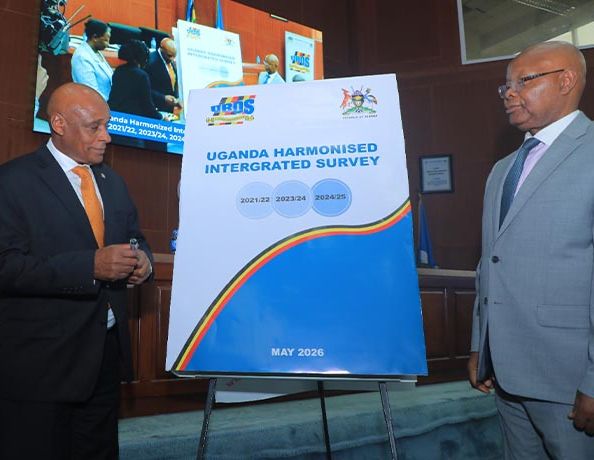
These are some of the key findings contained in the Uganda Harmonized Integrated Survey (UHIS) 2021/22, 2023/24 and 2024/25 released by the Uganda Bureau of Statistics in Kampala on Wednesday.
The survey, which tracks households across multiple years, provides insights into changing socio-economic conditions and welfare trends in Uganda.According to the report, Uganda’s education sector recorded some of the strongest gains during the survey period.
School attendance among children aged six to 12 years increased from 85.5 percent in 2021/22 to 94.6 percent in 2024/25, while literacy among persons aged 10 years and above rose from 73.6 percent to 85.3 percent.
The report also showed significant improvements in rural literacy, which increased from 67.8 percent to 83.2 percent, narrowing the gap with urban areas.
Despite the improvements, learner retention remained a challenge at higher education levels, especially in secondary school where only 41.5 percent of learners who were in Senior Four in 2021/22 remained in school by 2024/25.
The labour force findings pointed to a gradual shift away from subsistence agriculture toward wage employment and services.
Non-farm wage employment among persons aged 15 years and above increased from 14.9 percent in 2021/22 to 19.7 percent in 2024/25, while the proportion engaged in subsistence work declined from 30.4 percent to 25.8 percent.
Employment in agriculture, forestry and fishing also dropped from 61.6 percent to 53.3 percent over the three-year period, while services sector employment expanded from 29.5 percent to 36.5 percent.However, unemployment rose slightly from 10.2 percent to 11 percent nationally.
The survey further revealed improvements in household living conditions.Access to improved drinking water sources within one kilometre increased from 70.2 percent in 2021/22 to 78.4 percent in 2024/25.
Grid electricity access also improved from 25.3 percent to 29.5 percent nationally, although major disparities between rural and urban households persisted.
The use of clean cooking fuel and technology remained low despite slight growth from 1 percent to 2.1 percent over the survey period.Financial inclusion recorded notable progress, particularly through mobile money services.
Access to mobile money among persons aged 15 years and above increased sharply from 34.4 percent in 2021/22 to 47.7 percent in 2024/25.
Banking access also improved modestly, with access to bank services rising from 10.7 percent to 13.4 percent, while ownership of active bank accounts increased from 6 percent to 8.1 percent.
However, access to credit declined during the survey years. Persons obtaining cash credit reduced from 15.3 percent to 13.4 percent, while those accessing credit in kind declined from 16.1 percent to 14.1 percent.The survey additionally highlighted the growing role of household enterprises in supporting livelihoods.
The proportion of households operating enterprises increased from 36.9 percent in 2021/22 to 38.8 percent in 2024/25, with urban households recording higher participation levels than rural households.
Agriculture remained central to Uganda’s economy and household survival, with 63.9 percent of households engaged in agricultural activities in 2024/25.
The report showed increasing cultivation of cash and food security crops such as coffee, cassava and bananas.
Coffee-growing households increased from 27.5 percent to 32.2 percent, while cassava cultivation rose from 46.2 percent to 51.3 percent.Fertiliser use also increased from 34.8 percent to 41.1 percent, suggesting growing adoption of modern farming practices.
However, access to agricultural extension services remained limited. Only 11.9 percent of agricultural households accessed extension services in 2024/25, while 75.2 percent reported receiving no extension support across all three survey years.
On poverty dynamics, the survey revealed that 57.2 percent of households were never poor throughout the three survey years.
At the same time, 8.9 percent remained chronically poor, while 14.5 percent of households slipped into poverty during the survey period.Another 9.7 percent managed to move out of poverty, highlighting the unstable and fluid nature of household welfare in Uganda.
UBOS said the harmonized survey is intended to support evidence-based planning, policy formulation and monitoring of Uganda’s socio-economic transformation under the country’s national development agenda.