


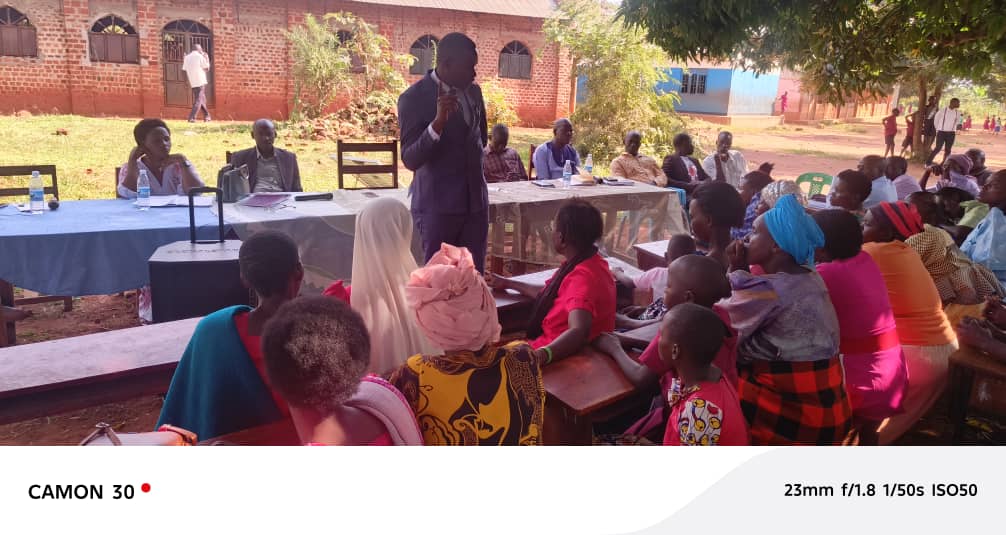
Buyende District is grappling with a growing ghost pupil crisis, with the Resident District Commissioner (RDC), Paul Mwidu Kalikwani, warning that inflated enrolment figures have become a widespread practice in some government-aided schools.
Speaking during a parents’ engagement meeting at Wandago Primary School in Ndalike Parish aimed at improving academic performance, Kalikwani said preliminary findings indicate that some headteachers are deliberately inflating pupil numbers to attract larger government capitation grants.
Without revealing the extent of the problem across the district, the RDC described the practice as unacceptable and pledged to investigate schools suspected of manipulating enrolment records.
“My office has ascertained that this has become a common practice in some schools, where headteachers deliberately inflate pupil numbers to attract bigger capitation grants. This is ridiculous and unacceptable,” Kalikwani said.
He noted that enrolment figures reported by some schools do not correspond with the actual number of learners attending classes, raising concerns over the accountability of public education funds.
To establish the scale of the problem, Kalikwani announced plans to conduct a comprehensive audit of school enrolment records and government funding received.
“This is an issue I will audit to the dot and ascertain the total funding received and the corresponding number of pupils,” he said.
Wandago Primary School Under Spotlight
The concerns came into sharper focus at Wandago Primary School, where Headteacher Mande Frank Ronald disclosed a significant discrepancy between the school’s official register and the actual number of pupils.
According to Mande, official records indicate that the school has 1,236 pupils, yet the current physical enrolment stands at only 635 learners.”The official register currently indicates a total of 1,236 pupils, whereas the actual count stands at 635, a discrepancy that I find perplexing,” he said.
The headteacher also revealed that he has inherited serious financial challenges following his appointment.
He said the School Management Committee directed him to pay Shs4 million to his predecessor to clear outstanding debts, leaving the school struggling to meet its operational expenses despite government capitation grants reportedly having been released for two terms.
“I am currently operating the school on a borrowing basis. Information from the Education Department confirms that payments for the two terms have already been processed, yet I have been in this situation for the past four weeks,” Mande said.
He further alleged that his predecessor established a private school adjacent to Wandago Primary School, which he believes may have influenced the inflated enrolment figures previously reported.
“I suspect that the school adjacent to ours served as a significant influence in attracting pupils to this school, and following his transfer there was a marked and rapid decline in enrolment,” he said.
The Chairperson of the School Management Committee, Yoweri Ibanda, backed the headteacher’s claims, confirming that the current enrolment does not match the figures contained in the school’s official records.
RDC Orders Accountability
Kalikwani cautioned school administrators against treating public schools as personal property and stressed that outgoing headteachers must properly hand over both assets and liabilities to their successors.
“Cease treating educational institutions as personal properties. It is imperative to transfer both liabilities and assets to the incoming headteacher to ensure proper accountability,” he said.
He vowed to pursue the matter until all missing funds are accounted for and, where necessary, recovered.”I will pursue this matter to the dot and ensure that any funds improperly handled are returned to the school’s account,” the RDC said.
National Challenge
The developments in Buyende mirror a long-standing national problem that has cost Uganda billions of shillings in misallocated education funding.
According to estimates by the Ministry of Finance, ghost pupils cost taxpayers approximately US$11 million (about Shs41 billion) annually through inflated capitation grants.
In response to the challenge, the Ministry of Education and Sports introduced an enhanced Education Management Information System (EMIS) in 2022 to improve learner registration, strengthen education planning and eliminate ghost learners.
However, the persistence of enrolment discrepancies in some schools suggests that gaps in implementation remain.
Education stakeholders say stronger audits, improved digital learner registration and greater accountability among school administrators will be critical in eliminating the ghost pupil phenomenon and ensuring that public education funds reach the learners they are intended to serve.