


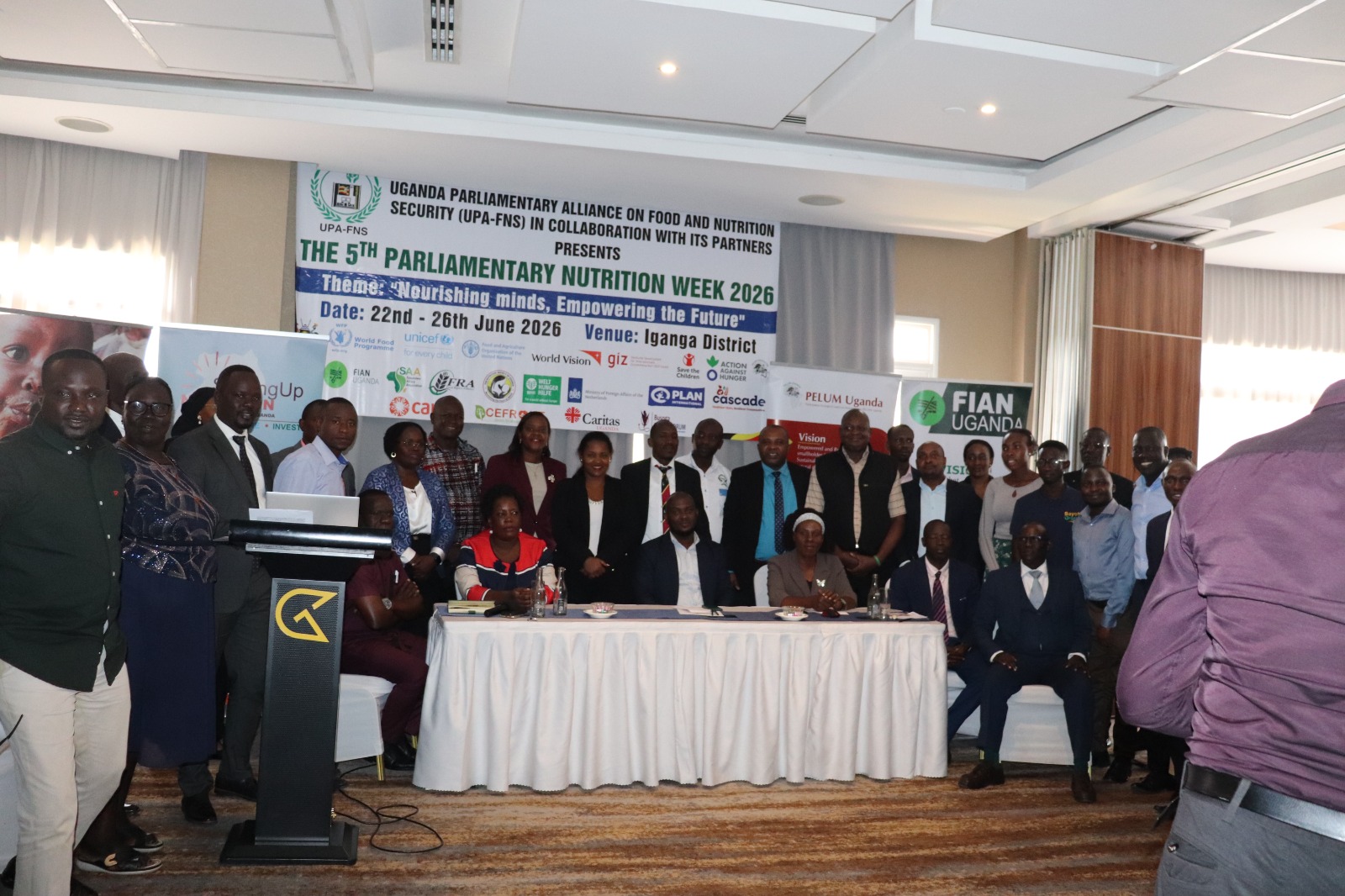
Iganga District has been selected to host the 5th Parliamentary Nutrition Week 2026, an annual national campaign aimed at strengthening efforts to combat malnutrition and improve food and nutrition security across Uganda.
The week-long event, scheduled to take place from June 22 to 26, 2026 at Nakalama Primary School in Iganga District, will be commemorated under the theme: “Nourishing the Minds, Empowering the Future.”
The event is being organized by the Uganda Parliamentary Alliance on Food and Nutrition Security (UPA-FNS) in partnership with several Civil Society Organizations including PELUM Uganda, FIAN Uganda, Action Against Hunger, Food Rights Alliance, Caritas Uganda, ESAFF Uganda, World Vision and the Uganda Nutrition Society, among others.
The launch of the Parliamentary Nutrition Week was held on Friday, May 22, 2026 at Golden Tulip Hotel in Kampala and attracted Members of Parliament, development partners, civil society actors, representatives from Ministries, Departments and Agencies (MDAs), Chief Administrative Officers from Kamwenge, Moroto and Iganga districts, as well as members of the media.
Speaking during the launch, Bukooli Islands Member of Parliament and Chairperson of UPA-FNS, Hon. Peter Okeyo, warned that Uganda risks undermining its future if urgent action is not taken to improve child nutrition and school feeding systems.
“A hungry child cannot concentrate in class. A malnourished learner cannot fully achieve their potential. And a nation that neglects the nutrition of its children compromises its future and human capital,” Mr Okeyo said.
He emphasized that school feeding should be viewed as a strategic investment in education, health and national development because well-fed learners perform better academically and are healthier.
Mr Okeyo also expressed concern over the paradox of persistent hunger and malnutrition in a country endowed with fertile soils and favorable agricultural conditions.“Uganda is naturally blessed. Much of our land is arable land. One part of the country produces a lot of food and another part of the country is struggling,” he noted.
According to recent nutrition data, about 26 percent of children under five in Uganda are stunted due to chronic malnutrition, while nearly two million children are affected nationwide. The situation remains particularly severe in vulnerable regions such as Karamoja and parts of Eastern Uganda.
In Busoga sub-region, where Iganga is located, malnutrition indicators remain worrying despite the region’s agricultural potential. Studies indicate that only 17 percent of children in Busoga receive the minimum acceptable diet, while anemia among children aged 6 to 59 months stands at 67.4 percent — far above the national average. Executive Director of Food Rights Alliance, Agnes Kirabo, described malnutrition as a national emergency that requires urgent and coordinated interventions.
“The Global Hunger Index of 2025 categorised the hunger situation of our country as serious,” Ms Kirabo said. She added that chronic malnutrition continues to deny millions of Ugandan children the opportunity to reach their full potential. “Twenty-six percent of our children shall never live to their full potential because of stunting. That is the national average,” she explained.
Ms Kirabo also raised concern about the growing burden of obesity and poor feeding practices, especially in urban areas. “If you look at places like Kampala, statistics are telling us that close to 50 percent of women are obese,” she said.She criticized the absence of structured school feeding systems in many schools across the country.
“We are opening schools next week to pump content into our children that are going to spend the whole day at school without a meal,” she added.Officials from the Ministry of Health Uganda noted that Uganda is increasingly facing a double burden of communicable and non-communicable diseases linked to poor nutrition and unhealthy diets.
Speaking on behalf of the Ministry, Harriet Nakigozi said government is strengthening nutrition systems through improved screening, nutrition research, training and regulation of food additives and manufacturers.
“We are a double burdened country. We are still struggling with communicable diseases and at the same time non-communicable diseases,” Ms Nakigozi said.Meanwhile, Iganga District Chief Administrative Officer Mr. Kagimu welcomed the decision to host the Parliamentary Nutrition Week, describing it as an opportunity for Busoga to showcase local efforts in promoting nutrition, school feeding and community health interventions.
Mr. Kagimu pledged the district’s commitment to work closely with Parliament, civil society organizations and development partners to ensure the success of the event and strengthen implementation of nutrition-related commitments in the region.The Parliamentary Nutrition Week was first launched by UPA-FNS in 2022 at Parliament of Uganda as an annual platform for raising awareness, sharing knowledge and mobilizing action on food and nutrition security. The initiative has since expanded beyond Kampala to regional engagements aimed at increasing grassroots impact.
The 2024 Parliamentary Nutrition Week was held in the Western Uganda districts of Kamwenge, Buliisa, Kikuube, Fort Portal, Kyegegwa and Kyenjojo, while the 2025 edition took place in the Karamoja sub-region covering Moroto, Napak, Nabilatuk, Amudat, Kotido, Nakapiripirit, Kabong and Abim districts.
Organizers say the 2026 edition in Iganga will focus on strengthening school feeding programs, promoting nutrition-sensitive agriculture, mobilizing political leadership, and enhancing accountability in addressing malnutrition across Uganda.