Thursday, May 21, 2026
Home Blog Page 2

12TH PARLIAMENT LEADERSHIP: Political winds shift in parliament race as PLU retracts endorsement of Among and Tayebwa, Muhoozi now backs Oboth-Oboth

0

The Chief of Defence Forces, Gen. Muhoozi Kainerugaba, has publicly endorsed Jacob Oboth-Oboth for the position of Speaker of Parliament for the 2026–2031 term, declaring that there is “no Speakership battle” within the ruling establishment.

In comments posted on his X platform, Gen. Muhoozi said the decision on the next Speaker had already been made and described Oboth-Oboth as the best minister in government over the last five years.

“There is no Speakership battle. Our God Jesus Christ won that battle a long time ago. We already have our new Speaker. Supported by UPDF,” Gen. Muhoozi wrote.

“We have already made our decision on the new Speaker (a man). Men were born to lead. That’s the natural order of things,” he added.

The army chief further stated: “He has been the best Minister in our government for the past 5 years. I want to be the first to endorse him for Speaker of Parliament (2026-2031). God bless Hon. Oboth-Oboth!”

Gen. Muhoozi also commented on Deputy Speaker Thomas Tayebwa, describing him as “a very good man” and his “younger brother.”

“Hon. Tayebwa is a very good man. He is my younger brother. He has no problems. He is protected!” he posted.

The remarks come at a politically sensitive time following a recent shift in position by the Patriotic League of Uganda (PLU), a political platform associated with Gen. Muhoozi.

In a statement dated May 12, 2026, and signed by the PLU General Secretary, David Kabanda, the organisation announced that it had withdrawn its earlier endorsement of Anita Annet Among and Thomas Tayebwa for the positions of Speaker and Deputy Speaker of the 12th Parliament.

The statement noted that the directive issued on March 11, 2026, had been “retracted and withdrawn with immediate effect.”

Gen. Muhoozi’s latest comments are expected to intensify political debate surrounding the leadership of the next Parliament, particularly within the ruling National Resistance Movement and allied political groups ahead of the 2026–2031 parliamentary term.

FREE MEDICAL SERVICES: Rotary, Busoga Kingdom and dfcu Bank unite to improve community with major health camp in Busoga

0

The Second Deputy Prime Minister of the Busoga Kingdom, Owek. Alhaji Osman Ahmed Noor, has applauded dfcu Bank for demonstrating commitment to community service beyond profit-making as the bank marked its 62nd anniversary with the launch of a major health camp in Walukuba, Jinja.

Representing His Majesty the Kyabazinga of Busoga at the dfcu Humanity Day event, Owek. Osman praised the bank for dedicating its anniversary celebrations to humanity, health, and community wellbeing.

He highlighted the launch of the joint dfcu Bank–Rotary Uganda Health Camp, which offered free medical services including sickle cell screening, diabetes testing, malaria diagnosis and treatment, dental care, eye care, and general medical consultations.

The initiative builds on previous collaborative efforts by dfcu Bank and its partners that have already benefited more than 21,700 Ugandans, including support for over 2,500 surgeries and 22 life-saving heart procedures.

Owek. Osman said the health camp aligns with the Kyabazinga’s vision that “health comes before everything else,” aimed at building a healthy, productive, and self-reliant Busoga.

He urged residents to take advantage of health camps whenever they are organised, embrace early testing, and adopt preventive healthcare practices.

“Health is foundational to the prosperity of our kingdom,” he said.

The Busoga Kingdom official also invited dfcu Bank to widen its partnership with the kingdom beyond health initiatives to include youth skilling, women empowerment, education, agriculture, and efforts to combat teenage pregnancies.

Speaking at the event, Kate Kiiza, who represented the bank’s Chief Executive Officer, reiterated dfcu Bank’s belief that strong communities are key to sustainable growth.

She noted that the health camp successfully reached its target of serving more than 2,000 people with essential health services that are often inaccessible because of cost and long distances to health facilities.

“We are deeply appreciative of the support and partnership of the Busoga Kingdom,” Kiiza said, commending the kingdom for its mobilisation efforts and leadership on social issues.

She also thanked Rotary Uganda for its longstanding partnership with the bank in health, education, and community development programmes.

Kiiza revealed that dfcu Bank had allocated Shs1 billion towards humanitarian activities in partnership with Busoga Kingdom and Rotary Uganda to support communities across the Busoga sub-region.

She further disclosed that the bank plans to organise 17 health camps across the country as part of activities to celebrate its 62nd anniversary, with the Jinja health camp marking the official launch of the nationwide campaign.

After her remarks, Kiiza introduced dfcu Bank staff members to guests who attended the event.

Meanwhile, the District Governor of Rotary District 9213, Geoffrey Martin Kitakule, expressed gratitude to dfcu Bank and the Busoga Kingdom for the partnership.

He echoed the Kyabazinga’s message on the importance of health, saying that without a healthy population, there can be no strong kingdom.

Kitakule reaffirmed Rotary’s commitment to working with partners to improve livelihoods and transform communities across the region.

The event concluded with the official declaration of dfcu Humanity Day and the opening of the Walukuba Health Camp.

The function was attended by Busoga Kingdom ministers including Owek. Babirye Yudaya, members of the royal family, royal chiefs led by Samuel Zirabamuzale Nkuutu, government officials, health professionals, and Rotarians.

The health camp ended after serving more than 2,000 people.

The collaboration highlights growing partnerships between the private sector, cultural institutions, and humanitarian organisations in addressing healthcare challenges and promoting socio-economic development in Busoga.

THRIVING PRIVATE SECTOR: Harshad Barot, chairman of Tirupati Group, hails Museveni’s visionary and transformational leadership at 7th swearing-in ceremony

0

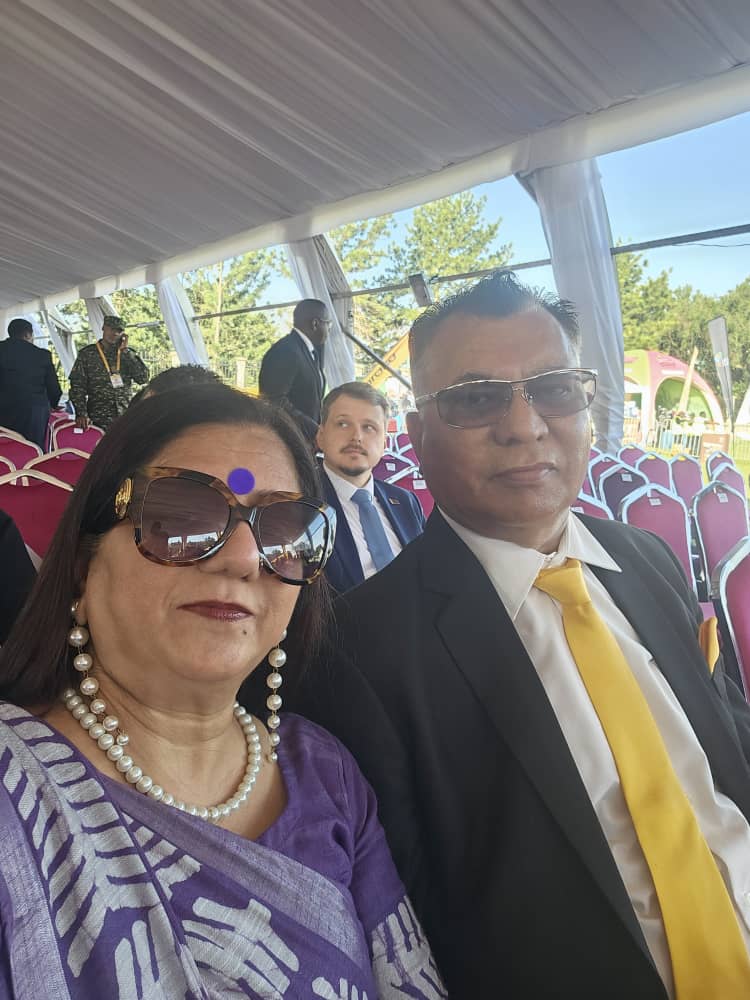
The Chairman of Tirupati Group Ltd, Mr. Harshad Barot, accompanied by his wife Mrs. Poonam Barot, attended the swearing-in ceremony of President Yoweri Kaguta Museveni at Kololo Ceremonial Ground in Kampala on 12th May 2026, on the invitation of State House. The event marked President Museveni’s historic 7th term in office, a milestone celebrated by various dignitaries including over 40 heads of state and government from across the world.

On the sidelines of the ceremony, Mr. and Mrs. Barot took the opportunity to reflect on Uganda’s remarkable journey under President Museveni’s leadership, acknowledging the pivotal role the President has played in turning around Uganda’s economy over the past four decades. Mr. Barot noted that the peace and security ushered in by President Museveni in 1986 has been the critical springboard for the country’s private sector and the broader economy. Speaking to the media at the event, Mr Barot said: “President Museveni’s leadership has created stability, and stability is the foundation upon which businesses grow, investments flourish, and families prosper.”

Mr. Barot further emphasised that good governance by President Museveni has not only attracted investment to Uganda but has ensured that both local and international investments are sustained over the long term. “A strong economy is built on peace, infrastructure, and confidence in the future. President Museveni’s leadership has enabled entrepreneurs and investors to dream bigger and achieve more. Witnessing President Museveni’s 7th swearing-in is a testament to a leader who has remained steadfast in his commitment to Uganda’s progress. This is not just a moment for celebration, it is a moment of confidence for every investor in this country,” Mr Barot said. He added that President Museveni has given Uganda direction, and that direction has created opportunity for all in the private sector.  

Under Mr. Barot’s leadership, Tirupati Group Ltd has grown into one of Uganda’s foremost property development and construction companies. Operating across both the private and public sectors, Tirupati delivers world-class commercial shopping malls, residential apartments, warehouses, business parks, housing estates, and industrial parks.  “The economic foundation President Museveni has built gives every entrepreneur the confidence to invest, to expand, and to dream bigger for Uganda. President Museveni has created an environment where local investors are not just welcomed — they are empowered. That is the mark of a visionary leader,” Mr Barot noted.   

Mr. Barot also praised the collaborative spirit between Uganda’s public and private sectors, noting that this partnership has been central to the country’s economic success:

“The private sector in Uganda has flourished because we have a President who understands that a strong economy is built on the shoulders of strong businesses. President Museveni has always seen the private sector as a partner, not just a participant. That partnership has made all the difference for businesses like ours. When leadership is consistent and purposeful, investment follows naturally. Uganda is living proof of that truth.” Mr Barot acknowledged.   

BURNT TO ASHES: Police probe suspected mob justice killing of two men in Kamuli

0

Police in Kamuli District have launched investigations into a suspected case of mob justice that left two unidentified men dead in Bulopa Sub-county.

According to authorities, the bodies were discovered in a swamp along the Nagwenyi–Bulopa Road in Bukabare Zone, Nagwenyi Parish, following a report received at Bulopa Police Station at around 3:00am on Monday.

The report was made by a local leader who alerted police after the discovery of two bodies lying near a burnt motorcycle, registration number UFT 817V, and a male goat tied nearby.

Preliminary findings indicate that the deceased were intercepted by an unknown group of individuals believed to have been moving on motorcycles from the direction of Bagaza Zone. Police suspect that the victims were accused of stealing a goat before they were attacked and killed.

The Territorial Police in Kamuli have described the incident as a suspected murder by mob action and say efforts are underway to establish the identities of the deceased and the suspects involved.

Busoga North Police spokesperson, SP Samson Lubega, strongly condemned acts of mob justice, warning communities against taking the law into their own hands.

He urged members of the public to instead report suspects to the nearest police station for proper investigation and lawful handling of cases.

Police said investigations are ongoing to trace those involved in the killing and establish the full circumstances surrounding the incident.

SOVEREIGNTY BILL: Busoga expresses dissatisfaction

0

A cross-section of stakeholders from the business community, civil society organizations, boda boda riders and local residents across the Busoga sub-region convened on Monday at Bax Hotel in Jinja City, their shared concern clear: Uganda’s proposed Protection of Sovereignty Bill, 2026 is stirring unease, confusion, and sharp divisions.

The consultative meeting, organized by the First African Bicycle Information Organization (FABIO), aimed to gather grassroots perspectives on the contentious legislation. But as discussions unfolded, it became evident that while some see the bill as necessary, many fear its potential consequences on livelihoods, governance, and civil liberties.

At the heart of the debate lies a central question: Who qualifies as a “foreign agent,” and at what cost?

Deborah Mutesi Magezi, one of the participants, voiced concern over what she described as excessive powers granted to the Minister of Internal Affairs under the proposed law. She warned that such authority could open doors to abuse and corruption.

“We need our Members of Parliament to come on the ground and consult us about this bill,” Mutesi said. “We have seen them do it on other laws. Why not this one?”

Her concerns were echoed in different forms across the room, particularly around the speed at which the bill is reportedly being pushed through legislative processes.

For Paul Ssenabulya, a businessman in Jinja, the bill is not entirely unwelcome—but its current form raises red flags. “We need this law,” he admitted, “but some sections and clauses must be reviewed.”

Ssenabulya questioned the urgency surrounding the bill, suggesting that the pace could indicate hidden interests. “It makes you feel that some individuals are interested in it,” he said. “People need enough time to understand and interpret it.”

His concerns are also personal. Like many Ugandans in a globalized economy, Ssenabulya works for employers based outside the country. “If the bill is passed into law, I will definitely become a foreign agent. How fair can that be?” he asked.

This fear of broad classification was a recurring theme during the discussions.

Priscilla Atana, representing Women’s Peace International, argued that the bill risks labeling a vast majority of Ugandans as foreign agents due to the country’s reliance on external support.

“Almost every Ugandan shall be a foreign agent in one way or another,” Atana said. “The majority of Ugandans are living on foreign aid.”

She pointed to churches, schools, and hospitals, many of which depend on international funding, as examples of institutions that could be affected.

However, not all voices were critical.

George Mubiru, the Assistant Resident City Commissioner for Jinja, defended the intent of the bill, framing it as a long-overdue effort to reduce Uganda’s dependency on foreign influence.

“This is not a one-time practice,” Mubiru explained. “It is a step-by-step exercise.”

He further alleged that Western countries have historically exploited Uganda through resource extraction and by funding political actors to destabilize the government—a claim often cited by proponents of tighter controls on foreign involvement.

Yet critics argue that the bill could have unintended economic consequences.

Wilwer Kibwakikaire, a local politician affiliated with the People’s Front for Freedom (PPF), warned that the legislation could cripple the non-governmental organization (NGO) sector, a major source of employment in the country.

“The government has created unemployment with this bill by eliminating NGOs which have provided jobs to many Ugandans,” he said.

He also questioned the bill’s framing of “foreigners,” noting the deep connections many Ugandans maintain with relatives abroad. “We have our brothers and sisters outside the country. Why call them foreign?” he asked.

FABIO Executive Director Joy Kawanguzi, whose organization facilitated the dialogue, raised both legal and practical concerns about the bill’s structure and implications.

She cautioned that the proposed law risks blurring the line between citizens and foreigners in an increasingly interconnected world.

“Many Ugandans travel in and out of the country every day,” Kawanguzi said. “If this bill is passed, it may turn Ugandans into foreigners.”

Kawanguzi emphasized the need for clarity in defining key terms within the legislation, particularly “foreigner,” warning that vague definitions could lead to misinterpretation and misuse.

She also questioned the necessity of introducing a new law when existing frameworks already regulate foreign funding. These include the Anti-Money Laundering Act, the Non-Governmental Organizations Act, and oversight by the Financial Intelligence Authority.

“Instead of creating a new law, amendments could be made to strengthen the existing ones,” she suggested.

Beyond legal concerns, Kawanguzi highlighted the financial realities facing civil society organizations, many of which operate on billion-shilling budgets funded largely through international partnerships.

“Capping foreign aid could severely limit their operations,” she noted.

The Protection of Sovereignty Bill, 2026 seeks to tighten state control over foreign influence by requiring individuals and organizations deemed to be acting on behalf of foreign interests to register as “agents of foreigners,” declare funding sources, and comply with strict regulations. It also proposes limits on foreign funding and penalties for activities considered to interfere with national policies, governance, or electoral processes.

As the meeting concluded, one thing was clear: the bill has ignited a critical national conversation, one that pits concerns over national independence against fears of economic disruption and shrinking civic space.

For many in Busoga, the call is not outright rejection, but deeper consultation. Whether Parliament will heed these voices remains to be seen.


Crested Crane Award: Barot’s Honour Sparks Pride Among Indian-Ugandan Community with Bhambhatt Samaj Honours

0

The Bhambhatt Samaj Uganda held a special celebratory gathering this week in honor of community member Shri Harshad Maganbhai Barot, following his receipt of the Crested Crane Grand Officer Award, one of Uganda’s most distinguished civilian honors, conferred by President Yoweri Kaguta Museveni.

The event drew members of the Bhambhatt community alongside business leaders and well-wishers who gathered to mark the occasion. Speaking on behalf of the family, Miraj Harshad Barot offered heartfelt thanks to the Samaj for its warmth and recognition.

“This award is a reflection of the values our community stands for integrity, and hard work. My father arrived in Uganda in 1993, and we are proud to call Uganda home. This honor belongs to every Ugandan of Indian origin who has contributed to this great nation.” Miraj Harshad Barot, son of the honoree

The Samaj leadership was widely praised for bringing the event to life. Special recognition went to Sachin Brahmbhatt, Chairman of Bhambhatt Samaj Uganda, as well as to Nitesh Brahmbhatt and Nilesh Brahmbhatt, whose organizational efforts ensured a memorable and meaningful occasion.

Shri Harshad Barot’s recognition underscores the growing role of Uganda’s Indian community in the nation’s civic and economic life, and serves as a point of pride for a diaspora that has called Uganda home for generations.

POSITIVE BREAKTHROUGH: How new HIV prevention drug lenacapavir works and why it could change Uganda’s fight against infections

0

Uganda’s introduction of lenacapavir, a breakthrough HIV prevention drug, signals more than just the arrival of a new medicine. Health experts say it represents a fundamental shift in how HIV can be prevented, particularly among high-risk populations.

The long-acting injectable, developed by Gilead Sciences and delivered through a partnership between the United States and the Global Fund, is being rolled out under the leadership of the Ministry of Health.

A different way of stopping HIVUnlike traditional HIV prevention pills that must be taken daily, lenacapavir works by targeting a critical stage in the HIV life cycle. It blocks the virus from replicating inside the body by interfering with the protective “capsid” shell that HIV needs to survive and multiply.

By disrupting this process early, the drug prevents the virus from establishing infection in the body—even if exposure occurs.

Medical researchers describe this as a major scientific advancement because it attacks HIV in a way that is different from most existing prevention drugs, offering a powerful new line of defence.

Twice-a-year protection

One of lenacapavir’s most distinctive features is how it is administered. Instead of daily pills, the drug is given as an injection just twice a year, roughly every six months.

This long-acting formulation allows the medicine to remain in the body at protective levels over an extended period, steadily working to block infection without the need for frequent dosing.

For many users, especially those who struggle to maintain daily medication routines, this could significantly improve adherence and overall protection.

“It removes the burden of remembering to take a pill every day,” a health official involved in the rollout explained. “That alone can make a huge difference in real-world effectiveness.”

Simple but structured delivery

The administration of lenacapavir follows a structured clinical process. Individuals first undergo HIV testing to confirm they are HIV-negative before receiving the injection.

Once cleared, the injection is administered by trained health workers, typically in a clinical setting. Follow-up visits are scheduled every six months for the next dose, along with routine monitoring and support.

Health officials say the simplicity of this schedule makes it easier to integrate into existing health services, including maternal care and youth-friendly clinics.

Why it matters for Uganda

Uganda continues to record nearly 37,000 new HIV infections annually, with adolescent girls, young women, and mothers among the most affected groups.

Experts believe lenacapavir could be particularly effective in these populations, offering discreet, long-term protection without the stigma or logistical challenges associated with daily medication.

Its high efficacy, over 99 percent in clinical trials, means it has the potential to dramatically reduce new infections if widely adopted.

Expanding access

Under the current rollout plan, Uganda is expected to receive enough doses to cover about 46,000 people in 2026, with expansion planned in subsequent years.

The broader global initiative aims to reach up to 3 million people by 2028, with Gilead Sciences supplying the drug at cost and supporting the production of more affordable generic versions.

Not a standalone solution

Despite its promise, health experts caution that lenacapavir is not a replacement for other HIV prevention strategies.

Testing, education, condom use, and treatment programmes remain essential components of the overall response. Instead, the new drug is expected to complement these efforts, adding a powerful tool to the prevention toolkit.

A shift in prevention strategy

As Uganda begins rolling out lenacapavir, the focus will be on ensuring access, awareness and consistent follow-up care.If successfully implemented, the twice-yearly injection could redefine HIV prevention, making it simpler, more effective and more accessible, and bring Uganda closer to its goal of ending HIV as a public health threat by 2030.

ORDER vs SURVIVAL: Here are the advantages and minimal disadvantages of trade order implementation

0

By Baluye Michael Waiswa

Efforts to enforce trade order in Uganda’s urban centres are increasingly shaping debate among policymakers, traders, and the public, as authorities seek to balance urban planning with economic survival.

Trade order implementation is largely aimed at regulating street vending and informal business activities. It is a pathway to cleaner and more organised towns. This trade order has come with it’s advantages which i present in this article.

Improved cleanliness of cities and towns

Enforcing structured trade systems has immediate visible benefits. Among them is improved cleanliness and order in cities and towns, as unregulated street vending is reduced and congestion eased.

Organizing trade activities helps reduce street congestion, littering, and unregulated vending, making urban areas cleaner and more orderly.

This contributes to better mobility, sanitation, and overall aesthetics, particularly in fast-growing towns where informal trade often spills onto roads and walkways.

Encouragement of new construction

Increased demand for formal business spaces leads to the construction of shops, markets, and commercial buildings.

The policy also appears to be reviving dormant commercial spaces. As traders are pushed into designated markets and shops, landlords benefit from increased occupancy of previously vacant premises.

This shift is further stimulating investment in infrastructure, with rising demand for formal trading spaces encouraging construction of new shops, arcades and markets.

Disadvantages of Trade Order Implementation.

Despite these benefits, the policy has sparked discontent among sections of the public—especially small-scale traders who rely on informal spaces for survival.

Many argue that enforcement measures, including evictions and confiscations, often lead to loss of stock and income, pushing vulnerable households into financial distress.

Critics say the abrupt nature of some enforcement operations undermines trust in authorities and fuels resistance.

Some members of the community become unhappy with authorities implementing the policy, especially if it disrupts their livelihoods.

Revenue and compliance challenges

Local governments may also face unintended consequences. While formalisation is expected to improve long-term tax compliance, the transition period can result in reduced revenue as displaced traders drop out of the system altogether.

Pundits note that informal traders often contribute through small daily fees, which may be lost if they are unable or unwilling to transition into formal business setups.

Need for awareness and gradual transitionSocial commentary emphasise that sensitisation will be critical to the success of trade order policies.

Educating traders about existing laws, such as the Trade (Licensing) Act, could help bridge the gap between enforcement and compliance.

They argue that a gradual and well-communicated transition, rather than abrupt crackdowns, would allow traders to adapt and relocate without severe economic disruption.

A “conventional exit” strategy, where affected traders are supported to move into formal spaces, has been proposed as a more sustainable approach.

Balancing order and livelihoods

Ultimately, the debate over trade order implementation reflects a broader policy dilemma: how to modernise urban centres without excluding those who depend on informal economies.

While the push for cleaner, more organised cities aligns with Uganda’s development ambitions, its success will depend on how inclusively the transition is managed.

For now, the challenge for authorities is clear, enforce order, but without leaving thousands of small traders behind.

HON.JOHN SSIMBWA TO DPP: All implicated officials Karamoja Mabati Scandal liable as per section 21A, Not only Nandutu

0

A fresh legal argument has emerged in the ongoing Karamoja iron sheets scandal, with former legislator Ssimbwa John calling for broader prosecutions of all implicated officials, rather than the selective application of charges.

In a detailed opinion, Ssimbwa, who moved amendments to the Anti-Corruption Act 2009 during the 9th Parliament, argues that the offence of “dealing in suspect property” should apply to all ministers and government officials who received iron sheets meant for vulnerable communities in Karamoja.

Questioning selective prosecution

The controversy stems from the decision by the Office of the Director of Public Prosecutions to charge some suspects under different provisions of the law, while prosecuting Agnes Nandutu specifically under Section 21A of the Anti-Corruption Act.

Ssimbwa contends that this approach risks creating unequal accountability in a scandal that has drawn widespread public scrutiny.

“I don’t see why the DPP decided to prosecute other suspects under different sections of the law and only prosecuted Hon. Nandutu under Section 21A,” he argues, insisting that the same legal threshold applies to all those who benefited.

The legal case: “dealing in suspect property”

At the centre of the debate is Section 21A, which criminalises possession or handling of property reasonably believed to have been unlawfully obtained.

According to Ssimbwa, the iron sheets—procured under a government relief programme for Karamoja—clearly qualify as “suspect property” once diverted from their intended beneficiaries.

He outlines key elements required for prosecution, including possession, knowledge (or reasonable suspicion), and lack of lawful justification.In his view, ministers and officials who received the iron sheets meet these criteria by virtue of their roles in government.

“They knew or should have known that the iron sheets were meant for Karamoja,” he states, arguing that public officials are held to a higher standard of awareness.

Burden of explanationThe former MP further argues that once possession of such property is established under suspicious circumstances, the burden shifts to the accused to provide a credible explanation.

Courts, he notes, often rely on circumstantial evidence in corruption cases, particularly where actions suggest awareness of wrongdoing.

He adds that “constructive knowledge”—where an individual is expected to know based on their position—can be sufficient to establish liability, even if direct knowledge is denied.

Call for fresh charges

Based on this interpretation, Ssimbwa is urging the DPP to revisit the case and bring additional charges under Section 21A against all implicated individuals.He maintains that doing so would promote fairness and reinforce the principle of equal accountability before the law.

“We believe the DPP should open fresh charges against those not charged under this section to ensure equal culpability,” he states.

Broader implications for anti-corruption fightThe analysis also revives debate over the enforcement of anti-corruption laws in Uganda, particularly provisions introduced to strengthen asset recovery and deter illicit enrichment.

Ssimbwa notes that while amendments such as mandatory confiscation of illicit property were introduced, their full implementation has faced delays, limiting their impact.

Nonetheless, he argues that existing provisions—if consistently applied—are sufficient to hold public officials accountable.

A test for institutions

The Karamoja iron sheets scandal has become a litmus test for Uganda’s anti-corruption framework, raising questions about enforcement, political will and the consistency of prosecutions.

As legal interpretations continue to emerge, attention is now turning to how institutions such as the DPP will respond to calls for broader and more uniform application of the law.

For many observers, the outcome could shape public confidence in the country’s ability to tackle high-level corruption, and determine whether accountability extends to all, regardless of position.

LAND WRANGLES: Busoga University land dispute deepens as residents demand compensation

0

A land dispute involving Busoga University’s agricultural study centre in Kamuli District has intensified, with residents accusing authorities of forceful evictions without compensation.

The university, now a government-owned institution following its takeover from the Church of Uganda, operates a branch in Bukwenge, Northern Division of Kamuli Municipality. The campus sits on approximately 98 acres of land, covering nearly half of the village.

However, some residents who say they originally offered land for the university’s development claim they have never been compensated and are now facing eviction.

“We have occupied and maintained this land for over 40 years, but we have not yet been paid,” some of the affected residents said during a stakeholders’ meeting.

The meeting, held at the campus and led by Mafumo Adonai, sought to address the growing tensions. Mafumo directed that residents be given an opportunity—on designated days within a one-month period—to present their land claims to a university task force for verification and possible compensation.

He also instructed university security to allow residents to continue accessing and cultivating their gardens as the verification process progresses.

The Chairperson of the task force for the re-establishment of Busoga University as a public institution, John Tabuuti, urged claimants to present clear evidence of land ownership to facilitate an organized compensation plan.

Meanwhile, the LC3 Chairperson of Northern Division in Kamuli Municipality called for a transparent and peaceful process, emphasizing the need for thorough investigations into the land ownership claims.

Kamuli District Chairperson, Sarah Sambya, criticized the Church of Uganda, accusing it of misleading the government by claiming that bonafide occupants had been compensated.

She appealed to the government to ensure that all verified claimants who were not compensated receive due payment.

Other stakeholders present at the meeting included Mugarura Henry, Assistant RDC Rechae Bakaki, and Katwalo Mulungi.

The dispute highlights ongoing land ownership challenges surrounding public institutions, particularly where historical claims and compensation processes remain unresolved.