Friday, May 22, 2026
Home Blog Page 40

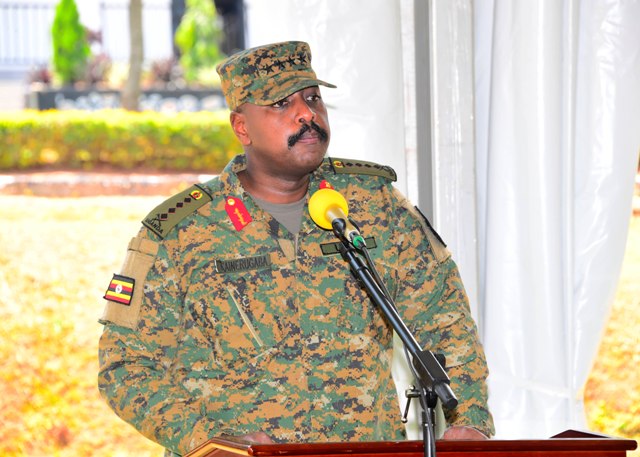
IMPORTANT QUESTION: Is Gen Muhoozi Kainerugaba the lodestar of anti-corruption leadership in Uganda?

0

By Oweyegha-Afunaduula

There is probably nobody in Uganda who has talked more about the evil of corruption that President Tibuhaburwa Museveni over the last 45 years.  For decades, he has portrayed himself as fierce opponent of corruption, vowing to eradicate the scourge from the fabric of Ugandan society (Nabakooza, 2024).  More than any other leader of Uganda, he has excelled in erecting institutions to combat corruption. In September 2024, Daily Monitor reported that the President was set to establish two new institutions to combat corruption (Onyango, 2024).

President Tibuhaburwa Museveni has condemned corruption at every opportunity (e.g The State House, 2024) although at one time he was reported in the media saying that corruption builds the economy,  and when his Inspector General of Government, Bettie Kamya, sought to use Lifestyle Audit – a method that was successful in erasing corruption in Singapore – he discouraged her by saying that it would compel the corrupt to invest their loot, which was government money, elsewhere instead of in Uganda. However, while addressing CID and DPP and ODPP officers, the President said that corruption is a big problem but easy to fight (The State House, 2024). When he recently showed that he wanted to extend his 40 year-rule by another 5 years beyond the 2026 elections, he evoked corruption as one of the key issues motivating him to do so (e.g., Kiiza, 2025).He said he aims to tackle Uganda’s endemic corruption, which has robbed the country of a fair share of its value (Kiiza, 2025). Pushing the scourge of corruption to the people, perhaps in an effort to shield the high-ranking thieves surrounding him whom he protected against Kamya’s Lifestyle Audit, he said:

“I have decided to come forward and see how to escort the Bazukulu and their parents forward for another five years, and in this time, I want us to really wipe out corruption. This corruption shouldn’t be there because you are in charge. Remember, when NRM came into government, it gave you power to elect people at all levels. Those people you elect should be your overseers in each area. Why do you allow corruption to happen? Why don’t you check to ensure that the health center is working well, the drugs are not stolen, and the PDM money that is sent to the parish is all delivered? This can be done because you have the power. You are the ones who elect LC 1, LC 2, and LC 3. Elect those who can do that on your behalf”.

Although in the past the President himself has used money to bribe people for political gain (which is an aspect of political corruption)he recently appealed to Ugandans to reject bribery ahead of the 2026 elections (The Independent, 2025).  There is a school of thought which now believes that the President is co-ruling Uganda with General Muhoozi Kainerugaba. 

According to the school of thought, the recent action by General Muhoozi-Kainerugaba to order the arrest of fake preachers on the streets of Kampala (Exclusive Bizz, 2025), which would necessarily be a Presidential Order, demonstrates that the General is co-ruler of Uganda with his father.

Although the term “bicameral leadership” refers to a legislative system where the law-making body is divided into two separate chambers, often referred to as houses, and aims to create a system of checks and balances, preventing any single group from wielding too much power, one may characterise the current leadership of Uganda by President Tibuhaburwa Museveni and his son as bicameral but still argue that Uganda is under the family rule of the First Family.

Apparently, General Muhoozi Kainerugaba, whoserise through the ranks of the army was fast-tracked bt the Commander-in-Chief of the Armed Forces,has been characterised by some critical thinkers and critical analysts as insidious political corruption of the army, is also simultaneously committed to erasing corruption in the army (e.g., Ashaba, 2024; Asiimwe, 2024; Katungulu, 2025; and Ocungi, 2024).

Dr David Namanya (2024), writing in the government Newspaper, New Vision, recognised General Muhoozi Kainerugaba as having been instrumental in combating corruption and graft in Uganda.

Timothy Kalyegira (2025) writing in Daily Monitor cited President Tibuhaburwa Museveni predicting that his [only] publicly known son, General Muhoozi Kainerugaba, would be tough on corruption.

Jordan Ddungu (2024), writing in The Independent, did not hesitate to characterise General Muhoozi Kainerugaba as alodestar of Anti-Corruption Leadership in Uganda. A dictionary definition of the word “lodestar” is “a star that is used to guide the course of a ship, especially the Pole Star”. Ddungu seemed to suggest that the President was already using the CDF to fight corruption in Ugasnda.

There is now no doubt that General Muhoozi Kainerugaba has been a fast-rising star in the military and in Uganda’s politico-military status quo. As I stated above, his rise in the army was fast-tracked by the President. Today he is not only the Chief of Defense Forces (CDF), but he also promotes or demotes other soldiers. And as noted above, he may order anything to take place, including arresting street preachers. The question is: Are all the emerging roles and actions of General Muhoozi Kainerugaba prearranged, incidental or coincidental?

If prearranged, then it was arranged or agreed upon in advance within the First Family, so that no one in the family can oppose or challenge it. If incidental or coincidental, time the best judge, will tell. However, as Liam Taylor (2022) noted, there is so muchMuhoozi Talk, which is intricately intertwined with the Future of Uganda. In fact, according to Liam Taylorthe Muhoozi Talk has been weaponised. In an interview broadcast on 17 October2022, and cited by Liam Taylor (2022),PresidentTibuhaburwa Museveni said that his son “should not and will not” tweet about partisan politics. The next day Kainerugaba tweeted that “I am an adult and NO ONE will ban me from anything”. Muhoozi talk has been weaponised. It could one day push the regime – and Uganda – to the brink (Liam Taylor, 2022).

To weaponise something is to use it in order to deliberately inflict harm on people for whatever gain or to whatever end. If you start pelting your brother with mangoes, he might accuse you of weaponising your fruit salad. When a group or government weaponise something, they take an ordinary object and turn it into a weapon.

From what I have written so far, and if we take it that the Muhoozi Talk has been weaponised, then there are two main targets of the weapon: the Opposition in Uganda and the Corrupt in government and the army.

The weapon has been enhanced by Parliament giving it the UPDF Act 2025, which can be used to target anyone. Th UPDF Act 2025 may be used by th CDF as a military head or as a politico-military. He owns a disguised political party called the Patriotic League of Uganda, which we now know is an offshoot of the National Resistance Movement (NRM). Some of its members hold important positions in the NRM government and in UPDF. General Muhoozi Kainerugaba himself is the CDF under whose powers and on whose orders some Ugandans have been either kidnapped or incarcerated and then released or not released, often showing signs of torture.

Politically, it is important to take note of a Tweet cited by Liam Taylor (2022) in his article “Muhoozi Talk and the Future of Uganda” in Democracy in Africa (DIA):

“In 2026 [the year of the next presidential election] it will be 40 years of the old people in charge. That will change. Those are instructions from Jesus Christ! Our generation will be in charge of this country.”

Before I come to the end of my article, let me address myself to the lingering question;

  1. Is General Muhoozi Kainerugaba the Lodestar of Anti-Corruption Leadership in Uganda” as Jordan Ddungu put it?
  2.  If so, will he be tough on corruption as President Tibuhaburwa Museveni assured Ugandans?
  3. Which corruption will General Muhoozi Kainerugaba be tough on: financial corruption, political corruption, ecological corruption, environmental corruption, moral corruption, spiritual corruption, executive corruption, legislative corruption, judicial corruption seed corruption, academic corruption or intellectual corruption, all of which are burdening Uganda?
  4. Can General Muhoozi Kainerugaba go it alone on corruption in Uganda?

General Muhoozi Kainerugaba – who once put his name to a book about the “tradition of manoeuvre” – is said to be using Twitter to wage a guerrilla war against the old guard. He is even retiring the old guard from the army. In June, 2022 amid friction between Kainerugaba and other generals, President Museveni called a meeting in which he ordered commanding officers not to comment on social media about security or foreign affairs. The first son has flouted that directive shamelessly (Liam Taylor, 2022). He is still using social media to propagate his views and influence politics and the military in Uganda as the CDF.

There is evidence that the CDF will not tolerate corruption, fraud and misappropriation in the army.A few days prior to my writing this article,Uganda was taken by storm when the powerful son of the President, General Muhoozi Kainerugaba, started to arrest some top soldiers in the Uganda Peoples Defense Forces (UPDF), on account of gross corruption. On 1st July, he announced that he had arrested Brigadier-General Cyrus Besigye Bekunda, Chief of Engineering, along with other officers from the Engineers Brigade, after serious allegations of corruption and financial mismanagement within the military’s Engineering Department.

Said General Muhoozi Kainerugaba, “Yesterday I ordered the arrest of Brigadier Bekunda and other officers of the Engineers Brigade. They poisoned, contaminated and desecrated a sacred principle we have always embraced as UPDF – that we can be self-sufficient and efficient. They received money and misused it. Let their punishment serve as a lesson to others”.

General Muhoozi Kainerugaba has been more forthright and aggressive against corruption [in the army]than his father who has spent most of his time as President promising to deal with the vice, or condemning it, but taken minimal action against it.

During a speech at the College of Logistics and Engineering (COLE) at Magamaga in February 2024 General Muhoozi Kainerugaba strongly spoke against corruption at the College. In his speech that focused on logistics and inventory management, he reminded his officers that misuse of resources directly affects the army’s ability to protect the country and care for its soldiers. He added, “Any individual or group wth selfish interests – whether corruption, misappropriation of resources, or mismanagement of any kind – must reform immediately or leave the cherished UPDF before they are exposed”.

There is no doubt that General Muhoozi Kainerugaba’s action on corrupt officers is a determined effort to restore public trustin the army and the integrity of the army, and inspire honesty, responsibility and accountability across all ranks of the army, all of which have been plummeting meteorically.  However, corruption has not only eaten up the army but it has alsoeaten up the entire ethico-moral fabric of the country.

Therefore, if General-Muhoozi Kainerugaba is to manifest as the true lodestar of anti-corruption leadership in Uganda, he will have to act beyond the realm of the army in order for his ant-corruption leadership to be felt in and influence all the sectors of the economy,or else confront all the different types or forms of corruption in the country. However, he cannot do so because even if he is co-ruling Uganda with his father, as the cited school of thought above claims, he is not the President of Uganda. The President of Uganda is Tibuhaburwa Museveni.  The President has the duty and obligation to provide leadership to combat corruption in all its different types and forms rather than pass the crusade over to the voters or to General Muhoozi Kainerugaba.  If the President says General Muhoozi Kainerugaba will be tough on corruption, it may suggest that he has failed to combat corruption, and that he has already given up the fight to the CDF who is not, and may not be President of Uganda, although anything is possible in the country .

For God and My Country.

Prof Oweyegha-Afunaduula is a Conservation-Biologist and member of Center for Critical Thinking and Alternative Analysis

ENDANGERED: the fate and future of public intellectuals- the case of Uganda

0

By Oweyegha-Afunaduula

When I was an academic many years ago, I was torn between advocating for thought leaders and think tanks on the one hand, and public intellectuals on the other.  The world was getting flooded by thought leaders and think tanks, which were greatly influenced by people strongly anchored mostly in the disciplinary fields of knowledge and practice and associated professions. Meanwhile both the intellectual and public intellectual were becoming endangered species and being squeezed out of the universities and from the public space in favour of thought leaders and think tanks. This freed politicians and/or policy makers from the need for critical thinking, critical analysis and alternative analyses as solutions to our complex problem (the so-called wicked problems). The solutions tended to be recycled from one place to another, and from one problem to another. There were frequent claims that those who sought the services of thought leaders and Think Tanks, or consultancies, also told them what kind of results or recommendations they expected. Therefore, the problems remained and became even more complex and intractable. Unfortunately, we continued to use the simple methods of the disciplines to address them.

In this article I argue that in this era of increasingly complex(wicked) problems, we need to de-emphasise reliance on thought leaders, consultancies and think tanks, all of which tend to have entrenched interests and to ally with power to maintain the status quo. I suggest that we need to resuscitate the intellectual in general and the public intellectual in particular, to keep decision-makers on their toes, and to continue articulating and clarifying issues for society. We need public intellectuals to be at the centre of political and social processes, let alone discourses of any kind, to make sense out of nonsense.

Let me start by discussing the key concepts in the article.

  1. Intellectuals

“A healthy culture accepts the affronts of its intellectuals, since it understands that evolving serious discriminations out of a nuanced description of a society demands attentiveness, passion, and lack of compromise”. – Barbara Mistzal, 2007.

_____________________________________________________________

Intellectuals are the lifeblood of society’s knowledge. They are the people who dedicate their lives to discovering big ideas, engaging in critical thinking, and making breakthroughs that push the boundaries of human intellect (Hassan, 2024). Intellectuals probe into the future and its unknowns, excavate the past and interrogate today’s big questions. However, there are two types of intellectuals: those working primarily within specialised academic or professional circles and public intellectuals striving to connect their findings with society (Hassan, 2024).

Pires (2009) referred to the various roles intellectuals have played in culture and society along the times and to the issue of the public intellectuals’ position in democratic societies in the twenty-first century and in the future.  She enquired if they still have authority and prerogatives and, if so, which are the sources of their intellectual power. Related to this, and as another reflection connected to the previous points, we have the issue of the nowadays so often referred “decline and fall” of public intellectuals and the fact that they have even been considered as “an endangered species” (e.g., Lanham, 2006).. Citing Richard Posner, the author of Public Intellectuals: A Study of Decline(2002), she submits that an intellectual “is a person who, drawing on his intellectual resources, addresses a broad public on issues with a political or ideological dimension”.

Desch (2016) defined public intellectuals broadly as ‘persons who exert a large influence in the contemporary society of their country through their thought, writing or speaking”

Chongyi Feng (2005) defined an intellectual as a specialist who creates and communicates symbolised knowledge as means of living, and hopefully intervenes in social and political affairs in the name of universal values, truth and justice.

Therefore, the intellectual is different from the politicians, the soldiers, the businessman and others who exercise political, financial, military and other forms of power other than intellectual power in their social function in a country or society (e.g, Chongyi Feng, 2005). When production and communication of knowledge are taken as the primary concern of an intellectual, “the death of concerned intellectual” becomes an unwarranted anxiety because there is no reason to believe that knowledge and truth will no longer be pursued and valued by humankind (Chongyi Feng, 2005). Chongyi Feng (2005) argued that marginalisation of “critical imagination”, where it is a reality, seems to be caused not so much by absence of power of intellectuals as by lack of solidarity among intellectuals to fight for a common cause. He further argued that the problem lies as much in the lack of enthusiasm among intellectuals to transcend the boundaries of their professional relevance and intervene in broader social and political issues. However, governments and institutions of higher learning have also been working to ensure that intellectuals deviate from their role of clarifying and articulating social and political issues to emphasising academic and career objectives so that politicians have a field day to do anything they want below the Sun without challenge.

Mintz (2022) argues that intellectual history matters because ideas matter. He takes the power of ideas and discourse seriously. What is worrying is that it is becoming more difficult to separate the good ideas from the bad. This is where public intellectuals are important, because they serve the function to analyse and critique influential and emerging ideas in the public forum (Oxbridge Applications, Undated; Hartle, 1988).

The death of the intellectual has left a void in the centre of public life. In place of thought, we have opinion; in place of argument, we have journalism; in place of polemic, we have personality profiles; in place of reputation, we have celebrity. In place of public forums for debate, we have nothing but academic conferences (Ignatieff, 1997). Zelinsky (2020) has called for a new sociology of intellectuals for the 20th and 21st Century. This is particularly important because the influence of digitally-oriented intellectuals and/or public intellectuals is rising supersonically.

  • Public Intellectuals

Public intellectuals are experts who are versed and trained enough to be able to comment on a wide range of public policy issues. The public intellectual serves a vital purpose in democratic discourse: exposing shibboleths masquerading as accepted wisdom. Public intellectuals are critics, and critiquing those who hawk bad policy wares is a necessary function in a democracy (Drezner, 2017) and in democracy building.Conversely, they are those academics, thinkers and writers who know a little bit about a great many things. They are willing to share their opinions on many aspects of our politics and our culture.

At worst, a public intellectual is a “second hand dealer in ideas” (Hayek, 1949), and at best a challenger of the conventional wisdom (Kim, 2017). Smith (2014) explored Hayek’s views on intellectuals, whom he called second-hand dealers in ideas. In Hayek’s context, the term “second-hand” does not disparage the intelligence, knowledge or importance of intellectuals. Intellectuals may be intelligent or stupid, wise or foolish, knowledgeable or ignorant, quick-​witted or dull, original or hackneyed. By “second-hand” Hayek means second in the order of the transmission of knowledge. Hayek’s intellectual is defined in terms of his social role in the dissemination of specialised knowledge to a wider audience; he is an “intermediary in the spreading of ideas.” (Smith, 2014).To put it another way, intellectuals, according to Hayek, are not the scholars or experts in a field but, instead, are the middlemen of ideas. Inhabiting diverse fields from journalism to medicine, they are familiar with a wide range of topics and have mastered the art of communicating them to the public. They write columns in newspapers and discuss current events on the radio and in town halls, salons, and businesses. They are respected in their own fields and are listened to when they discuss broad social issues. By virtue of their role as the middlemen of ideas, intellectuals determine which ideas reach, and are likely to be accepted by, the general public. (Hayek, 1949 cited by Stefanie Haeffele and Molly Harnish, 2019). Peters (2019) characterised Hayek as a classical liberal public intellectual.

An honest public intellectual will have lots to say about the future of higher education, but rather than offering a single definitive description of the postsecondary world of 2030, they may put forth a number of scenarios (Kim, 2017).

One thing is true and will remain true. Public intellectuals as they have traditionally been perceived, as individual scholars speaking truth to power, are a declining feature of public life globally.  Costa and Murphy (2020) have submitted that the future of Public Intellectuals lies in reforming the digital public sphere. They have argued that academia needs to further value and prioritise engagement with the digital public sphere and that beyond simply taking its forms and standards as a given, the future of public intellectualism rests on constructively improving this discourse for the benefit of the public as a whole. Besides, they argue thatthe question of the future of public intellectualism, is not just a question of repositioning the public intellectual, but also how we consider scholarship and the university itself.

In another article (Murphy and Costa, 2019), they argued that the concept of public intellectual needed reframing in the context of recasting academic scholarship in the era of digitality. They added that the digital public sphere a well-evidenced set of interventions from the academy. Noting that the ideals of digital scholarship are tampered with the realities and politics of academia, they suggest that public pedagogy needs to be directly aligned to the digital sphere as a space of intellectual engagement. They conclude that rise of the digitised public intellectual will march on, regardless of what the university does or does not do (Lange, 2015 cited by Murphy and Costa, 2019). It is also the case that the university itself as an institutional force is currently undergoing considerable change and is being reimagined in various ways (Barnett, 2013 cited by Murphy and Costa, 2019); Barnett, 2016 cited by Murphy and Costa, 2019) and Robertson, 2017) cited by Murphy and Costa, 2019). Nevertheless, existing in tandem with these developments is a still strong desire on the part of both publics and the academy to engage with ideas in the public (Murphy and Costa, 2019).

Mauro BasaureAlfredo Joignant and Rachel Théodore (2022) recognise the global digital public intellectual, the global digital stage and the role of both in shaping a new public intellectual. Korom (2014) stresses how spaces of opinion shaping the new public intellectual. In 2023 the Daily express recognised me as the second most influencial opinion writer in Uganda and, in the same year, Tell Media of Kenya recognised me as the most influential multigenre writer in East Africa. Both Daily Express and Tell Media are digital public media.  Writers are public intellectuals (e.g., Hawes, 2016; Heynders, 2016) just like philosophers are (Baert, 2016; Halwani, 2016; Weinberg, 2016)influencing minds.

The demand and desire for new forms of public intellectualism goes much further than calls for evidence-based policy and increased critical literacy. Instead, the responsibility is now on academia to re-imagine one of its core remits: connecting theory and practice. Strengthening and deepening this connection would go some way to helping ideas flourish and disseminate in the digital public sphere (Costa and Murphy (2020). This shift in focus and alignment would assist the university in its desire to encourage public engagement, an activity that this reconstituted public intellectualism is perfectly designed for (Costa and Murphy, 2020).

Currently, there are those, such as Alex Fergnani (2023) who thinkthat our public intellectuals are not responsibly informing the public about the future(s). Alex Fergnani (2023) says that public intellectuals should impartially discuss multiple images of the future to teach the public that the future is not predetermined. They should also meticulously examine the visions of the future they present, taking into account the emotional load they carry, in order to steer clear of fearmongering or excessive idealisation. Additionally, it is crucial for them to ensure that these visions are not influenced by fleeting trends and immediate events (Alex Fergnani, 2023).

We need public intellectuals now more than ever. While the importance of both intellectuals and public intellectuals cannot be either/or, as each plays a unique and necessary role, the public intellectuals in today’s world make a more visible impact on society (e.g., Hassan, 2024). However, Cummings (2016) and Lanham (2006have looked at the idea of the public intellectual, considering whether such thinkers are becoming an endangered species.

  • Thought Leaders

A thought leader is an individual or organization recognized as an expert and authority in a specific field, whose ideas and opinions influence others. They are often sought out for guidance and insights within their area of expertise, and they play a role in shaping discussions and trends. They can wield a lot of power on thought processes in various sectors of the economy. Thought leaders know one big thing and believe that their important idea will change the world (Drezner, 2017). They tend to be specialised, sometimes overspecialised.  only becomes known for something when one can successfully and confidently share one’s unique point of view and communicate clarity in one’s purpose. One’s audience, and success, will follow (Biderman-Gross, 2023)

Biderman-Gross (2023) has defined a Thought Leader asa person who is specialized in a given area and whom others in that industry turn to for guidance. As the term implies, a thought leader leads others in the thinking around a given topic(Biderman-Gross, 2023).A Thought Leader typically stands out among competitors (Biderman-Gross, 2023). However, being a thought leader is about more than profits or even industry status. It’s about being authentic and empowering. It’s about influence – getting other people to think differently about something specific. It’s much more than just generating content and commenting on world events and trends. Thought leaders bring alternate views and insightful points to the table (Biderman-Gross, 2023).

According to  Biderman-Gross (2023)anyone who aspires to become a thought leader in their industry should consider: Are you firm in your purpose and beliefs? Are you staying true to yourself? Are you willing to shout about and defend your purpose?

Being a thought leader means having a unique point of view and consistently living it. You must demonstrate strength and discipline in all your actions. You must have clarity about your purpose. That’s how you become known for something, productize it and even monetize it (Biderman-Gross, 2023). However, Aarts (2025) notes that Thought leaders have not always been called thought leaders. Today everyone is a thought leader because everyone has a platform. Says Daniel Monehin cited by Aarts (2025)’ “A few decades ago, if you were given a platform to share your thoughts or point of view, you were part of an elite group. Today, everyone has a platform”. 

Credit Internet, a whole new ecosystem has emerged for business and professional content -one in which almost anyone can be an expert (Aarts, 2025). If you have a good idea or a smart observation, there is now very little stopping you from sharing it with, quite literally, the entire working world (Daniel Monehin cited by Aarts, 2025). This digital democratization makes it much easier to hang out your shingle as a thought leader. The pool of people that can participate—and who can, therefore, share useful information with others—has grown exponentially.” If you have a good idea or a smart observation, there is now very little stopping you from sharing it with, quite literally, the entire working world (Daniel Monehin cited by Aarts, 2025). Gatekeeper are now gone (Aarts, 2025).

Winick (2025) has recently explained the difference between a Thought Leaders and Philosophers. Philosophers think deep thoughts about ideas. Thought leaders lead in converting an idea into reality. The ability to take your ideas, create content, and shape products that help others solve their toughest problems is at the heart of thought leadership – and so is market viability (Winick, 2025).

  • Think Tanks

The word ‘think tank’ stems from the RAND Corporation, which operated as a closed and secure environment for US strategic thinking after World War II. The term entered popular usage in the 1960s to describe a group of specialists who undertake intensive study of important policy issues (Stone, 2005).

UNDP (2003) cited by Stone (2005) defines think tanks as follows: … organizations engaged on a regular basis in research and advocacy on any matter related to public policy. They are the bridge between knowledge and power in modern democracies” (UNDP, 2003: 6). They practice what Diane Stone (2013) called Think Tank Thinking.

Think tanks are proliferating. Although they are outside of government, many of these policy research institutes are perceived to influence political thinking and public policy (Stone, 1997). As think tank numbers explode, they have become an integral part of political life. Political leaders, corporations and non-governmental organisations draw upon their expert advice to advance their causes in the battle of ideas (Stone and Denham,2004).

Think tanks go by many names: think tank, research centre, public policy research institute, idea factory, investigation centre, laboratory of ideas, policy research institute, and more. In other languages, the list is even longer: centro de pensamiento, groupe de réflexion, Denkfabrik, serbatoi di pensiero to name but a few (IFRI).

IFRI observes that Think Tanks find themselves at the crossroads of four spheres: political (including diplomatic and military dimensions), economic (corresponding to the action of companies with an international dimension and that of business circles), media (organizing around the flow of information and contributing to shaping opinions, mentalities and representations) and academic (the origin of the production of knowledge and partly structuring the dissemination of knowledge).

On a global scale, think tanks form a small industry, which is a sector of activity on its own. They are open organizations, built around a permanent base of researchers or experts, whose mission, on the one hand, is to develop analyses, summaries and ideas on an objective basis with a view to inform the conduct of private or public strategies in the general interest; on the other hand, to actively debate issues within their field of competence (IFRI).

According to the 2019 Think Tank State of the Sector (TTSS), which analyses think tanks around the world, the majority of think tanks for which there is data available are non-profit organisations (67%), followed by university institutes or centres (16%), government organisations (10%), for-profit organisations (5%) and a small group of other (2%). This also varies by region. For instance, in China the percentage of government think tanks is 74% while in the US and Canada 97% are non-profit.

According to Stone’s (2005) classification of Think Tanks, which relates to the think tank’s origin, and cited by Build a Think Tank (https://buildathinktank.org/think-tanks/) the following are the types of Think Tanks:

  • Independent civil society think tanks established as non-profit organisations.
  • Policy research institutes located in, or affiliated with, a university.
  • Governmentally created or state-sponsored think tanks.
  • Corporate-created or business-affiliated think tanks.
  • Political party (or candidate) think tanks.

These, however, are just examples of Think Tanks. There can be variations within each category. Within independent civil society organisations, for example, some behave like research consultancies, undertaking research on demand and even bidding on calls for proposals.

While academics often pride themselves on their detachment from immediate policy problems . . . think tanks pursue a strategy of semi-detachment: maintaining a certain distance from day-to-day policy-making, but keeping close enough to attract the attention of policy-makers to their longer-term perspectives and alternative analyses (Wallace, p. 282, cited by John Fenwick, 2006).

In their Stone, Diane and Maxwell, Simon. Eds. (2005) “Global Knowledge Networks and International Development: Bridges Across Boundaries” published Routledge highlighted the value building bridges across boundaries.  Indeed, if we embrace the new and different systems or cultures of knowledge production of crossdisciplinarity, interdisciplinarity, transdisciplinarity and extradisciplinarity, we shall not only broaden the mindsets of thought leaders but also the collective mindsets of Think Tanks by bridging the boundaries between the fields of knowledge and practice.

Think Tanks, like Thought Leaders, have squeezed Public Intellectuals from the public space, thereby reducing the value of critical thinking, Critical anlysis and critical alternative analysis which critical public intellectuals bring in the public space.

Market Place of Ideas

The marketplace of ideas theory is a concept suggesting that the best ideas will emerge and gain acceptance when there is open and free competition of thought and expression in a public forum. It’s based on the analogy of a free market in economics, where competition leads to the best products being selected. This theory is often applied to discussions about freedom of speech and the press, particularly in the context of democratic societies. 

The expression “marketplace of ideas” is used in reference to John Stuart Mill’s political theory in “On Liberty”. The metaphor describes a situation in which people speak and exchange ideas freely. It reflects something of Mill’s liberalism – his desire to minimise governments’ and society’s interference in the life of the individual (Gordon, 1997). It also reflects ideological beliefs that market behaviour represents paradigmatically the kind of freedom to which we aspire, so speech and action must befree (Gordon, 1997). However, the metaphor does not come from Mill’s own text On Liberty. Quite to the contrary, it does not reflect accurately Mill’s free speech expressed in On Liberty (Gordon, 1997).

Blocher (2008) recorded that academic and popular understandings embraced the notion that free speech, like the free market, creates a competitive environment in which the best ideas ultimately prevail. However, as with the free market for goods and services, there are discontents who point to the market failures that make the marketplace metaphor aspirational at best, and inequitable at worst. The marketplace of ideas model remains faithfully wedded to a neoclassical view that depends on a perfectly costless and efficient exchange of ideas, but also remains vulnerable. Blocher (2008), by addressing the “economic” objections to the marketplace metaphor, attempted to better describe, explain, and rehabilitate the marketplace of ideas.

Lombardi (2018) observed that the traditional model of a “marketplace of ideas” was intended to justify freedom of speech in terms of its optimal outcome in the production of truth. But today our behavior on the internet, the main locus of the “marketplace of ideas,” is continuously monitored and processed through the analysis of big data. He thought the Marketplace of ideas is an illusion. Nunziato (2019) surveys the severe problems in today’s online marketplace of ideas and the efforts that regulators – and the online platforms themselves- have recently adopted in an attempt to address such problems. While the change in the marketplace of ideas has increased diversity in creative thinking, it tends to build obstacles for the public intellectuals trying to filter out the bad from the good in the market place of ideas (Drezner, 2017).Morgan Weiland (2022) was convinced the marketplace of ideas wa dead and that there was instead a rise of a post-truth free-flow of information.

Ideas Industry

Drezner’s (2017)The Ideas Industry”is a must-read book for anyone even remotely interested in influencing where higher education will go in the next few decades. If you are interested in ideas and the spread of ideas, then you will love this book. If you are a merchant of ideas, then read The Ideas Industry as both a critique of your world and as a roadmap (Kim, 2017).

The central thesis of The Ideas Industry”is that the modern marketplace of ideas is tilted heavily in favour of thought leaders over public intellectuals.  Thought leaders know a few things, and they waste no opportunities to proclaim these beliefs (Kim, 2017). In fact, Drezner (2017) puts forth the argument that the traditional public intellectual has been supplanted by a new model: the “thought leader”. What is happening, according to Drezner, is that the marketplace of ideas has turned into the Ideas Industry. The twenty-first century public sphere is bigger, louder and more lucrative than ever before. A surge of high-level panels, conference circuits, and speaker confabs allows intellectuals to mix with other members of the political, economic and cultural elite in a way that would have been inconceivable a half century ago (Drezner, 2017).

There is a great deal of good that can come from the twenty-first-century Ideas Industry. It is surely noteworthy that a strong demand has emerged for new ideas and vibrant ways of thinking about the world. But like any revolution, there are winners and there are losers. These trends also handicap more traditional purveyors of ideas housed in universities or think tanks. Some, if not most, of these institutions have not adapted as quickly to the new ecosystem of ideas, even though some individuals housed within these institutions have (e.g., Drezner, 2017).

Although their roles are similar, thought leaders and public intellectuals remain two distinct entities. Public intellectuals’ training gives them the authority to discuss a wide range of issues; thought leaders’ enthusiasm gives them an audience who will listen to their ideas. Public distrust in authority figures has led to a significant rise in “thought leaders”. Kim (2017 believes that higher education needs more public intellectuals (particularly those coming out of the technology and learning community), but that those of us within that world would be better off shooting for thought leader status.

Drezner (2017) demonstrates that today’s most prominent thought leaders are often advancing the agendas of the already fortunate. The ability to translate scholarship into policy is largely dependent on access to capital. The ideas of think tanks and consultancies with the deepest pockets are likely to gather the most attention (Kim, 2017) indecision-making circles, thereby making the contribution of higher education to meaningful and effective change towards freedom, justice and democracy minimal or a letdown.

The Ideas Industry: How Pessimists, Partisans, and Plutocrats are Transforming the Marketplace of Ideas (Drezner, 2017) argued that three trends were transforming the public sphere: the erosion of trust in authority and expertise, the rise in political polarization and the emergence of plutocrats with a vested interest in funding certain ideas. This led to a marketplace of ideas in which the barriers to entry were much lower but the barriers to exit were much higher. In short: it has become easier to introduce new ideas into the public sphere, but bad ideas just don’t die (Drezner, 2024 citing Drezner 2017).

The Fate and Future of Public Intellectuals in Uganda

Public intellectuals in Uganda are individuals who engage in public discourse and contribute to societal conversations, often alongside their academic or professional careers. These individuals leverage their knowledge and expertise to address issues relevant to Uganda’s social, political, and cultural landscape. However, they are an endangered species.

Sserunjogi Charles Dickens (2023) examined of the historical role of scholars and public intellectuals in Uganda’s post-independence politics: and given a critical study of the gang of four that mushroomed during the reign of the Uganda National Liberation Front (UNLF) at the end of the 1970s.  The Gang of Four were Edward Bitanywaine Rugumayo, Dani Wadada Nabudere, Omwony Ojok and Yashpal Tandon.

Earlier, Daily Monitor (2018) wondered where Uganda’s public intellectuals and, hence, public intellectualism had disappeared to. The Independent newspaper noted that between 1960 and 1990 intellectuals exerted great influence on public policy discourse and their views were of great significance to the nation. The academics would go beyond the confines of the narrow specialisations participate in national debates on issues of national import and come face to face with leaders.

Apparently, this was still the case when I joined the academic staff of Makerere University at the beginning of the 1990s and it continued well into the new millennium. I was one of the key participants in those debates. Uganda became a glaring example of a country which experienced intellectual death and the death of the public intellectual (Kato, 2023; Oweyegha-Afunaduula, 2025). By the time I retired from academic life in 2009, public intellectualism in Uganda was almost dead (Oweyegha-Afunaduula, cited by Kato, 2023).

Whatever the debate concerning intellectuals, thought leaders, think tank thinkers, and public intellectuals globally, public intellectuals are now needed more than ever, particularly in Uganda where ignoramuses, charlatans and fake thinkers now predominate in every sphere of human life and endeavour, and the politicians and their sycophants have consumated the traditional intellectual and public intellectual spaces. They serve a new and vital purpose. They need to analyse and criticise popular thought leaders.

Public intellectuals are necessary to filter the quality thinkers from the charlatans. Besides, we need public intellectuals capable of engaging in critical thinking, critical analysis and generation of alternative analyses and ideas, and debating without fear or favour.Public intellectuals know enough about many things to be able to point out intellectual charlatans (e.g., Drezner, 2017).

If politics is to deliver in terms of quality development, quality transformation and quality progress in all spheres of human endeavour, the unity of politics and public intellectualism must be pursued and enhanced.Public intellectuals must be allowed to manifest intellectually in the public space. Otherwise, the public space becomes a theatre for political and economic manipulation to the detriment of our current and future generations of Ugandans. Already development, transformation and progress of Uganda and Ugandans seem to be things of the past. Politicians and their backers have reduced everything to money. Thinkers are despised and crooks are glorified.

Unfortunately, institutional powerhas now combined with political power to squeeze intellectual power out of the institutions of higher learning in favour of academic power.  Institutional power refers to the influence and control that established organizations, such as governments, universities, corporations, or religious institutions, have over individuals and society. It stems from the formal and informal structures, resources, and authority these institutions wield, enabling them to shape rules, norms, and behaviors. 

This power can manifest in various ways, including setting policies, allocating resources, and influencing public opinion. Political power refers to the ability of individuals, groups, or institutions to influence or control the behavior of others within a political context. It encompasses the capacity to make decisions, set agendas, and shape public policy. This influence can be exerted through various means, including coercion, persuasion, and the manipulation of social structures and institutions. “Academic power” can refer to several related concepts: the influence and authority within academic institutions, the power structures that govern them, or the capacity to influence knowledge and discourse. It can also refer to the individual ability to succeed academically. Academic power today prefer reversal to scholasticism and academicism at the expense of intellectualism.

Together institutional power, political power and academic power have coalesced their influences to almost completely kill intellectualism in the universities and public intellectualism in the public spaces in Uganda. Many fake ideas of the politicians and institutional intellectuals deliberately escape the scrutiny of the public intellectuals.

Those public intellectuals can only engage in critical thought on the fake ideas and offer alternative analyses in print media, social media, electronic media or end up just writing articles for publication in print and digital media. This status quo has helped presidentialism to grow and mushroom, and for the President to become the main source of ideas, as academics concentrate on academic production and building their careerism.

If there was a period of post-intellectualism in the 20th Century characterised by decline in democracy, reason and responsibility (Wood, 1996), what was a twentieth century phenomenon spilt over into the 21st Century and is exemplified by Uganda. Here intellectuals are despised and almost squeezed out of the universities. More seriously, public intellectuals are so threatened that their space is now occupied by charlatans whose reasoning serves the status quo and their ideas go untested in the marketplace of ideas. In the universities it is the thought leaders that predominate in the disciplines, where multidisciplinarity is tolerated but the new and different knowledge production cultures or systems of crossdisciplinarity, interdisciplinarity, transdisciplinarity and extradisciplinarity are hotly resisted. Yet these knowledge cultures or systems, expand the visions of thinkers and enable them to think critically and reason better, and accept responsibility for their failures more readily.

There is a suggestion that our universities should take the field of study called Futures Studies seriously and begin to develop toolsin academia necessary to prepare public intellectuals adequately so their projections, visions, and insights about the future are not overly singular, simplistic, and emotionally loaded (Fergnani, 2023). This, however, requires the universities to open up to the new and different cultures or systems of knowledge production – crossdisciplinarity, interdisciplinarity, transdisciplinarity and extradisciplinarity. In most, if not all universities in Uganda in particular and Africa in general not is the field of Futures Studies absent, but the new systems of knowledge production are decades away to be accepted on the campuses.

Revival of the public intellectual in Uganda should be a must. However, it is necessary that power does not emphasise fear as a tool of governance as this will deter people from entering the public space to articulate and clarify issues for society. If the public intellectuals re-emerge in Uganda the public should demand more of our public intellectuals when they discuss the future. We have the right and responsibility to both forgive them and demand more from them. Our future(s) is at stake (e.g, Alex Fergnani, 2023). However, genuine public intellectuals should talk about our past, present and future responsibly and do not just toe the line of thinking desired by power. If they do, they will fail our society, which has already been failed by the political leadership, which has chosen to be selfish, ethnicitists and overly consumptive.

in this era of increasingly complex (wicked) problems, we need to de-emphasise reliance on thought leaders, consultancies and think tanks, all of which tend to have entrenched interests and to ally with power to maintain the status quo. I suggest that we need to resuscitate the intellectual in general and the public intellectual in particular, to keep decision-makers on their toes, and to continue articulating and clarifying issues for society. We need public intellectuals to be at the centre of political, social processes and environmental processes, let alone discourses of any kind, to make sense out of nonsense.

For God and My Country.

Prof. Oweyegha-Afunaduula is a Conservation Biologis and a member of Center for Critical Thinking and Alternative Analysis


BIG PROMISE: Museveni to develop martyrs’ birthplaces in Kaliro and Mayuge into pilgrimage and religious tourism sites

0

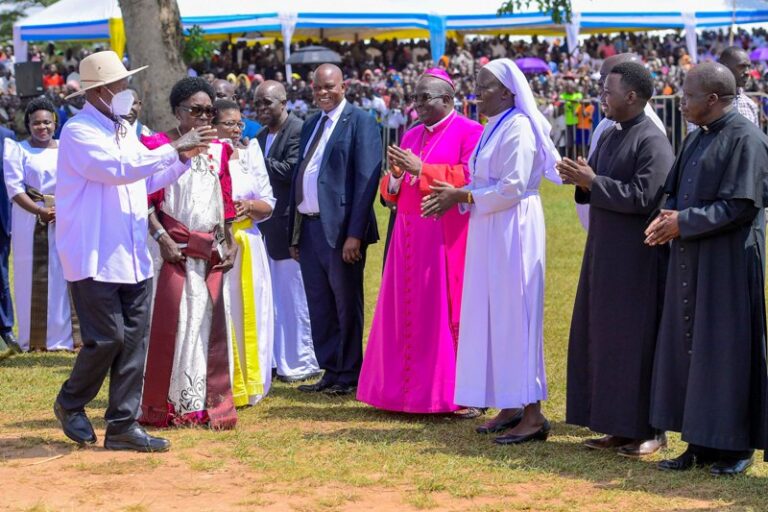
President Yoweri Museveni has reinforced the government’s unwavering commitment to developing religious tourism sites across Uganda, with a particular focus on transforming Bugonza Shrine in Kaliro district into a significant pilgrimage destination. The President made these remarks on Sunday, July 6th, 2025, while attending the national celebrations for St. Gonzaga Gonza Day as the Chief Pilgrim at Bugonza Shrine, an event organized by the Jinja Diocese.

President Museveni highlighted that the government has consistently allocated funds in the national budget to support the annual commemoration of Martyrs’ Day at Namugongo. He affirmed that similar dedication would be extended to the birthplaces of other revered Uganda Martyrs.

“Developing this site here will be done. I discussed with the priests, and I told them what shall be done here at Bugonza and also at Matia Mulumba’s place at Kyebando and the one of Bishop Hannington in Kyando because all these people are important and capture the sentiment of our people,” President Museveni stated, promising the development of Bugonza and Kyebando Catholic Pilgrimage sites will commence in the next Financial Year 2026/2027.

The day commemorated the life and martyrdom of St. Gonzaga Gonza, one of Uganda’s revered martyrs who was killed for his unwavering faith. “I’m very happy to be here to take part in these celebrations to commemorate St. Gonzaga Gonza,” the President noted.

He also proudly recalled his role in making June 3rd a public holiday, easing the commemoration of all religious martyrs for Ugandans. “Before the NRM came, they would wait for a weekend to celebrate the Uganda Martyrs Day, but when I came, I discussed with Cardinal Nsubuga to make it a public holiday,” he added. President Museveni also reminded the congregation of the June 9th Heroes Day, dedicated to those who shed their blood for Uganda’s liberation.

Beyond the religious tourism initiative, President Museveni made substantial financial pledges aimed at supporting the developmental projects of the Jinja Diocese. He committed Shs 950 million towards the completion of the Minor Seminary in Iganga. Additionally, he pledged Shs 300 million to the SACCO of Priests in the Diocese of Jinja and another Shs 300 million to complete their commercial building located in Kamuli district.

In a significant show of support, the President pledged full financial backing from the government to ensure the completion of the Uganda Martyrs Hospital in Jinja. He commended the Jinja Diocese leadership, stating, “And I’m glad these priests know how to use resources sparingly. We gave them Shs. 2 billion to celebrate Namugongo Martyrs Day two years ago when Jinja diocese was leading. They used some of it and saved a portion which they used to start the Martyrs Hospital which we are going to complete.”

Furthermore, President Museveni donated a tractor to the Jinja Diocese to bolster agricultural production and pledged to offer financial support to Bishop Charles Martin Wamika of Jinja Diocese for his medical treatment.

President Museveni’s visit and generous commitments underscore the government’s continued recognition of the profound spiritual and cultural significance of the Uganda Martyrs, linking historical reverence with tangible development initiatives for both tourism and community welfare.

EARLY PREPARATIONS: Bugweri launches management team to spearhead MTN Busoga Masaza Cup 2025 campaign

0


Bugweri chiefdom has officially unveiled a new executive committee to steer its football team, Bugweri FC “Entuudhi”, through the 8th edition of the Busoga Masaza Cup.


The launch, held on Wednesday 18th June, marks a fresh chapter for the team as it seeks to make history in the prestigious regional tournament.


The committee will be led by newly elected chairperson Nsereko Henry, who vowed to mobilise resources and build a united support base that will drive the team towards success.

The leadership will oversee team preparations, fundraising, and coordination with tournament organisers.


Speaking during the official unveiling, the Prime Minister (Katikkiro) of Bugweri Chiefdom, Owek. Nabongo Godfrey emphasised the importance of community support and expressed hope that the team will reach the final for the first time since the tournament’s inception in 2016.


“This committee is going to guide us through this journey. They will show us where to invest our money and how the tournament is progressing. We are hopeful that Bugweri will go far, even reach the finals. I urge all people from Bugweri, wherever they are, to rally behind the team,” said Owek. Nabongo.


He acknowledged that the tournament coincides with a busy season marked by harvests and political activities but called on the public to prioritise support for the team.


“Beyond this tournament, we want to build a lasting football club—not just a seasonal Masaza team,” he added.


Former Players and Politicians Urged to Join Hands
In his remarks, Chairman Nsereko Henry called upon former players, politicians, and the wider Bugweri community to offer both moral and financial support.


“ This team belongs to all of us. Former players, leaders, businesspeople—let us come together and push Entuudhi to the top. The people of Bugweri must own this journey if we are to make it,” Nsereko urged.


Bugweri has been drawn into the competitive Mawembe Group, alongside Bunhole-Bunhanumba, Bukono, and Budiope.


While the exact date for the tournament’s kickoff is yet to be confirmed by the Busoga Masaza Cup organising committee—chaired by Owek. Amin Bossa Nkono—the opening match is expected to feature a clash between Budiope and Bukono.

Youth Leaders Back the Cause
The youth wing of Bugweri Chiefdom, under the leadership of Omulangira Magoola Abdulhakiim, also pledged full support to the team. Representing the Busoga Kingdom Youth Council, Magoola called on all youth, especially those with roots in Bugweri, to actively engage and contribute.


Aiming for History
Since the Busoga Masaza Cup was inaugurated in 2016—with Bukono North emerging as the inaugural champions—Bugweri has never reached a final. With new leadership in place and renewed commitment from community stakeholders, hopes are high that 2025 could be a breakthrough year.
Bugweri Entuudhi is now setting its sights not only on glory in this year’s Masaza Cup, but also on laying the groundwork for a permanent football club that could eventually represent the region at higher levels of Ugandan football.

QUALIFICATIONS QUESTIONED: Bugiri’s Kasajja Mulumba to be sued over fake academic papers despite getting nominated for the NRM primaries

0

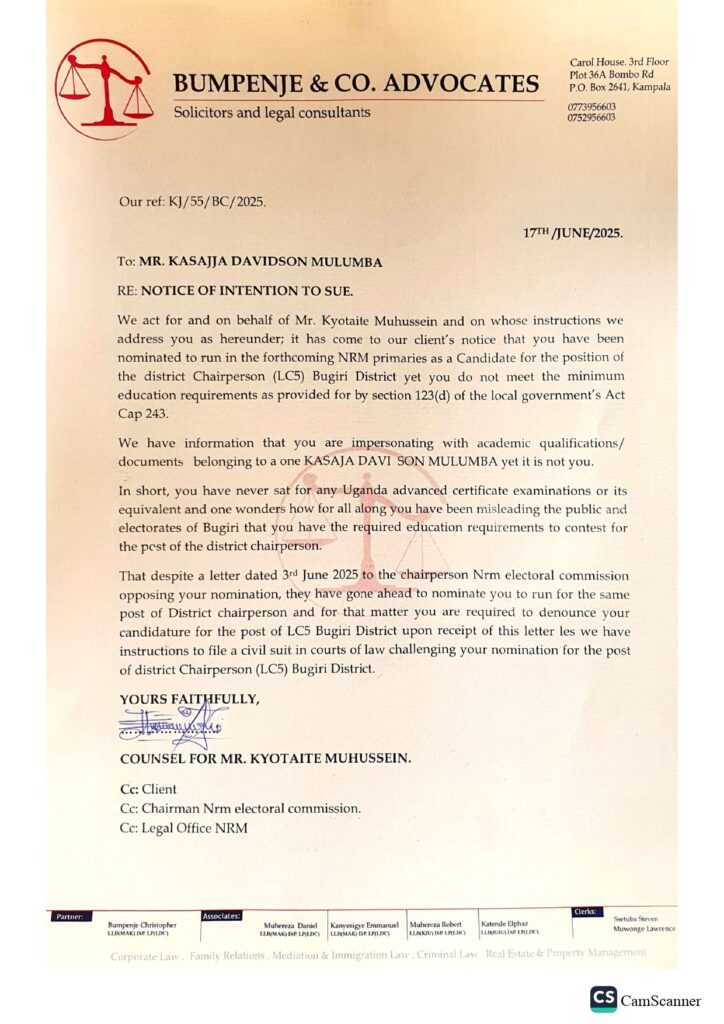
The race for the Bugiri District Chairperson (LC5) seat is experiencing significant turbulence as the impending National Resistance Movement (NRM) primaries are clouded by a legal challenge against the nomination of Mr. Kasajja Davidson Mulumba, the incumbent.

Bumpenje & Co. Advocates, representing Mr. Kyotaite Muhussein, have formally notified Mr. Mulumba of their intention to file a lawsuit, asserting that he fails to meet the minimum educational prerequisites as outlined in Section 123(d) of the Local Government Act Cap 243.

The notice, dated June 17th, 2025, alleges that Mr. Mulumba is presenting academic qualifications that belong to another individual named “Kasaja Davi Son Mulumba,” and that he lacks the necessary Uganda Advanced Certificate of Education (UACE) or its equivalent, a mandatory requirement for the position.

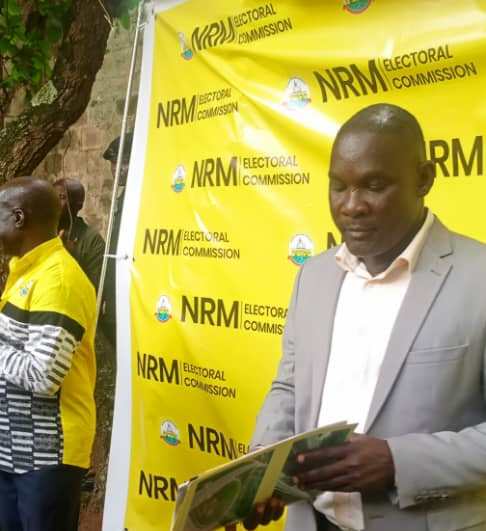
Beyond the legal notice, Bumpenje & Co. Advocates have also petitioned the NRM Electoral Commission of Uganda, formally challenging Mr. Mulumba’s nomination.

This petition reiterates the claims made in the legal notice, arguing that Mr. Mulumba’s nomination contravenes Article 44(1) of the NRM Constitution, which stipulates that candidates must fulfill all legal requirements to be eligible for nomination.

The petition also highlights a previous letter sent to the NRM Electoral Commission on June 3rd, 2025, which flagged similar objections to Mr. Mulumba’s nomination.

The current legal action was prompted by the Commission’s decision to proceed with the nomination despite this prior warning.

Bumpenje & Co. Advocates are now imploring the NRM Electoral Commission to urgently review Mr. Mulumba’s nomination documents and ultimately revoke his candidacy.

The petition explicitly warns that failure to take action will result in legal proceedings against both the Commission and Mr. Mulumba himself.

“We trust that the commission will handle this matter with the seriousness it deserves and uphold the integrity of the electoral process,” the petition reads, underscoring the importance of ensuring a fair and transparent selection process.

If substantiated, these allegations could have serious ramifications for both the NRM primaries and the subsequent LC5 elections in Bugiri District.

The outcome of this legal challenge is being closely monitored by political observers and residents of Bugiri, as it raises pertinent questions about the thoroughness of the candidate vetting process and the overall integrity of the electoral system.

As of the time of this report, Mr. Mulumba has not issued a formal statement addressing the allegations. Similarly, the NRM Electoral Commission has yet to publicly comment on the petition lodged against his nomination.

This is a developing story and further updates will be provided as more information becomes available. The unfolding events will undoubtedly shape the political landscape in Bugiri and potentially influence the outcome of the upcoming elections.

EMPOWERING YOUTH: Busoga receives digital equipment and vocational tools donation from MTN Uganda in effort to bridge digital divide in region

0

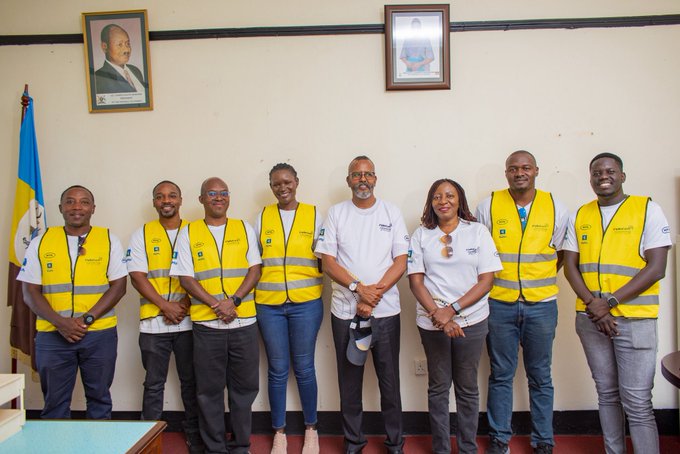
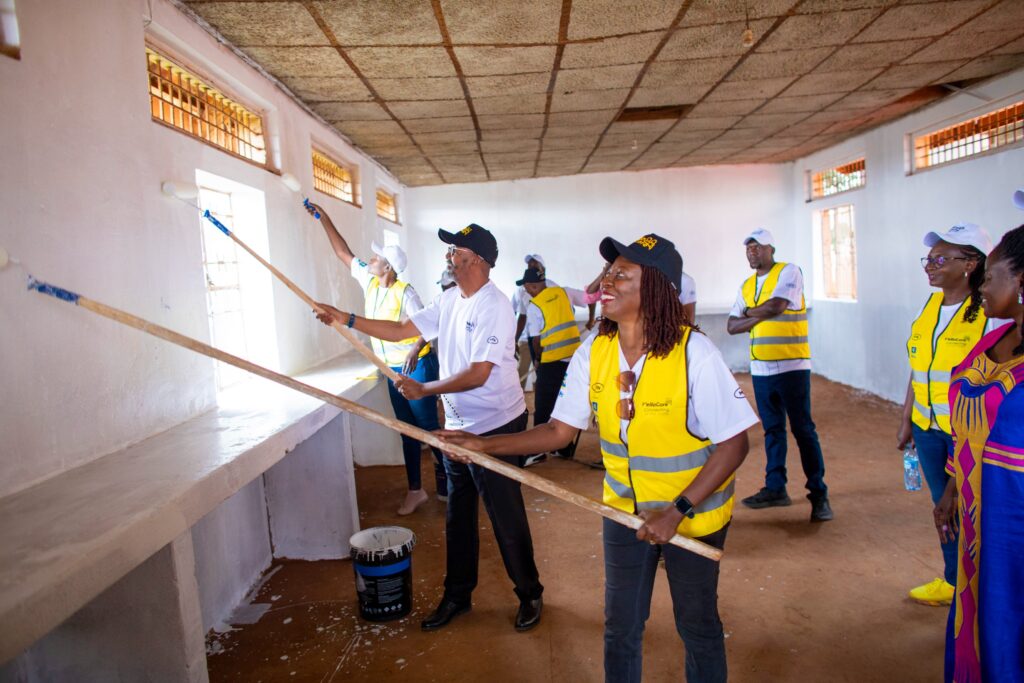
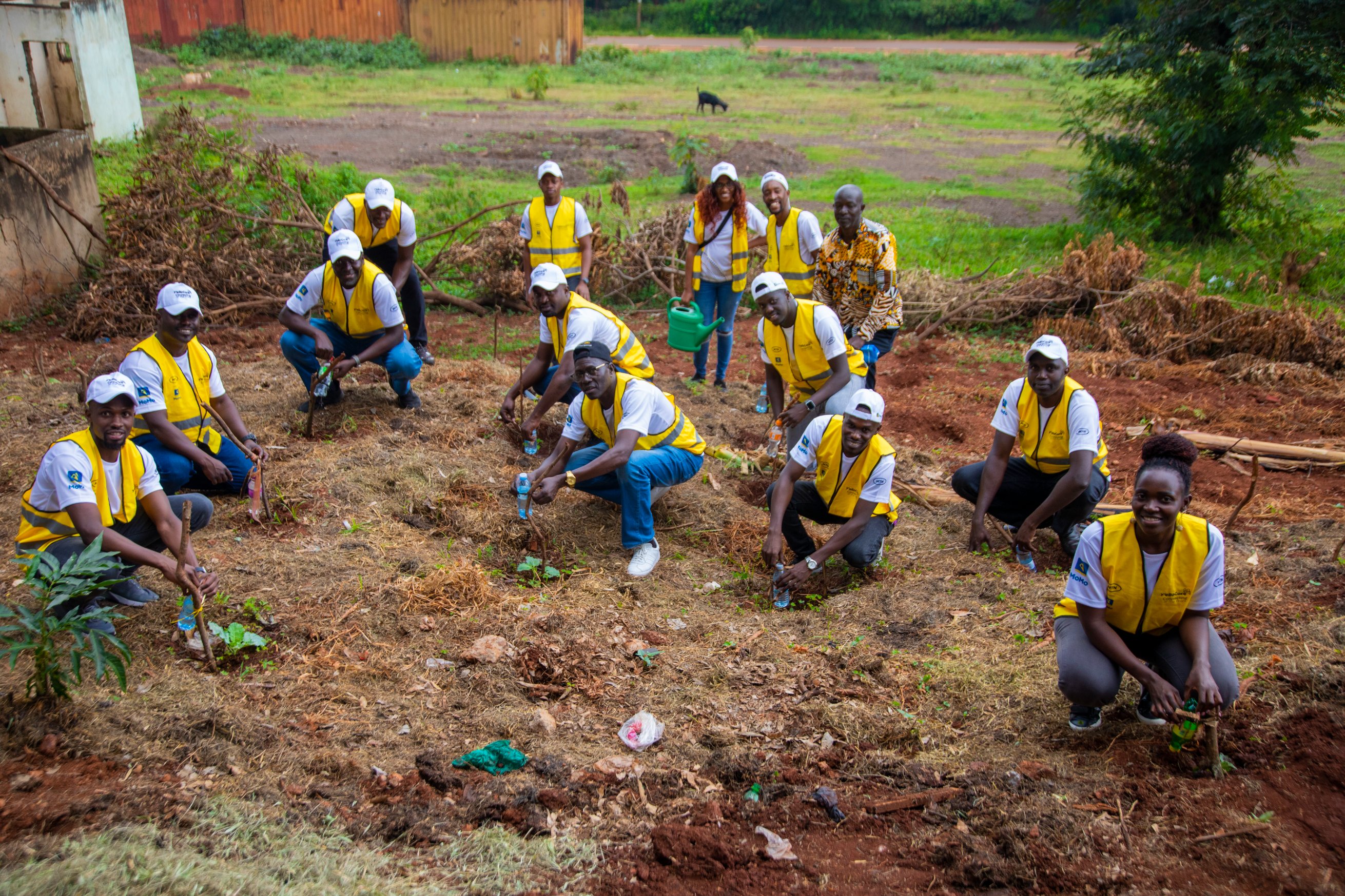
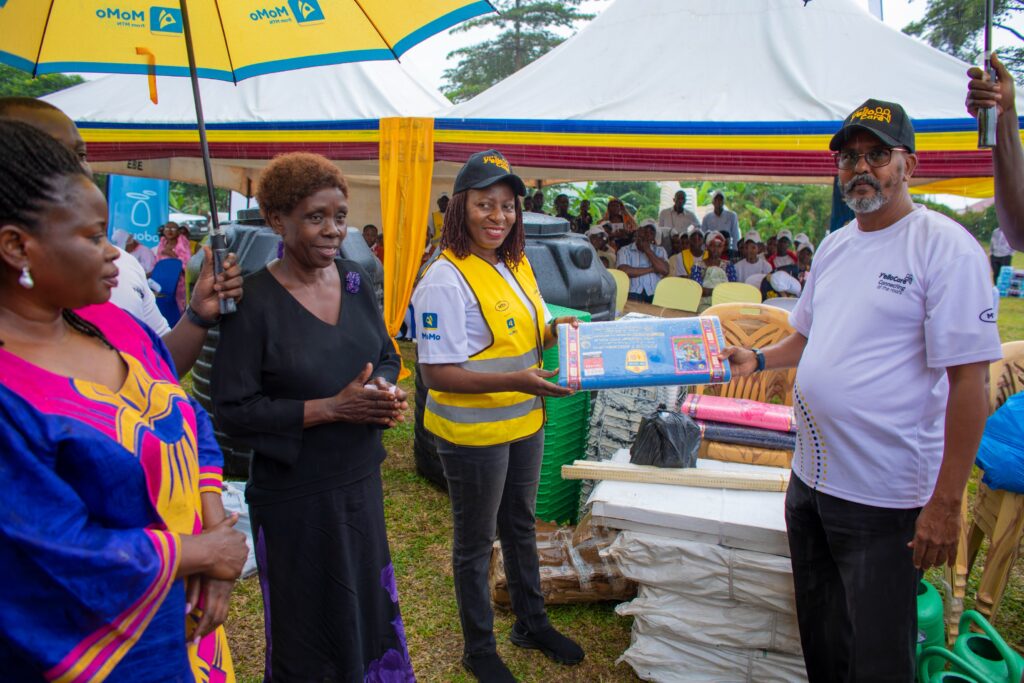
MTN Uganda, in partnership with several key organizations, has reaffirmed its commitment to bridging Uganda’s digital divide and empowering youth through a significant donation of digital equipment and vocational tools to the Busoga Kingdom.

The donation, which took place on Tuesday, June 17th, 2025, at the Inhebantu Lady Alice Mulooki Memorial Library and ICT Centre in Jinja, is part of MTN’s annual 21 Days of Y’ello Care volunteerism campaign.

The support was gratefully received by the Busoga Kingdom’s Second Deputy Prime Minister, Owek. Osman Noor Ahmed, on behalf of the Kingdom, highlighting the importance of such initiatives in the region.

Owek. Ahmed was accompanied by other prominent Kingdom figures, including Kyabazinga Affairs Minister Owek. Babirye Yudaya and Busoga Kingdom’s Minister of Gender and Children Affairs Florence Kafuko.

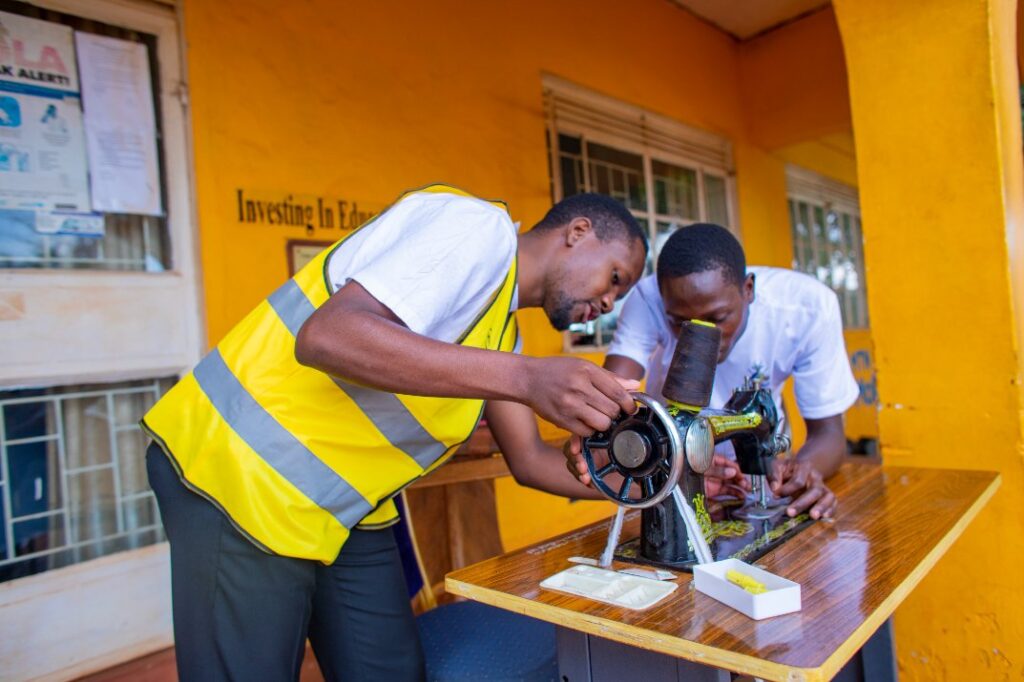
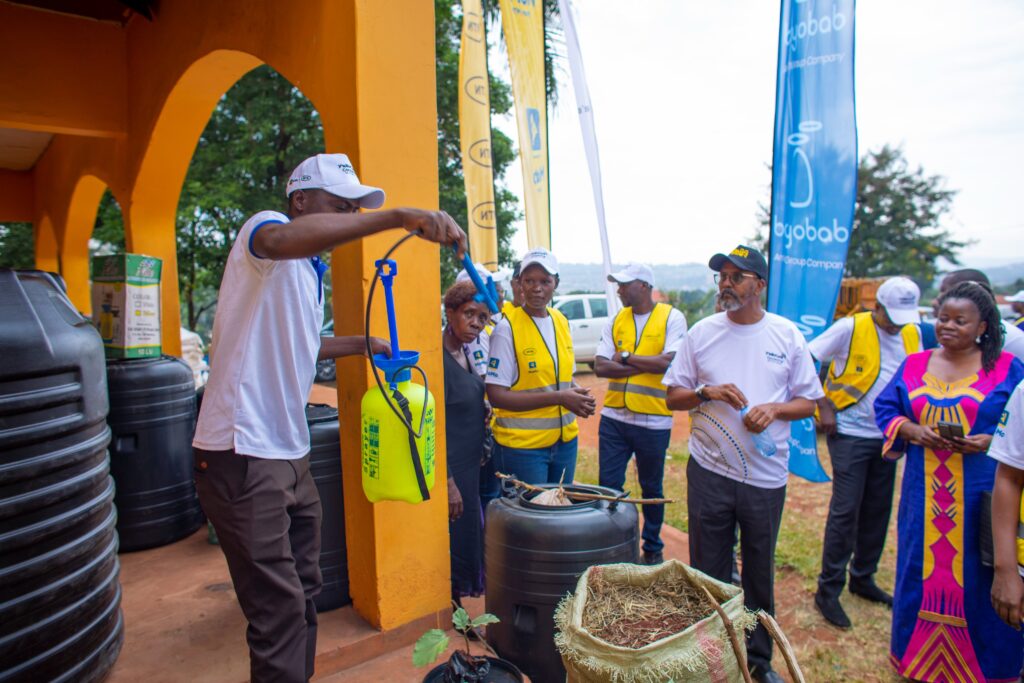
The comprehensive donation included ten computers with one-year internet subscriptions, ten tailoring machines, ten hair-dressing kits, and water-harvesting tanks designed to support kitchen gardening initiatives.

This comprehensive approach aims to enhance digital literacy and create income-generating opportunities for vulnerable groups, particularly teenage mothers and young women. Furthermore, the water-harvesting tanks will contribute to improved household food security, addressing a critical need within the region.

In addition to the material donations, MTN Uganda’s female staff engaged in a friendly football match with teenage mothers, fostering a sense of community and breaking down stigma. This initiative served to empower the young women and raise awareness about the prevention of teenage pregnancy, a pressing concern in the Kingdom.

“We greatly thank MTN for its continued support in empowering our young people with the tools and skills they need to thrive in a rapidly changing world,” said Owek. Ahmed during the event.

He emphasized the importance of the partnership, stating, “This partnership strengthens Busoga’s commitment to youth development and resilience through technology and training.” He also conveyed greetings from His Majesty Kyabazinga of Busoga William Gabula Nadiope IV and his wife Her Royal Highness Jovia Mutesi, the Inhebantu of Busoga.

This initiative comes at a crucial time for Busoga, which faces a high rate of teenage pregnancy – estimated at over 30% among adolescent girls, according to the Ministry of Health.

Simultaneously, digital access remains limited across Uganda, with only 10% of the rural population owning or being able to use a computer and just 27% regularly accessing the internet, according to the Uganda Bureau of Statistics.

Juliet Kakayi Nsubuga, Managing Director of Bayobab Uganda, an MTN Uganda affiliate, framed the initiative as part of a broader effort towards digital inclusion. “Connectivity is no longer a luxury but a necessity,” she stated. “Our partnership with Busoga reflects a commitment to inclusive growth through expanded access to digital infrastructure and knowledge.”

Nsubuga emphasized that the combination of vocational tools and reliable connectivity forms a critical component of MTN’s strategy to reduce economic vulnerability among young women by equipping them with employable skills that promote independence.

This marks the second time Busoga has benefited from MTN’s Y’ello Care campaign, with a previous donation of 20 computers to the same center in 2016. Those resources have since proven invaluable in equipping thousands of learners with essential digital skills.

The 2025 Y’ello Care campaign, themed “Connecting at the Roots – Connecting Communities through Digital Tools,” builds on this foundation and expands support across five regions within Uganda.

Beyond Busoga, MTN Uganda is actively implementing similar projects nationwide. In Kampala, they are collaborating with the Kampala Capital City Authority (KCCA) to address urban youth unemployment through the Kabalagala Youth Centre.

In the Greater Central region, specifically Luwero District, MTN is partnering with the Nnabagereka Development Foundation to promote youth-led agribusiness initiatives.

In northern Uganda, the focus is on addressing teenage pregnancy through digital reproductive health education in collaboration with the Ker Alur Kingdom. Finally, in western Uganda, MTN hopes to support the Tooro Kingdom in advancing digital tourism and raising awareness about HIV/AIDS prevention.

The campaign, valued at UGX 500 million, is a collaborative effort involving various organizations, including the Ministry of ICT and National Guidance, MTN Mobile Money Uganda Ltd, Bayobab, Maendeleo Foundation, AYO Uganda, Roofings Group, Transsion, Xeno Investment, and AYO.

Launched in 2007, the 21 Days of Y’ello Care campaign mobilizes MTN staff across Africa each June to volunteer their time and expertise in community service.

This initiative aligns strongly with MTN Uganda’s Ambition 2025 strategy, which places digital and financial inclusion at the forefront of its vision for sustainable national development.

Through these targeted interventions, MTN Uganda is making significant strides in empowering communities, bridging the digital divide, and fostering a brighter future for the nation.

MOSES MAGOGO: Kadiba Stadium 25% complete but ready for AFCON training use

0

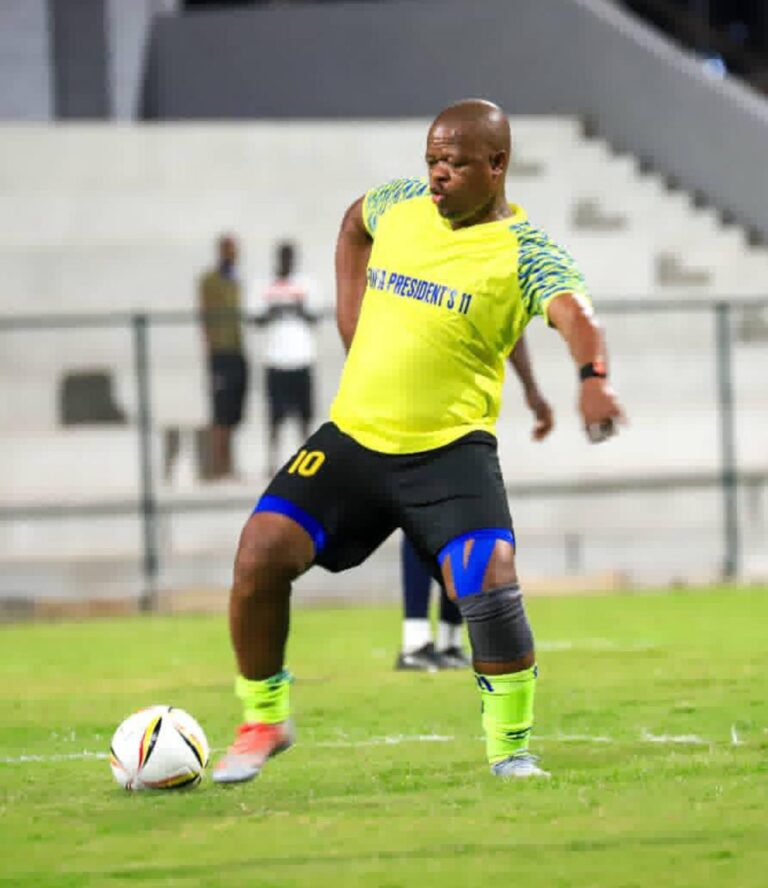
The newly renovated Kadiba Stadium is only 25% complete, but according to FUFA President Eng. Moses Magogo Hasim, it is already fit to serve as a training facility for the Africa Cup of Nations (AFCON).

Speaking after a floodlit friendly match between the Parliamentary Football Club and the President’s Eleven on Tuesday night, Magogo said he was pleased with the facility’s early performance despite ongoing work.

“So far, so good. This facility is usable,” said Magogo. “Even at 25% completion, it meets the standards to be a training ground for AFCON. We’re testing it at night to see how the pitch responds and how the lighting performs.”

Kadiba currently runs on 30% lighting capacity, but plans are in motion to upgrade it to 100% illumination to reach full broadcast-standard floodlighting. “When the lights are complete, they’ll meet international requirements, including TV coverage,” Magogo added.

The game also served as a test event for the playing surface, infrastructure, and night-time match suitability. The positive turnout and performance of the facility gave FUFA confidence in its interim readiness.

Despite the promising progress, Magogo emphasized that Kadiba remains a work in progress. “Only a quarter of the full development plan has been implemented. But our strategy is clear—every phase should be functional,” he noted.

He stressed that continued support from government and FIFA is critical for full completion, but called on more stakeholders to invest in football infrastructure, especially in upcountry regions.

“The dream is not just for Kadiba,” Magogo said. “Regions like Busoga, Bugisu, Ankole, and West Nile deserve similar facilities. That’s where Uganda’s future football talent lies.”

The stadium joins Uganda’s limited list of venues capable of hosting night football, including Namboole, Kitende, Nakivubo, and Philip Omondi Stadium.

Meanwhile, MP Hon. Asuman Basalirwa, who played in the match, praised FUFA’s phased approach. “I pushed for increased football funding in Parliament. Seeing this progress shows that the money is being put to good use,” he said.

THE RIGHT ONE: Kamuli District NRM delegates endorse Kadaga for key CEC position

0

By Moses Kintu


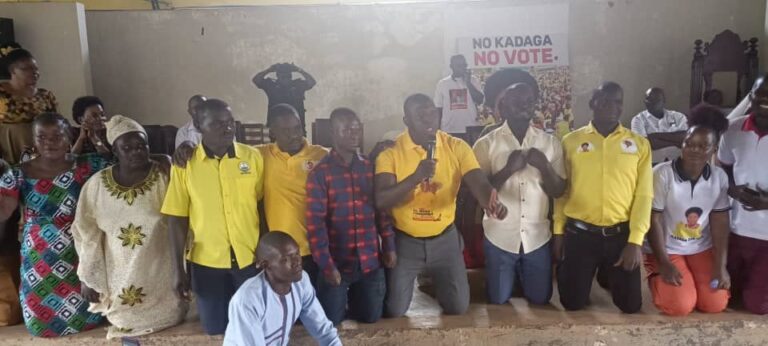
In a unanimous decision, the National Resistance Movement (NRM) delegates and leaders of Kamuli district have endorsed Rebecca Alitwala Kadaga for the position of the NRM Central Executive Committee (CEC) member (female).


This decision was made during a meeting held at the youth center, attended by Members of Parliament, spiritual leaders, stakeholders, aspiring Members of Parliament, and LC5 candidates.


The NRM leaders in Kamuli district have expressed their support for Kadaga’s bid to retain her seat in the CEC, a position that has caused divisions among the NRM leaders.


The endorsement of Kadaga is a result of her outstanding achievements in Kamuli, Busoga, and Uganda at large.


The Chairman of NRM Kamuli district, Bazanya Mathias, emphasized the importance of supporting Kadaga, stating that she is the right person for the position.

He said, “We want to support you, Mama Kadaga, because you are the right person for the CEC position.”


Kadaga has been a significant figure in Ugandan politics, having served as the Speaker of Parliament for two consecutive terms.

Her achievements during her tenure as Speaker have been remarkable, and she has been a strong advocate for women’s rights in Uganda.


Under Kadaga’s leadership, Kamuli district has seen significant development, with various infrastructure projects being implemented.

She has also been instrumental in advocating for the rights of the people of Busoga, and her influence has been felt throughout the region.


The NRM delegates and leaders of Kamuli district believe that Kadaga’s experience and achievements make her the best candidate for the CEC position.

Her leadership skills and dedication to serving the people of Uganda have earned her the respect and support of many.


The endorsement of Kadaga by the Kamuli district NRM delegates is a testament to her leadership abilities and her commitment to serving the people of Uganda.

It is a clear indication that she has the support of the people she has served, and they believe in her ability to continue making a significant impact in Ugandan politics.


In conclusion, the NRM delegates and leaders of Kamuli district have endorsed Kadaga for the CEC position, citing her achievements in Kamuli, Busoga, and Uganda at large.


Her leadership skills and dedication to serving the people of Uganda have earned her the respect and support of many, and she remains a significant figure in Ugandan politics.

ADDRESSING PERIOD POVERTY: Relief in Buyende as girls receive menstrual hygiene kits from SHARE Project

0

Jubilation on 5th June 2025 filled the air in Makanga Town Council, Buyende District, as the community commemorated World Menstruation Day, an event organized by Right To Play under the Sexual Health and Reproductive Education (SHARE) Project program.

The arrival of Veronica Babirye Kadogo, former Buyende District Woman MP and current EALA MP, was met with enthusiastic cheers and applause, highlighting the importance of the occasion and the impact of the SHARE Project.

The event took on a poignant turn when a young girl, overcome with emotion after being invited to lead the anthems, burst into tears. Kadogo, a trained social and community health professional, quickly recognized the cause: the girl had unexpectedly started her period.

This incident served as a stark reminder of the challenges faced by girls in the district, highlighting the lack of essential resources in schools, including emergency sanitary pads, proper washrooms, and access to safe water.

This experience galvanized Kadogo to champion school sanitation programs. “Menstruation hygiene management is not a privilege, but a human right,” she declared, condemning the stigma and exclusion that girls and women face due to a natural biological process.

Speaking passionately, Kadogo emphasized that managing menstruation requires more than just sanitary pads. Access to clean water, soap, and privacy are crucial. She urged leaders to prioritize budgetary provisions for these essential resources in schools, public institutions, and homes.

Kadogo further highlighted the ongoing struggle to advocate for menstrual health within government. She recalled raising concerns in the 10th Parliament about girls missing school due to a lack of resources, advocating for free sanitary pads in schools.

She argued that if the government could provide free condoms, prioritizing menstrual health for girls was equally vital. Unfortunately, these appeals have so far been unsuccessful.

Nelson Mandela Odero, the program officer of Right to Play Uganda, outlined the SHARE Project’s multifaceted approach. This includes menstrual education, distribution of reusable cloth sanitary pads, and the creation of safe spaces for open discussions.

“By providing girls with the necessary knowledge, resources, and support, the program empowers them to manage their periods with dignity, attend school regularly, and pursue their education without interruptions,” he explained.

The program targets pupils aged 10-14, community youths aged 15-24, teachers, parents, district leaders, and health workers, impacting over 2,700 youth.

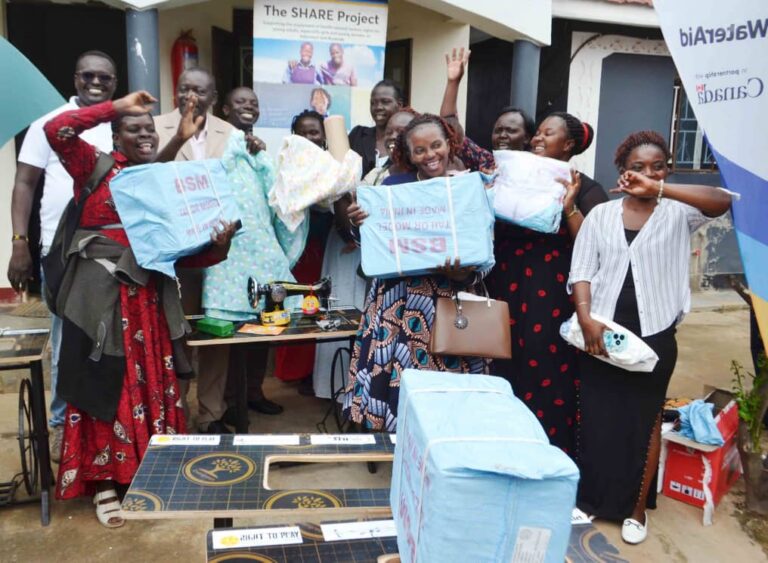
Buyende District Education Officer Dison Bwire officially handed over 91 menstrual hygiene management skills start-up kits and materials to 65 primary schools’ senior women teachers and 26 community mentors.

He emphasized the importance of advancing menstrual equality in schools and communities to address period poverty, promote gender equality, support environmental conservation, and contribute to the holistic development of girls.

Many girls, he explained, resort to unhygienic alternatives due to a lack of access to affordable sanitary products, leading to missed school days and perpetuating harmful social norms.

Emmanuel Kaigulo, Buyende District Community Development Officer, praised the SHARE Project for contributing to the achievement of the United Nations Sustainable Development Goals, particularly Goals 5 (Gender Equality) and 12 (Responsible Consumption and Production).

He called for increased awareness, peer-to-peer support in schools, child-friendly information platforms, and the provision of disposal containers (“pad pin bins”) in schools and communities.

Josephine Poni, a community mentor from Kagulu sub-county, expressed her gratitude to Right to Play for their intervention. She believes the program will empower girls and women with affordable reusable sanitary pads and valuable skills, enabling them to become economically independent and ensuring more girls attend school without fear.

To mark World Menstruation Day, the Right to Play distributed 91 branded sewing machines and materials for training to make reusable sanitary pads, worth UGX 51 million, to 65 primary schools’ senior women teachers and 26 adolescent girls and young women community mentors.

This initiative promises to bring significant relief to girls and women in Buyende, ensuring they can manage their menstruation with dignity and continue their education without interruption.

The hope is that this progress will inspire wider systemic changes and increased government investment in comprehensive menstrual hygiene management programs.

FRESH HOPE: Can Bugabula finally break through and make its mark in the MTN Busoga Masaza Cup this season?  

0

As the stage is set for the 8th edition of the MTN Busoga Masaza Cup, anticipation is building across the region—but nowhere more than in Bugabula, a county long admired for its football talent, yet still chasing a first-ever appearance in the tournament final.

With the 2025 edition just about to kick off, Bugabula finds itself in what looks like a “promising draw,” raising fresh hopes that this could finally be the year they break their semi-final curse.

Format, Hopes

This year’s format groups the 14 participating counties into four zones: Bukowe, Kagulu, Nhendha, and Mawembe.

Bugabula is placed in the Bukowe group, along with Luuka and Bukooli Bugiri. The Kagulu group features Buzaaya, Bulamogi, and Bunha. Crucially, under the 2025 knockout arrangement, only one team from Bukowe and Kagulu combined will reach the final.

The semi-final structure—pitting winners and runners-up from these two groups against each other—means Bugabula could face familiar opposition in both the quarter-finals and semi-finals. This scenario not only increases their chances of progressing but also ensures that they avoid teams that have previously knocked them out until the final stage, if at all.

The Semi-Final Wall

Bugabula’s story is not short on heartbreak. Since 2022, when the tournament resumed after the COVID-19 break, they have consistently made it to the semi-finals—only to be denied a spot in the final each time.

In 2022, it was Kigulu who ended their dream.

In 2023, it was Busiki who pulled the plug.

In 2024, it was Butembe who stood in the way.

Ironically, those three counties are now in positions where they can only face Bugabula in the final—provided they make it that far. This means Bugabula’s toughest past opponents are not in their direct knockout path this time.

A 75% Shot?

Bugabula has a 75% chance of reaching the final this year—a hopeful prediction based on their draw, past performance, and the absence of their historical semi-final blockers in early rounds.

Still, they will need to navigate a competitive field that includes Luuka, Bukooli Bugiri, Buzaaya, Bulamogi, and Bunha—all of whom are also eyeing the single final slot available to Bukowe and Kagulu teams.

Bunha has previous finals experience, while the others remain hungry and ambitious. If Bugabula is to rise above them, they will need to front a well-prepared, united, and motivated squad from day one.

The Unpredictability Factor

Recent editions of the Masaza Cup have been anything but predictable.

In 2022, Bukooli Namayingo shocked everyone to win the title.

In 2023, it was Busiki.

In 2024, Bukono joined the list of surprise final appearances.

This unpredictability gives every team—no matter how unheralded—a real shot. For Bugabula, it’s both a warning and a motivation: reputation alone won’t carry them to the final.

All Eyes on Bugabula

The tournament hasn’t started yet, but already the spotlight is fixed on Bugabula. Their consistency, strong fan base, and hunger for glory make them one of the most-watched teams of the 2025 edition.

If they seize the moment, avoid internal slip-ups, and ride the wave of opportunity that this year’s format presents, Busoga could finally see Bugabula in the Masaza Cup final—for the first time in history.

The journey begins soon.