
Saturday, May 23, 2026
Home Blog Page 54

FROM 1986 TO 2006: How Uganda became a lucrative market for domestic and external slaves

0

By Oweyegha-Afunaduula

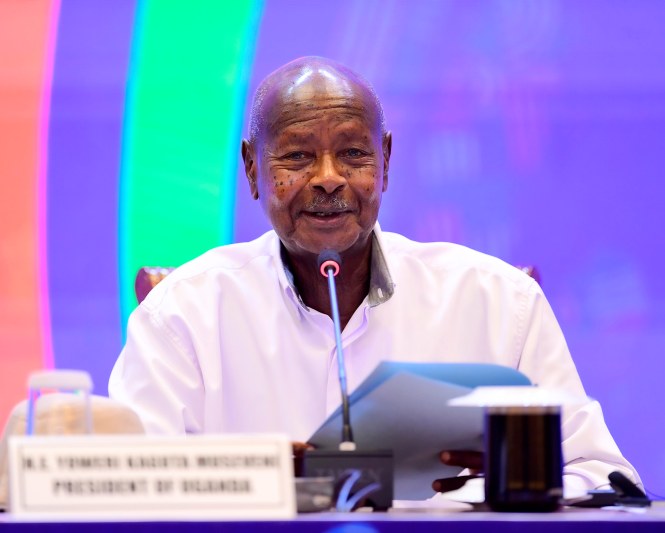
There is an emerging school of thought that holds that, despite repetitive talk of development, transformation, and progress” of Uganda during the 40-year rule of the country by President Tibuhaburwa Museveni and his National Resistance Movement (NRM), Uganda has become both a renewed labour reserve and a lucrative market for domestic and external slaves.

The school of thought is convinced that the conversion of Uganda into a renewed labour reserve and lucrative market for domestic and external slaves has been the political goal of President Tibuhaburwa Museveni and his NRM.

According to the school of thought, the President has been able to conceal the political goal of building Uganda as a labour reserve and a market for slaves in modern times, by preoccupying the people with politics, not production. “It is politics before elections and after elections in a cyclic manner”, says one proponent of the school.

If we are to agree with the school of though, then we have to apply the word “Kugumaaza”, introduced in politics of Uganda by President Tibuhaburwa Museveni some years back to mean “diversionary” to ideas such as Operation Wealth Creation, Parish Development Model and Myooga, which are cast as tools for eliminating poverty.

It is obvious that just as ideas have been pursued and implemented at very high cost to the tax payers, poverty has been proliferating even far more widely than ever before since the President and his NRM grabbed power in the country.

Simultaneously, Uganda has become more of a new labour reserve and a source of domestic and external slaves. This is a confirmation that rather developing and transforming Uganda in terms of people’s development, the governors have been de-developing and underdeveloping the country.De-development and underdevelopment are at the core of what is these days known as MUSEVENOMICS. Those promoting and practising MUSEVENOMICS know exactly what it is all about, but are exploiting the collective ignorance of Ugandans, which they are not even committed to reduce.

Let me expound on the two negative processes undermining the development, transformation and progress of Uganda in the 21st Century.

De-development

De-development” refers to a process that undermines or weakens an economy’s ability to grow and expand, potentially leading to a reduction in the stock of capital available to a group, and increases in poverty. It can damage data gathering and knowledge production abilities, let alone wreck the environment. Warring is an element in de-development.

According to Sara Roy (2016)de-development is a process shaped by a vision of denial and renunciation. The deliberate uprooting and displacement of the indigenous population, the ‘de-skilling’ and underuse of the…..labor force, the segmentation and fragmentation of the economic sector in the periphery, the usurpation of land and water, the proletarianization of the workforce and the increasing insignificance of the ‘proletariat,’ the alienation of the…. labor force, or the intentional denial of access to the means of production as a form of collective punishment. These phenomena are not simply the distortion of economic development, but the deliberate denigration of productive life to a lower level.It is precisely what you need to create slaves -domestic and external. If they are domestic, they may even be lecturers, professors or bureaucrat, whose pay is not commensurate with the qualifications, expertise and experience, while that of the mediocre is astronomical.

Ugandahas experienced 40 years of de-development and suppressed human potential and the right to development. Schemes such as Operation Wealth Creation, Parish Development Model and Myooga, which ultimately are tools of de-development are being cast as tools of development at the periphery, Fortunate for the rulers, most citizens are unable to perceive what is going on.

Underdevelopment

Underdevelopment, in the context of international development, refers to a state where certain countries or regions exhibit lower levels of development compared to others, often characterized by economic disparities, unequal trade relations, and hindered progress. If we go by this definition or description, Uganda is indeed an underdeveloped country. It is characterised by diminishing political participation, including people withdrawing from voting people they want to lead them. According to Adelman and Morris (1967), “the most important instruments for increasing political participation in underdeveloped countries are those that involve fundamental changes in socio-economic and political structure as well as a basic reorientation of development strategies.

Unfortunately, in Uganda, the economy is in the hands of foreigners and functionaries of the ruling party, whom the leadership seems to be protecting against the people. This explains the exclusion of the absolute majority of Ugandans from meaningful and effective political participation and the use of violence to contain them.

Underdevelopment goes hand in hand with dependence (Furtado, 2020). The more a country is underdeveloped the more it will be dependent in a diversity of human life and human endeavours. It cannot claim to be developing. Uganda for the last 40 years has been in this condition. Assembling cars and buses is an attempt to conceal this fact.

The sowing of seeds of de-development and underdevelopment started long before the NRM/A captured the instruments of power on 25th April 1986. It was a multi-process strategy. I will list them without further analysis.

The Luwero bush war (1981-1986), which is erroneously called liberation war, was only one of the elements in the multi-process strategies. The other elements, among others, were the following.

  1. Destruction of Cooperative Societies and Unions
  2. Destruction of industries in Jinja
  3. Barter trade Scandal, 1986-1987
  4. Foreign Exchange scandal, 1987-1988
  5. Economic Structural Adjustment
  6. Retrenchment
  7. Sale of Public enterprises at peanut prices
  8. Universal Primary Education
  9. Universal Secondary Education
  10. Discriminatory policies
  11. Discriminatory education system
  12. Impoverishmentproject
  13. Destruction of community responsibility for children
  14. Proliferation of production of Vagabonds
  15. Conversion of Politics into a lucrative employer and employment
  16. Engineering and institutionalisation of corruption
  17. Scandals involving trillions of shillings, diverting money from social development to individual enrichment.
  18. Use of violence as an electoral tool and tool of public management.
  19. Raising nincompoops over and above educated, expert and skilled Citizens
  20. Raising war above social development
  21. Resistance of Minimum Wage.
  22. Allowing too many refugees in the country and not limiting their access to jobs, citizenship, nationality and sovereignty of Uganda
  23. Using ethnicity as a political tool through political ethnisation and ethnic politicisation
  24. Military capture of civic spaces
  25. Executive capture of Parliament and the Judiciary, thereby denying Ugandans effective representation of their challenges, problems and issues and meaningful justice respectively
  26. Liberalisation and Privatisation benefiting foreigners.
  27. Putting a halt to meaningful and effective change of leadership and governance
  28. Apartheid-like education system
  29. Closing of Technical schools and teacher training colleges.
  30. Land grabbing by foreigners and people with unethical and immoral money.
  31. Removal of price controls

The combined effect of all these and other elements of the multi-process strategy of sowing de-development and underdevelopment is many in one: despondency, loss of interest in the country and work, drug addiction, suicides, killings, robberies, further impoverishment, and readiness (or compulsion) to offer oneself as a domestic slave or external slave. Meanwhile politicians use money, often ill-gotten to manipulate the poor and needy to enhance their political resources and fortunes.

For God and My Country

Further Reading

Adelman, I. and Morris, C.T. (1967) Society, Politics and Economic Development: A Quantitative Approach. John Hopkin, Baltimore.

Berberoglu, B. (1978). The Meaning of Underdevelopment: a Critique of Mainstream Theories of Development and Underdevelopment. International Studies17(1), 51-73. https://doi.org/10.1177/002088177801700103 (Original work published 1978)

Duffy, David (2002). Underdevelopment and Less Developed Countries.https://www.tcd.ie/Economics/assets/pdf/SER/2002/Underdevelopment%20and%20Less%20Developed%20Countries%20By%20David%20Duffy.pdf Visited on 8 April 2025 at 14:58 pm EAT

Furtado, C. (2020). Underdevelopment and Dependence: The Fundamental Connections. Review of Political Economy33(1), 7–15. https://doi.org/10.1080/09538259.2020.1827549https://www.tandfonline.com/doi/full/10.1080/09538259.2020.1827549 Visited on 8 April 2025 at 15:00 pm EAT.

Jo Kaybryn (2021). De-development: can it be managed. Linkedin, February 7 2021.https://www.linkedin.com/pulse/de-development-can-managed-jo-kaybryn/ Visited on 8 April 2025 at 12:45 pm EAT.

Roy, S. (1999). De-development Revisited: Palestinian Economy and Society Since Oslo. Journal of Palestine Studies28(3), 64–82. https://doi.org/10.2307/2538308.

Robin MILLARD (2023). Gaza Has Gone Through 16 Years Of ‘De-development’: UN. BARRON’S, October, 25 2023.https://www.barrons.com/news/gaza-has-experienced-16-years-of-de-development-un-5e93cca8 Visited on 8 April 2025 at 13:08 pm EAT

Roy, S. (2016). The Gaza Strip: The Political Economy of De-development (Expanded Third Edition), Institute for Palestine Studies. 2016.https://www.palestine-studies.org/en/node/1649448 Visited on 8 April, 2025 at 12:59 pm EAT.
GRAND PLAN: Uganda towards political equity and political justice in the 21st century

0

By Oweyegha-Afunaduu

The plan to reduce the number of constituencies and Ministers should not be as the plan that raised the number of Ministers from less than 12 in 1962 to the present 82 and the number of Members of Parliament from about 80 in 1962 to the current 529.

I have learned that the plan is to reduce the number of MPs to 260 and the number of Ministers to 21 after so much financial haemorrhage of the country politically.

Well-known journalist, Andrew Mwenda, once wrote that whatever President Tibuhaburwa Museveni thinks, conceives or does has political intent.

And since everything in Uganda is presidentially initiated or determined, we need to ask: Why reduce Ministers and MPs now? Is it new wisdom borne out of 40 uninterrupted one-man, rule of Uganda by the President or is the new phenomenon of Trump that will no longer waste money on what he called shithole countries or is it 2026?

If reducing the number of MPs is to be done it should be done equitably and justly without the political consideration of power retention.

Currently there are far more districts, counties, constituencies and Ministers from the Western Region than from any other region of Uganda.

It should not be to reduce number of constituencies excessively in the areas considered to be strongholds of the Opposition. That would be rigging elections, leadership and governance of Uganda in favour of NRM and our incumbent President.

The formula of reducing Ministers and MPs must be convincing and well-documented so that future generations will know how we did things whenever we acquired new superior wisdoms. Possibly The Parliament of Uganda will come out with the formula after legislating it into existence.

The key words should be Political Equity and Political Justice.

For God and My Countr

BUYENDE DISTRICT: NGOs raise red flag on early marriages, teenage pregnancies

0

The Uganda Police Force Annual Crime 2024 report indicated that Buyende district is number one when it comes to cases of defilement and number two in common assault. It also ranks highly when it comes to child neglect.

The Police Crime records indicate that Buyende topped defilement crime with 210 girls defiled, came second in common assault with 680 and 133 children suffered from neglect.

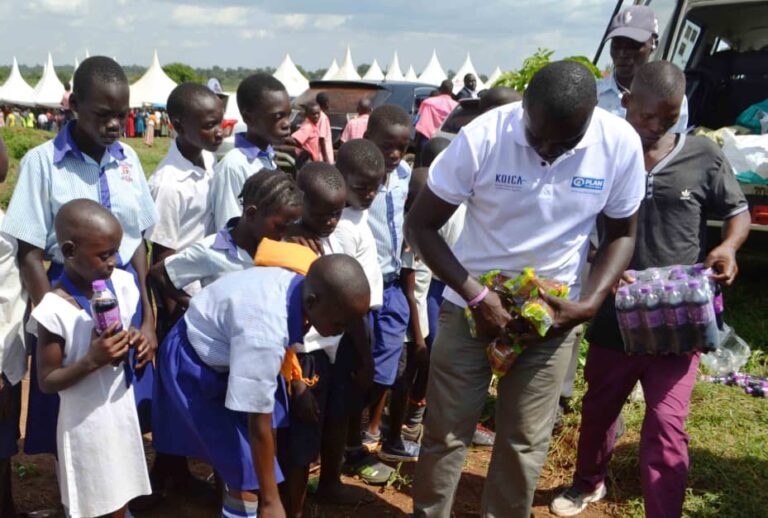
To mitigate these challenges, Plan International and its partners, Korea International Cooperation Agency (KOICA), SHARE with her consortium, FAWE, Right to Play, Water Aid and FHI, Caritas Jinja, Mama Africa, Community of practice and Girls Advocacy Clubs in Buyende have raised a red flag and called for action on ending teenage pregnancies and child marriages vices.

Presenting the call to action during the Buyende District Women’s Day celebrations held at Kirimbi Primary School, Saida Naigaga, the Plan International KOICA Adolescent Champion urged leaders and all stakeholders to stand with the girl child against these vices which are not only a violation of their rights but also morally wrong.

“It is time to take bold and collective action to protect the rights and potentials of girls. Teenage pregnancy and early marriage rob young girls off their potential, future and dignity. Our call to action is that together as one, let us stand up against these vices, be the change, protect and empower the girls,” she called.

Decrying the effect of teenage pregnancy and early marriage, the callers to action pointed out that teenage regnacy limits educational opportunities, exposes young girls to health risks while early marriages lead to early school drop outs, economic dependence, stunted empowerment lading to a generational cycle of poverty.

Miria Kagoda Kafuko, the FAWE Uganda Girls Empowerment Movement chairperson from Premiere College Gwase, challenged government to come out clear on provision of sanitary pads to girls to help them stay in school comfortably.

She also voiced to include wash and changing rooms in the institutions building plans in addition to supporting girls education and access to reproductive health services so that the girls make informed choices, decisions.

“It is very ironical that government provides free condoms to men and finds it not important and relevant to provide girls too with free sanitary pads when even the Minister of education, the Speaker of Parliament, the Prime ministers are women who should know the big need for pads to women and girls,” Kafuko said.

East Africa Legislative Assembly MP, Veronica Babirye Kadogo, pointed out that addressing these vices in the district requires a multifaceted approach that tackles the root causes, provides support to affected individuals and engages the community in creating lasting change.

Kadogo challenged political, cultural and religious leaders to lead, condone and aggressively fight these vices in their fora, programs, manifestos and sermons.

Kadogo, a former Woman MP Buyende district, and an International Girls Advocacy crusader, pledged to take the girls plight and NGOs call to action to various stakeholders and levels and have communities working to end harmful social norms that inhibit girls’ development and attainment of their full potentials.

“The call to action to end teenage pregnancies and early marriages should in reality shock all of us to rise up, swing into action so as to create an environment where every girl stays and completes school, pursues her dreams and lives a life free from the scare of early marriages, defilement etc,” Kadogo called.

Kadogo added that there is need for policy, budgetary and social streamlining to provide quality adolescent friendly, gender responsive and inclusive sexual reproductive health services, parenting up scaling and revival to value and appreciate the girl child challenges.

In response Buyende district council chairperson, Michael Kanaku, rallied the media as a fourth estate and watchdog advocate to set the agenda, create awareness and demand accountability.

He called for strengthening of the referral pathways, quick response to crime reports and hunt down of parents who thrive in early marriage and defilement business only reporting to Police when negotiations fail.

JUSTICE: Two remanded for damaging Milly Babalanda’s ambulance

0

The grade one magistrate court in Buyende district has remanded two men for allegedly damaging an ambulance which was donated to Kidera Health Centre in Buyende by the Minister for Presidency Milly Babalanda.

The young men, Sande Denis Salongo and Mpaulo Awali, have been remanded to Buyende government prison by His Worship Kauka Paul on Monday 7th April, 2025 for malicious damage.

The two were arrested on Thursday 3rd April 2025. They have been under police custody at Buyende Central Police since.

Court remanded the two after they failed to secure bail. They return to court tomorrow, 8th April 2025 for bail application.

Residents in Buyende believe the arrests are politically motivated. Many are pointing a finger at Milly Babalanda for influencing the arrest.

Noor Namatovu, a resident in Buyende said the actions of the minister are a total turn off.

Former Member of Parliament for Budiope West, Robert Musoke, castigated ‘political leaders who think they can force voters to love them.’

“How can we trust such people with a big office if this is how they are treating people in the area,” Musoke wondered.

The minister, born in Kamuli district, has expressed interest to contest for the post of MP for Budiope West in Buyende district. The post is currently being occupied by Kyoto Ibrahim.

She has, however, encountered riotous resistance from some members of the constituency especially the youths.

When her team delivered the ambulance, it is alleged that Sande and Awali led a group of youths to trap the motor with nails that deflated it’s tyres. Police moved in swiftly and arrested the two.

ENVIRONMENT GUARDIANS: One Student, One Tree campaign launched in Buyende district

0

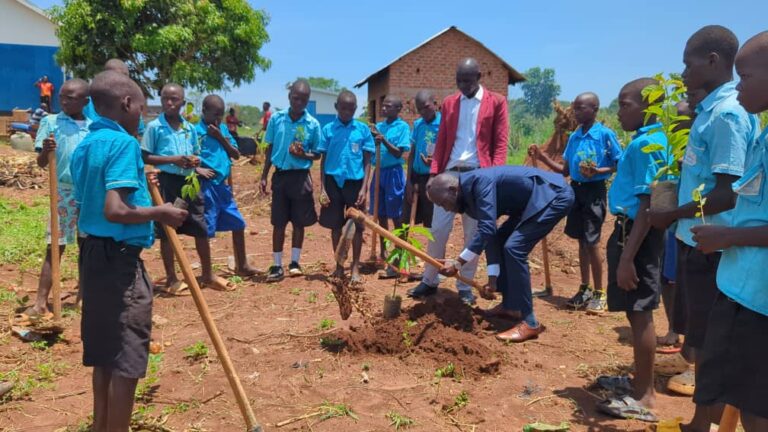
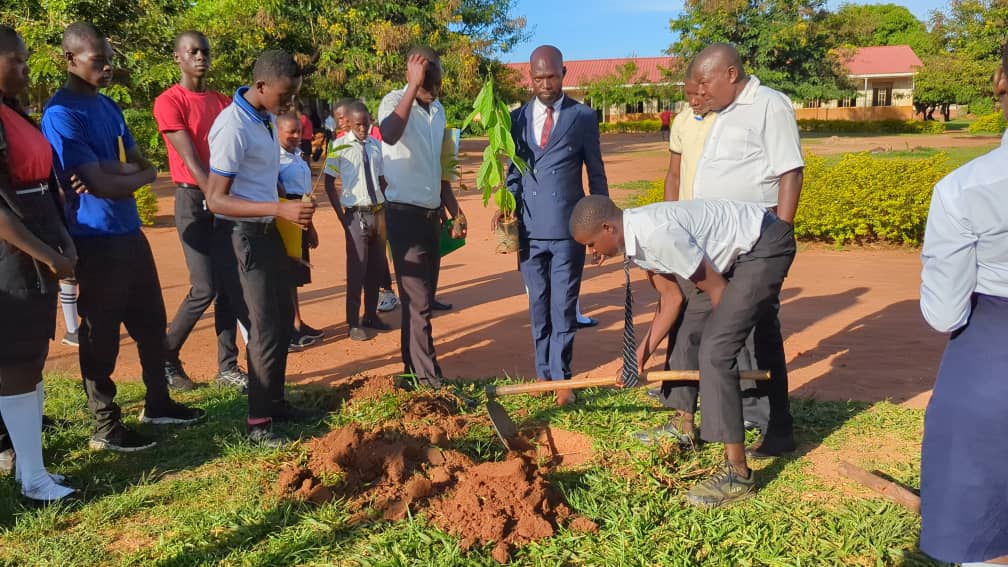
A campaign targeting students in schools across Buyende district has been launched as a deliberate effort to conserve the environment and mitigate climate change, which is a global challenge.

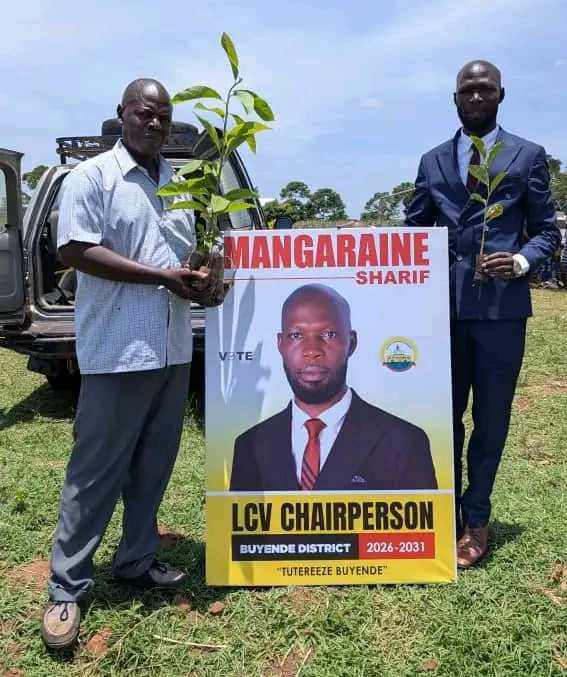
The campaign spearheaded by Mangaraine Sharif, one of the aspirants for the Buyende District LC5 chairperson seat, was launched at Kidera Secondary School on Friday.

“Our generation has witnessed an era of our fathers cutting down trees for charcoal as an economic activity for them to earn a living,” Mangaraine told Busoga Times.

“This practice has been done for decades without thinking about the increasing dangers and threats to the environment, like drought,” he added.

“The threat to the environment explains our urgency to initiate to emphasise the need for environmental protection that has never been greater,” he explained.

He revealed that they are launching the project “in schools because we must intentionally teach and model the practice to children, fostering an understanding and appreciation for it through various methods.”

Mangaraine explained that the tree planting exercise will be a big part of his 2026-2031 manifesto under the theme Tutereze Buyende.

“It’s the reason why we are working with the young people to change the world for a positive change under our new project, one student, one tree. Our mission is to inform, educate, enable and create a platform for urgent environmental action,” he elaborated.

Once a well-endowed district with natural forests, swamps, and streams, Buyende has lost its vegetation due to human activities, especially charcoal burning.

Charcoal burning is a leading economic activity in the district. Trees, including fruit trees, have been cut down to make charcoal and firewood, leading to the depletion of forests.

“Now, accessing firewood is a problem which is being faced in the communities. Remember these people cannot afford biogas or electricity to prepare a simple meal,” Mangaraine said.

BIG QUESTION: Is Uganda’s National Resistance Movement a mafia organisation?

0

By Oweyegha-Afunaduula

When some members of the National Resistance Movement (NRM) registered it as National Resistance Movement Organisation (NRMO) prior to the 2006 Presidential and Parliamentary elections, which cast it as a legal political party among the legal political parties, the owners of the Movement ignored NRMO and preferred to proceed as NRM from then on.

Even the Uganda Electoral Commission more or less moved along, because in every election it has organised since then, it has registered NRM, not NRMO, candidates for the elections, knowing fully well that the legal party is NRMO, not NRM.

NRM was an illegal rebel group as NRM/A that waged a five-year bush war in Uganda against the regimes of Apollo Milton Obote and Tito Okello. When it captured power on 25th January, 1986, it remained a bush war organisation with that name until 2006 when it registered as a political party -NRMO, to participate in parliamentary, presidential and council elections. However, its rejection of NRMO and sticking to its old name, NRM, cast it as a rebel group in government.

No one took the owners NRM to court for remaining a rebel group and participating in elections in Uganda and determine the future of Uganda while still a bush war organisation. Indeed, in every aspect of human life and endeavour NRM has continued to operate and resist anything that makes sense to Ugandans in favour of its own interests.  This way it is resisting Ugandans instead and imposing itself on them.

When I was researching for my article “Uganda: How the Mafia have rendered the National Resistance Movement Dysfunctional and Irrelevant” I asked a cross section of Ugandans in the country and in the diaspora: Is the National Resistance Movement a Mafia Organisation?”

In asking this question, I was guided by the following:

  1. National Resistance Movement seems to be owned by a few political families.
  2. Many people who have been engaged in dangerous deals that have ended up causing financial haemorrhage of the country are highly placed in the NRM
  3. The claims of two high-ranking members of the NRM government -Former Vice-President Prof. Gilbert Balibaseka Bukenya and current Prime Minister of Uganda, Robinah Nabbanja, that there are Mafias in the NRM government.
  4. There are Mafias in Africa, which have penetrated the economies of especially corrupt countries andmafia-style groups and networks exist in Africa, engaging in various criminal activities. 
  5. The choice by the leaders of NRM to reject the official party name of NRMO and retain the bush war name NRM.
  6. The continuing financial haemorrhage of Uganda by the NRM using its caucus in Parliament to divert trillions of shillings to consumptive ventures such as NRM/A Liberation Celebrations, et cetera.
  7. Impoverishing projects such as the Coffee Project and Lubowa Hospital Project.
  8. Inflating the national debt (domestic and foreign) to over 90 trillion over a period of nearly 40 years without evidence of commensurate development of the country.
  9. A Uganda Constitution 1995 that has allowed the capture of every civic space by the army and also the socio-economic process of the country in favour of foreigners.
  10. Tax holidays to foreign firms and sinking public money in them without
  11. Hereditary politics of political families that are also highly placed in the NRM and are involved in shadowy deals and businesses.
  12. A Uganda economy that does not deliver social goods and services to the indigenes of Uganda as much as it allows their exploitation by big political families and foreigners.
  13. Critical decisions on governance are decided by the NRM/NRA Parliamentary caucus, or the Central Executive Committee (CEC) outside the National Parliament,

So, when I asked to know whether the National Resistance Movement (NRM) was a Mafia organisation these are some of the answers I got:

  1. No. NRM is not a Mafia organisation.
  2. Yes, NRM is a Criminal Organisation.
  3. NRM is a mass Non-party organisation.
  4. NRM is a Cartel.
  5. NRM is a rebel organisation in power resisting Ugandans and their public interests.
  6. NRM is a militarist organisation serving the interests of settlers and/or refugees in Uganda.
  7. Most people involved in illegal activities such as money-laundering, human trafficking and human organ trade are NRM.
  8. Owners of loan-sharking and human trafficking firms are NRM.
  9. There have been many gangs in NRM claiming to be members of NRM and supported by power.
  10. The destruction of moral values by the NRM regime has allowed criminals to run the state.
  11. The judiciary, which is fully captured by the NRM/NRA cadre judges to the point where the judges can no longer be expected to dispense justice without fear or favor, ill-will or affection.
  12. The Ugandan State has become President Tibuhaburwa Museveni’s personal property. Facts, law and history are tweaked to sustain his ego and perpetuate falsehood. Uganda is a criminal state under the control of the NRM/NRA mafia.
  13. Uganda is an origin, transit and destination country for human trafficking, primarily for forced labour and sexual exploitation. Most adult victims are subjected to domestic servitude or forced labour in various sectors.
  14. Outside of Kampala, gangs known as ‘iron bar gangs’, periodically extort businesses, residents and visitors. Although cases are widespread, most of them are not linked to organized crime.
  15. Uganda has become a hub for arms trafficking across East, Central and West Africa, with one of the highest rates of gun violence in the region. 
  16. Uganda is a hub for counterfeit goods, and this is a huge burden on the country’s economic growth. Uganda’s borders with Kenya make it a hotspot for counterfeit goods trading
  17. Uganda is also a notable transit hub for wildlife trafficking, particularly for ivory, rhino horn and pangolin. Entebbe airport is a known hub for wildlife smuggling, due to high levels of corruption
  18. Uganda’s natural resource industry, particularly gold, has seen a significant rise in illegal activity in recent years. 
  19. The domestic cocaine market in Uganda is expanding, with powder and crack cocaine consumption on the rise.
  20. Uganda is recognized as a considerable cannabis exporter in the region, with cultivation occurring in several districts throughout the country.
  21. Key Ugandan government agencies lose billions of US dollars to corruption and financial crimes annually, as well as hundreds of millions lost in fraudulent procurement deals.
  22. High-level Ugandan officials have been implicated in organized crime, and the country’s presidential elections are allegedly influenced by vote-buying and security services suppressing opposition activities
  23. Criminal networks in Uganda operate across all criminal markets, thanks to rampant corruption and an abundance of resources
  24. The private sector is closely intertwined with politics, and corruption is central for its advancement.  When the IGG wanted to apply Life style Audit to catch the thieves  the President advised her not to, arguing she would discourage the corrupt from investing their loot, which he said was mainly government, money, in Uganda.
  25. The state, security and ruling party institutions have become so intertwined that the separation of powers is de-facto suspended. 
  26. Corruption is politically engineered and institutionalised in Uganda from top to bottom.

For God and My County

Further Reading

ANCIR (?). Mafia In Africa: How the Mafia Penetrates the African Economy. https://mafiainafrica.investigativecenters.org/ Visited on 4 April 2025 at 12:03 pm EAT.

BRIAN ADAMS KESIIME and Benson Tumusiime (2023).Notorious Kampala robbery suspect Sobi killed in Gomba land fight. The Monitor, November 18 2023https://www.monitor.co.ug/uganda/news/national/notorious-kampala-robbery-suspect-sobi-killed-in-gomba-land-fight-4468528 Visited on 05 April 2025 at 19:02 pm EAT

Grabianowsk, Ed and John Donovan (?). How the Mafia Works. HowStuffWorks, https://people.howstuffworks.com/mafia.htm Visited on 4 April 2025 at 11:44 am EAT.

Kungu Al-mahadi Adam (2025). BLOG: Gangs in Uganda: A Ticking Time Bomb. ChimpReports, January 4 2025, https://chimpreports.com/blog-gangs-in-uganda-a-ticking-time-bomb/ Visited on 04 April 2025 at 13:18 pm EAT.

Matogo, Phillip (2021). Let “the Mafia” Run Uganda. Daily Monitor, June 06 2025.https://www.monitor.co.ug/uganda/oped/commentary/let-the-mafia-run-uganda-3427628 Visited on 04 April 2025 at 12:37 pm EAT.

Obote Odora (2021).Uganda’s mafia family: How Gen. Museveni’s NRM transformed a weak state into a criminal enterprise. Sportlight East Africa,Mar 26, 2021.https://www.spotlighteastafrica.com/post/uganda-s-mafia-family-how-gen-museveni-s-nrm-transformed-a-weak-state-into-a-criminal-enterprise Visited on 05 April 2025 at 19: 08 pm EAT.

Onyango- Obbo, Charles (2023). This Mafia has ruled Uganda for 50 Years. Daily Monitor, January 5 2023, https://www.monitor.co.ug/uganda/oped/columnists/charles-onyango-obbo/this-mafia-has-ruled-uganda-for-50-years-4098396 Visited on 04 April 2025 at 13:08 pm EAT.

Oweyegha-Afunaduula (2022). The political engineering of corruption in Uganda. Watchdog, 2 March 2022.https://www.watchdoguganda.com/op-ed/20220302/131201/oweyegha-afunaduula-the-political-engineering-of-corruption-in-uganda.html Visited on 05 April 2025 at 19:59 pm EAT.

Oweyegha-Afunaduula and Charles Kawagga (2023). The Engineering and Institutionalisation of Corruption by the OPM.  Uganda Radio Network, 31sy July 2023, https://ugandaradionetwork.com/s/the-engineering-and-institutionalisation-of-corruption-by-the-opm/ Visited on 05 April 2025 at 20:03 pm EAT.

UGANDA RADIO NETWORK (2023).  Are there Mafias in Uganda? Uganda Radio Network, August 21 2023https://ugandaradionetwork.com/s/are-there-mafias-in-uganda/ Visited on 4th April 2025 at 12:19 pm EAT.

UGANDA: How mafia have rendered the National Resistance Movement government dysfunctional and irrelevant

0


By Oweyegha-Afunaduula

The key words in this article are mafia, government, dysfunctional and irrelevant. If they are linked in one spectrum of thinking, reasoning and analysis, it spells both tragedy and disaster.


Many thinkers and analysts are united in the belief that one cannot effectively decipher the condition of Uganda without evoking and integrating the detestable word “mafia” in thinking, reasoning and reflecting on the condition and analysing on how the mafia have negatively impacted the relevance, functionality and meaningfulness of government in Uganda in the various dimensions of human life and human endeavour. There is convergent thinking and belief that if there is no meaningful and effective government in Uganda anymore, then its distortion is due too the manifestations, greed and selfishness of the mafia. Many believe that the mafia now manifest more as deep state than individually.


Explaining the Term Mafia
Originally, the term referred to the Sicilian Mafia, a criminal organisation that emerged in Sicily in the 19th Century. Generally, refers to hierarchically structured, secret criminal organizations, particularly those of Italian or Sicilian origin, known for engaging in various illegal activities like racketeering, money- laundering, loan sharking, gambling, prostitution and fraud. drug trafficking and extortion.

The term is also used to describe the Italian-American Mafia, an offshoot of the Italian Mafia. However, other famous Mafias and the Russian, Israeli, Turkish and Albanian Mafia.


Throughout its history, the Mafia has controlled everything from the street-corner drug trade to the highest levels of government. Its members operate outside the law, yet become accepted and sometimes feared parts of the neighborhood and cities they inhabit.

Glorified by movies and television, hounded by law enforcement, marked for death by their enemies, these mobsters live violent and often brief lives.

There is talk of The Mafia Family Tree consisting of a BOSS, an Underboss below him, then CAPO below that one, SOLDIERS below that one and then ASSOCIATES at the bottom. This structure is for La Cosa Nostra but other criminal gangs have similar structure or slightly different.

Therefore, while Mafia organizations are often referred to as “families,” the term is a misnomer; they are not actual familial groupings, but rather criminal organizations with a hierarchical structure. 


These days the term Mafia is used informally to describe any criminal organisation that operates with similar hierarchical structure and methods, regardless of its origin.

In some cases, is even used to describe groups completely unrelated to crime. This has given the term a global reach, penetrating and interpenetrating even what appear to be systematic arrangements of institutionalisation and governance such as state agencies, Executive, Legislature and judiciary.

You can not describe the global village without evoking the term Mafia. Even global corporations such as those engaged in the pharmaceutical and arms industries may operate in Mafia-like fashion.

Wars may also reflect the operations of a Mafia culture, with all types of mafias involved from decision-making to execution.

When this happens countries may divert resources from social development to war-related activities, thereby denying their people quality life in terms of educatio, health and nutrition, or even quality infrastructure, which may involve firms belonging to well-connected Mafias that may even be protected by the powers that be.

In one short sentence Mafia sophisticated criminality”. If it penetrates a system everything that the agents of the system do will most likely be of a criminal nature but defended by the system as resolutely as it can.


Here is evidence that Mafia is in Africa and that the Mafia penetrates the African Economy. The Italian mafia has established a hidden but lethal presence in Africa. Its members own diamond mines, nightclubs and land, all with the complicity of corrupt regimes.


Is Uganda a Mafia Country?
The title of my article suggests that Uganda may have already found itself fully integra to the global Mafia network. The question is: Is Uganda really a Mafia Country and if it is what are the indicators that it is?

Well, if the Italian Mafia has penetrated the Economy of Africa and with the complicity of corrupt regimes, and Uganda’s regime is globally viewed as corrupt, it is not farfetched to state that the Mafia has penetrated the Ugandan economy.

Apparently the famous Coffee and Lubowa Hospital deals feature Enrica Pinetti, claimed to be an Italian-Arab business woman with no experience with coffee and construction of hospitals. But who can investigate to establish whether she in in the Mafia network?


I have read many articles on Uganda where the term Mafia has been alluded to but without properly explaining why Uganda should be perceived and understood to be a Mafia country.

A former Vice President of Uganda, Prof. Gilbert Balibaseka Bukenya claimed that his downfall from power was caused by Mafia in government. He later claimed that the Mafia Group in Uganda is a big network in the Government.

He was more or less supported by Prime Minister, Robinah Nabbanja alluded to the existence of a powerful corrupt Mafia in Government that can issue threats to those in and outside Government that threaten their interests.

Therefore, by the time Phillip Matogo (2021) wrote his article “Let the Mafia Run Uganda” the Mafia had long been evident in the Uganda economy.


Besides, many Government officials have talked of the existence of a Mafia network frustrating the system.

There is a claim that the Mafia network has its roots in State House Entebbe and Kapeka where the President’s young brother operates and that frequently the network base in Kapeka can sometimes overrule the decisions and choices of the President of Uganda.

If this is correct, it explains the financial haemorrhage the country is suffering through State House and Kapeka as well as other avenues.

Moreover, the middle class the President has been building with much ethnic orientation is a highly greedy and selfish Middle Class. Sometimes, if not always, it is armed and has access to the national budget, which it can use to finance its network operations.


From what I have written about Mafia, racketeering, money- laundering, loan sharking, gambling, prostitution and fraud, drug trafficking and extortion are all detectable in Uganda.


For the last 40 years the word fraud has become a most common word spoken and written. A multiplicity of fraud or scandals have characterised President Tibuhaburwa Museveni’s Uganda, involving high ranking government leaders, bureaucrats, civil servants, and even the business world.

The country has lost trillions of shillings to the underworld criminals who may be occupying high offices and even representing the people in Parliament.

However, because they are a secret group integrated in the Deep State, they may be difficult to identify. One may conclude that another is a fraudster by evoking his or her supersonic rise from a pauper to an extremely rich person even when his monthly salary is only 3.8 million shilling a month.


So many gambling points have sprang up and proliferated throughout the country. Some have been established by high-ranking people in government who prefer to remain anonymous. Many young people have left school and university to be engaged in gambling. They have even used their fees, which may have been given to them by their poor parents after selling their land to Mafias.


Money -laundering is a gainful preoccupation of some mafia in and outside government. Some People highly connected to the rulers of the country have been arrested in some world capitals money laundering. Because they were highly placed, they were not embarrassed by being put behind bars. They could have been rescued by other mafias in the capitals where they were arrested.


Uganda, now being far more a land of poverty, than ever before, boasts of excelling in the evil trade of prostitution. The prostitutes may belong to mafia, who make a lot of money from prostituting young girls and women, or who may have hotels and guest houses where prostitutes practise their trade.

Many prostitutes may be men and women serving in government, public institutions or in the business world, reflecting the moral decay in the country.


Loan-sharking has become a menace of the mafia in Uganda. They have digital firms, which they are using to make the increasingly impoverished Uganda as dependent on loans as they can. Every where in the country, the Mafia have established loaning points where they are robbing citizens of their land and other properties in case they fail to pay back the loan money, moreover at very high interest.


Drug-trafficking picked up in Uganda in the 1990s and has persisted, with increasing ownership of the trade by mafias many of whom may be connected to power.

However, what has shocked Ugandans recently is the trafficking of young Ugandans in what appears to be modern slave trade to the Middle East. Most trafficking firms are said to be owned by those in the Mafia network nationally and globally. Connected with trafficking of human beings is the trafficking of human organs, which is a very lucrative trade.

I wrote about this trade but did not explicitly mention that it is a trade that is attractive and sustained by mafias.


Lastly extortion has become common in Uganda. It may appear official such as in form of national budget making by government and allocation of money by government.

For example, the Uganda Revenue Authority (URA) may want 18 billion shillings for the healthcare of its staff and Members of Parliament may show reservations, but then it may proceed to extort the money from parliament by using money.

I am just giving an example because one time the boss of the Uganda Human Rights Commission (UHRC) told the nation that some Members of Parliament extorted money to have her organisation’s 2024/025 budged passed by Parliament.


Currently, the Mafia are feared to be working to ensure that the voters are confused in such a way that they cannot distinguish between National Unity Platform (NUP) and People Power Front (PPF) during the next Parliamentary and Presidential elections.

While Forum for Democratic Change – Katonga’s new party (People’s Front for Freedom, PFF) took so long to be registered by the Independent Electoral Commission of Justice Byabakama, PPF was registered in record time even if it uses more or less the same symbol and colours similar to those of NUP.


Has Uganda Government Become Dysfunctional and Irrelevant?
Many Ugandans think so. One school of thought believes that President Tibuhaburwa Museveni’s institutionalisation of poverty elimination through schemes such as Operation Wealth Creation (OWC), Myooga and Parish Development Model (PDM) have been penetrated by Mafias and extortionists, rendering them white elephants while enriching a few individuals connected to power.


Perhaps the worst operation of mafias in the country may prove to be land-grabbing in an ethnically oriented manner. Almost everywhere in the country landgrabbers belonging to the pastoral nomadic human energy system are wrecking havoc. The general belief is that behind the small land grabbers are mafias of the deep state. Many time the small land grabbers have a lot of money, which they use to buy the indigenes off their land.


The ultimate consequence of the operations of Mafias is that they have rendered the NRM government dysfunctional and irrelevant, leaving it to make promises, which it can never fulfill even if it was given another 100 years to rule.

Dysfunctional is the opposite of functional. Irrelevant is the opposite of relevant. When this is the case, the rulers will frequently be forced to use chaos and violence to compel people to choose silence and inactivity as the mafias do their acts. The Mafias will also deploy security organs to harass and quash the fourth estate so that only what promotes their choices and actions stands unchallenged. If people want social goods and services they must indefinitely wait as the Mafias enrich themselves.


If UBOS and NIRA have continued to disagree on how many Ugandans are, and if the “Independent Electoral Commission” is going to use the Census of 2014 instead of the more recent population census figures of 2024, this might be the best example of institutional decay and collapse in Uganda.


Have the Mafia penetrated the Electoral Commission and the Electoral Process in Uganda, ultimately confusing UBOS, NIRA and the Electoral Commission? If so, is the aim of the Mafia to render institutionalism meaningless and ineffective, and to ensure that regime change is not possible? Or to make Ugandans lose interest in elections altogether so that the country goes back to the time when elections were not allowed by the NRM regime.

When Electoral democracy fails, transparency and accountability are difficult to track and the Mafia have a field day. This is not surprising. Charles Onyango Obbo says Uganda has so far been governed by Mafias for 50 years (Onyango Obbo, 2023). Without people choosing who to govern them, we have gangarism at the centre of leadership and governance.


For God and My country.


Further Reading
Adam Nuwamanya (2024). Uganda Ranks 7th in Africa in Organised Crime -ODPP. NilePost, 2 April 204, https://nilepost.co.ug/news/196746/uganda-ranks-7th-in-africa-in-organising-crime—odpp Visited on 4 April 2025 at 13:23 pm EAT.
ANCIR (?). Mafia In Africa: How the Mafia Penetrates the African Economy. https://mafiainafrica.investigativecenters.org/ Visited on 4 April 2025 at 12:03 pm EAT.
Cretin, T. (1995). Attempted Definitions of Mafias., Revue de science criminelle et de droit penal compare Issue: 2 Dated: (April-June 1995). https://www.ojp.gov/ncjrs/virtual-library/abstracts/what-mafia-attempted-definition-mafias Visited on 4 April 2025 at 11:26 am EAT.
Grabianowsk, Ed and John Donovan (?). How the Mafia Works. HowStuffWorks, https://people.howstuffworks.com/mafia.htm Visited on 4 April 2025 at 11:44 am EAT.
Kakoma.ug (?). Watch Out for Mafia in Uganda. https://kakoma.ug/writing/watch-mafia-in-uganda/ Visited on 04 April 2025 at 11:12 pm EAT.
Kungu Al-mahadi Adam (2025). BLOG: Gangs in Uganda: A Ticking Time Bomb. ChimpReports, January 4 2025, https://chimpreports.com/blog-gangs-in-uganda-a-ticking-time-bomb/ Visited on 04 April 2025 at 13:18 pm EAT.
Matogo, Phillip (2021). Let “the Mafia” Run Uganda. Daily Monitor, June 06 2025. https://www.monitor.co.ug/uganda/oped/commentary/let-the-mafia-run-uganda-3427628 Visited on 04 April 2025 at 12:37 pm EAT.
Mc Weeney, S M (1987). Sicilian Mafias and their Impact on the United States. FBI Law Enforcement Bulletin Volume: 56 Issue: 2 Dated: (February 1987) Pages: 1-10. NCJRS Virtual Library https://www.ojp.gov/ncjrs/virtual-library/abstracts/sicilian-mafia-and-its-impact-united-states Visited on 4 April 2025 at 11:32 am EAT.
Olukya Godfrey (2022). Mafia buy children from some parents in Uganda to use them as beggars. AA 15 June 2022, https://www.aa.com.tr/en/africa/mafia-buys-children-from-some-parents-in-uganda-to-use-them-as-beggars/2614001 Visited on 04 April 2022 EAT.
Omar Kalinge Nnyago (2007). Uganda: Are the Mafia Devouring Each Other’s Throats? The Monitor, 30 August, 2007. https://allafrica.com/stories/200708301084.html Visited on 4 April 2025 at 13:30 pm EAT
Onyango- Obbo, Charles (2023). This Mafia has ruled Uganda for 50 Years. Daily Monitor, January 5 2023, https://www.monitor.co.ug/uganda/oped/columnists/charles-onyango-obbo/this-mafia-has-ruled-uganda-for-50-years-4098396 Visited on 04 April 2025 at 13:08 pm EAT.
UGANDA RADIO NETWORK (2023). Are there Mafias in Uganda? Uganda Radio Network, August 21 2023https://ugandaradionetwork.com/s/are-there-mafias-in-uganda/ Visited on 4th April 2025 at 12:19 pm EAT.

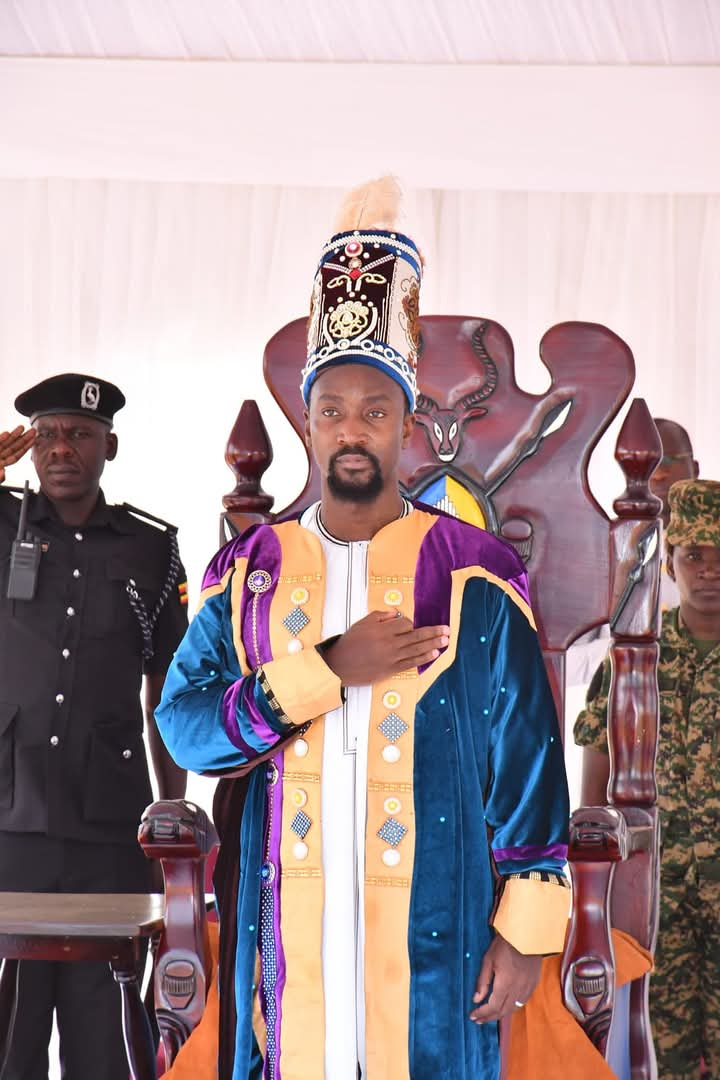
REASSURANCE: Kyabazinga Nadiope IV is in charge of Busoga Kingdom – Muvawala assures Basoga

0

The Katuukiro of Busoga Kingdom, Owekitibwa Joseph Muvawala, has in a lengthy and elaborative statement ‘assured Abasoga and the rest of Ugandans that His Majesty William Wilberforce Kadhumbula Nadiope IV is in charge and control of the Kingdom executing his duties as enshrined in the relevant legal regimes and Kisoga culture and norms.’

For close to two months, there has been rising concerns about the whereabouts of the Kyabazinga since his last public appearances in January. Matters were made worse when the First Deputy Prime Minister of Uganda, and Woman MP for Kamuli district, Rebecca Alitwala Kadaga, during a radio talksho with KBS Radio in Kamuli, announced that unscrupulous people had hijacked Obwakyabazinga.

In response, Muvawala said, “The Obwakyabazinga Bwa Busoga is under no control by any other forces apart from the authority and leadership of His Majesty Isebantu Kyabazinga,” adding “The Kyabazinga informs all of us that nobody is bigger than Busoga and our cosmopolitan nature and unity in diversity as Obwakyabazinga is our strength.”

TIGHT TARGET: Uganda U-17 Cubs faces must-win game against Zambia to qualify for knockouts and 2025 FIFA U-17 World Cup

0

By Musa Kikuuno, Busoga Times

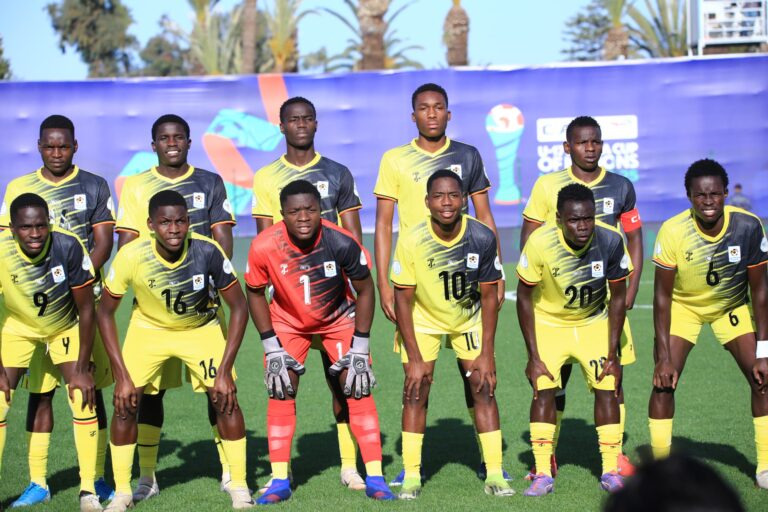
The Uganda U-17 Cubs are on the brink of making history at the 2025 Africa U-17 Cup of Nations (AFCON) in Morocco, with a decisive match against Zambia on Sunday, April 6, 2025, that could see them qualify for both the knockout stages and the 2025 FIFA U-17 World Cup in Qatar.

Going into the final group stage match, Uganda sits in third place in Group A with 3 points, just behind Morocco and Zambia, both of whom have 4 points. Tanzania is at the bottom of the group with no points, and their chances of advancing are already extinguished.

Morocco, already assured of qualification, sits at the top of the group due to their strong goal difference and will face Tanzania in the final match. Whether Morocco wins or loses, they will proceed to the knockout rounds. The only question for the Moroccan team is whether they will finish first or second in the group, depending on other results.

For Uganda, however, the stakes couldn’t be higher. The Cubs must defeat Zambia to have any chance of progressing to the knockout stages. A win would not only secure Uganda a place in the quarterfinals but also guarantee their qualification for the 2025 FIFA U-17 World Cup, as the top 10 teams in the AFCON will book their spots in Qatar.

A draw or loss would see Zambia advance, alongside Morocco, leaving Uganda’s World Cup dreams in jeopardy. In such a scenario, Zambia would secure second place, and Morocco would remain top of the group. The Cubs’ fate lies in their hands, with everything riding on their performance against Zambia, who will also be eyeing a victory to cement their qualification for the knockouts.

While Uganda’s journey in the competition still has some uncertainty, the Cubs have shown great determination so far, and fans are hopeful that they can rise to the occasion and secure a historic win.

With only one game to go, all eyes will be on Sunday’s encounter between Uganda and Zambia, a match that promises to be a thrilling finale to Group A. A victory for Uganda could propel them to greater glory, but only if they can conquer their regional rivals in a winner-takes-all clash.

REDEMPTION: Uganda makes easy work out of Tanzania at U17 AFCON in Morocco

0

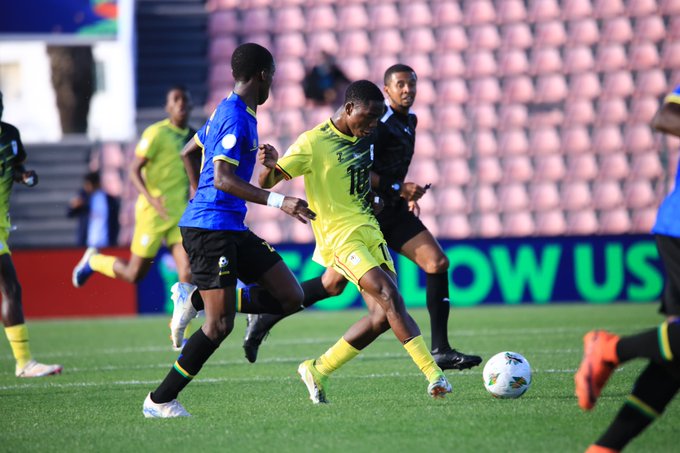
Goals from Simon Wanyama, Richard Okello and James Bogere were enough to see Uganda Cub beat their neighbours Tanzania at the ongoing U17 AFCON tournament in Morocco.

The results restore confidence in the teenage Uganda who lost their tournament opener 5-0 against hosts Morocco. Uganda heavily struggled to match the qualities of the Moroccans.

The Cubs earned their spot in the 2025 AFCON by winning the CECAFA U17 Qualifiers, defeating Tanzania 2-1 in the final. Uganda is in Group A with hosts Morocco, Zambia and Tanzania.

Uganda’s last U17 AFCON appearance in 2019 saw them finish third in the group stages, missing out on advancement to the World Cup.

Going into this tournament, Uganda Cubs coach Ssenyondo said their target was to use the tournament to qualify for the U17 World Cup. The semi-finalists at the tournament qualify for the World Cup.