Thursday, May 21, 2026
Home Blog Page 10

POLITICAL STABILITY: Namukuta Brenda makes history as Kaliro’s first two-term woman Member of Parliament

0

By Wabwire Andrew Goole

Namukuta Brenda has etched her name into the political history of Kaliro District after becoming the first Woman Member of Parliament to win a second consecutive term, shattering a long-held belief that the seat was only ever a single-term position.

For years, the Kaliro Woman MP seat had developed a reputation for political instability, with no holder managing to serve more than one term since the district’s creation. Many locals even dubbed it a “cursed” seat. However, Namukuta’s re-election has decisively broken that cycle.

Her political journey began in 2017, when she was elected District Councillor representing Workers. During her time on the council, she used the platform to build a strong grassroots base and lay the foundation for higher leadership. Barely a year into her term, she declared her intention to contest for the Kaliro District Woman Member of Parliament seat in the 2021 General Elections.

At the time, Namukuta Brenda was the youngest candidate in the race. She first secured victory in the 2020 party primaries with a commanding margin before going on to win the general election, making history as the district’s Woman MP.

Her success has largely been attributed to a results-driven leadership style rooted in service delivery. She openly rejected the locally criticised culture of “Tikulyamu bulya n’omala n’oyaba” (eat-and-go politics), instead embracing accountability, constant engagement with constituents, and visible impact on the ground.

As a Member of Parliament and a member of the Parliamentary Committee on Health, Namukuta played a key role in lobbying the Ministry of Health to equip Health Centre IIIs across Kaliro District with essential medical equipment. The intervention significantly improved healthcare delivery and strengthened confidence in public health services within the district.

Beyond health, she has consistently advocated for development projects and government programs, ensuring Kaliro benefits from national initiatives. Her accessibility, energy, and hands-on leadership have not only earned her widespread public support but have also inspired many young women to take an active interest in politics.

In the most recent elections, voters in Kaliro overwhelmingly renewed their trust in her leadership, granting her a second term and decisively ending the long-standing pattern of single-term representation.

Namukuta Brenda’s historic achievement stands as a powerful testament to how consistent service, integrity, and dedication can overturn entrenched political narratives and redefine leadership for future generations.

Mr Wabwire Andrew

 Goole is the ONC Coordinator, Kaliro District

Email: andrewwabwire872@gmail.com

SILENT DISAPPEARANCE: Land, loans, and the systemic unmaking of Uganda’s clan-based civilizations

0

Author: Professor Oweyegha-Afunaduula, in collaboration with the Center for Critical Thinking and Alternative Analysis.

Preamble: A Warning from the Source

We issue this not as a lament, but as a diagnosis of a living crisis. We document not a natural passing, but a designed dismantling. The clan-based cultural groups of Uganda—ancient, sophisticated systems of ecological governance and social belonging—are being systematically unmade. This is not evolution; it is erasure by policy, dispossession by debt, and conquest by ledger. We name the process, expose its engines, and sound an alarm for humanity. The disappearance of these clans is a microcosm of a global war against rootedness, diversity, and ecological wisdom.

1. The Vanishing World: The Clan as a Complete Socio-Ecological Universe

Before the distortion, there was integrity. Uganda was birthed from approximately 15 traditional states, each an ecosystem of clans. Take Busoga: a saucepan-shaped bio-region cradled by water, through which the Nile flows. It is perhaps the most clanned region on Earth, hosting nearly 300 of the world’s estimated 6,000 clans. Each clan was a sovereign cell of life:

· Its Politics was Territorial Stewardship: The clan head (Omwami we’kika) was a political leader governing a specific territory, its resources, and its people. His authority was inseparable from the land.

· Its Culture was Codified Ecology: Totems (Emiziro) were not mere symbols; they were binding ecological laws. A clan whose totem was the leopard protected the forests that housed leopards, thereby preserving watersheds and biodiversity. Knowledge of medicinal plants, soil renewal, and seasonal cycles was embedded in rituals and language.

· Its Spirituality was Geographically Anchored: Sacred sites (Emizimu)—forest groves, waterfalls, burial grounds—were the physical libraries of history, identity, and cosmic order. The Nnondo grove in Buganda or the Nhialic sites in Acholiland were not just “plots”; they were the beating heart of collective consciousness.

· Its Security was the Extended Family: The Kaka or Lapir system ensured that wealth, crisis, and opportunity were collectively managed. No one faced hunger or disaster alone. This was a paradigm of profound belonging, where identity was a trinity of people, land, and ancestral covenant.

2. The Foundational Betrayal: The 1995 Constitution and the Creation of Impotence

The first masterstroke of disappearance was legal. The 1995 Constitution, crafted under significant external influence, performed a critical act of political neutering.

· The Surgical Act: Traditional leaders (Kings, Chiefs) were stripped of their inherent political and decision-making powers. They were redefined, in law, as purely “cultural” or “traditional” leaders—institutions for ceremony, not governance.

· The Devastating Effect: This severed the essential nerve connecting cultural authority to territorial defense. A Kyabazinga, Kabaka, or Luo Rwot could preside over a coronation anniversary but could not legally stop a predatory land deal in his realm. It created a state-sanctioned power vacuum.

· The Outcome: The clan, and the cultural institution above it, were rendered spectators to their own dissolution. They watch, with cultural regalia but no legal leverage, as the structures they are meant to preside over are dismantled.

3. The Tripartite Engine of Erasure: A System Designed to Dispossess

Into this vacuum moves a system with a logic of extraction. The assault is threefold, a synergistic engine of destruction.

Engine A: The Political-Judicial Engine (The Framework of Legalized Theft)

The law itself became a tool of dispossession. The 1998 Land Act, while recognizing customary tenure, began a process of individualization that undermined communal holding. Government programs often treat customary land as “vacant” or “underutilized,” ready for state appropriation and reallocation to investors. A potent example is the controversial amendment of Article 26 of the Constitution, which eased government compensation processes for compulsory land acquisition, thereby accelerating the takeover of clan lands for large-scale “public interest” projects, often benefitting private interests.

Engine B: The Economic-Financial Engine (Debt as a Weapon of Mass Impoverishment)

This is the insidious, modern face of conquest. So-called “development” programs are, in practice, engines of entrapment.

· Operation Wealth Creation (OWC): Hailed as a poverty alleviation scheme, its rollout has been widely criticized. A 2017 Parliamentary Committee report documented widespread failure: poor quality inputs (diseased seedlings, counterfeit fertilizers) distributed as “credit” to farmers, leading to catastrophic crop failure and unpayable debt. The farmer, now indebted to the state, is forced to sell ancestral land to clear the liability.

· The Parish Development Model (PDM): The latest iteration. It injects millions of shillings as loans, not grants, into impoverished parishes. The financial infrastructure is weak, and the pressure to repay is immediate. When the promised “enterprises” fail—as they often do in a top-down, one-size-fits-all model—the only collateral is the family land. The exogene, often a wealthy individual with connections, waits to purchase this distressed asset. This is not development; it is a state-facilitated transfer of land from the communal poor to the individual rich. The clan member becomes a landless labourer or an internal refugee in their own homeland.

Engine C: The Ecological-Cultural Engine (The Erasure of Memory and Meaning)

The final assault destroys the very soul and memory of the people, ensuring the disappearance is permanent.

· Destruction of Sacred Sites: The Zoka Forest in the Madi sub-region, a sacred ecosystem and biodiversity haven, faces relentless encroachment and illegal logging, stripping away spiritual anchors and ecological balance. In Buganda, many Emizimu groves have been cleared for sugarcane or real estate.

· Imposition of Ecologically Empty Models: Vast tracts of land in Karamoja, Acholi, and Teso are being converted into privately-held ranches and monoculture farms (sugarcane, rice), displacing transhumance cultures and destroying complex dryland ecosystems. The promotion of GMOs threatens to erase millennia of adapted seed diversity and the knowledge that goes with it.

· Shattering of the Social Fabric: The extended family system, the clan’s social security net, is bankrupted by individual debt from programs like PDM. When one member’s loan fails, the whole family’s land is at risk, breeding distrust and collapsing mutual aid.

· Genetic and Moral Penetration: Strategic intermarriage by exogenes is not mere integration; it is, as noted, a “thieving genetic penetration” aimed at diluting lineage-based claims to land and leadership, and introducing a foreign ethic of individualism and extraction.

4. Naming the Crime: From “Development” to Concealed Destruction

This tripartite engine executes a suite of interconnected crimes:

· Ethnocide: The systematic destruction of a culture. By removing its land-base, distorting its governance, and ridiculing its knowledge, the culture is killed.

· Ecocide: The extensive destruction of the natural environment upon which that culture depends. Monocultures, pollution, and deforestation are its tools.

· Concealed Genocide / Ethnic Cleansing: Because the process is slow, bureaucratic, and dressed in the language of “law,” “investment,” and “development,” its genocidal outcome—the disappearance of a distinct people—is disguised. It is displacement by spreadsheet.

The primary victims are the settled Bantu, Luo, and Paranut (formerly called “Hamite”) groups, whose identities are tightly linked to specific territories. Their unmaking is a loss to all humanity.

5. The Paradigm War: Belonging vs. Extraction

At its core, this is a clash of two irreconcilable ways of being human on Earth:

· The Clan Paradigm: “We belong to the Land.” It is relational, duty-bound, holistic, and intergenerational. Value is measured in ecological health and social continuity.

· The Exogene/Extractive Paradigm: “The Land belongs to Us.” It is transactional, individualistic, short-term, and rootless. Value is measured in financial profit and political control.

The disappearance of clans signifies the temporary victory of the latter. But its logic is ultimately suicidal, destroying the very ecological foundations of life.

6. A Call for Conscientization and Action

This is not Uganda’s problem alone. It is a blueprint for the destruction of indigenous and rooted cultures worldwide. We therefore call for:

1. To the People of Uganda: Awaken to the systemic nature of the threat. Question the loan document. Reject projects that alienate you from your land and knowledge. Reconstitute the clan not as a dormant relic, but as an active forum for ecological defense, knowledge transmission, and collective economic resilience.

2. To UNESCO: Move beyond safeguarding intangible heritage in isolation. The true heritage is the entire, living socio-ecological system. Issue urgent advisories and intervene where this system is under direct assault by financial and legal instruments. Designate endangered cultural landscapes as “Sites of Urgent Ethnographic and Ecological Concern.”

3. To the United Nations Human Rights Council: Mandate a Special Rapporteur to investigate the nexus of development finance, land policy, and cultural rights in Uganda. Frame the findings within the concepts of concealed ethnocide and ecocide. The rights to culture, land, and a healthy environment (Resolution 48/13) are being collectively violated.

4. To the Global Academic and Activist Community: Abandon fragmented analysis. Adopt this integrative, critical framework. Document the links. Support local intellectuals like those at the Center for Critical Thinking and Alternative Analysis who are pioneering this holistic understanding against great odds.

Conclusion: The Choice Before Us

The clans of Uganda stand at the precipice of history. They can disappear into the footnotes of globalisation, another casualty of the extractive world order. Or, they can reappear as the vital teachers our century desperately needs—embodying sustainability, resilience, and a deep, non-negotiable belonging to the Earth.

The path to reappearance begins with conscientization—with seeing the invisible system. It begins with this paper. Read it. Share it. See what is being lost. And then, from that place of clear seeing, act.The future of diversity, both cultural and biological, depends on it. If it is interests, not identity, that matter ,as President Tibuhaburwa Museveni keeps telling us, every Ugandan – lead theer or led – must take what we are saying in this article as prime interest and strategies wherever he or she is to combat what is happening as the greatest war facing Uganda. We either rise or sink together. Real politics begins: The Politics of Human Survival!

For God and My Country

LIBERATION DAY 2026: Indian business tycoon Barot Harshad of Tirupati Group honoured with Crested Crane medal for contributing to Uganda’s economic development

0

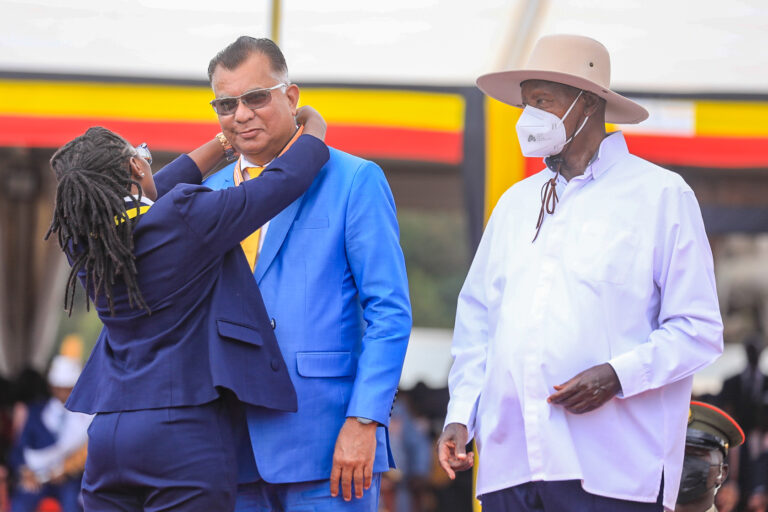
In a celebration of visionary leadership and transformative impact, President Yoweri Kaguta Museveni conferred the Distinguished Order of the Crested Crane (Grand Officer) upon Barot Harshad Maganbhai, the Chairman of Tirupati Development (U) Limited, during the NRM/A Victory Day celebrations.

This rare honor, reserved for foreign nationals who have made extraordinary contributions to Uganda’s development, underscores Barot’s unparalleled role in shaping the nation’s economic and social landscape over more than two decades.

From Humble Beginnings to National Icon

Born on January 3, 1959, in India, Barot’s journey to Uganda in 1993 began with a modest $150 and a determination to thrive. Starting with door-to-door sales of household items, he transformed his modest beginnings into a legacy of innovation and resilience. His success, he credits to Uganda’s peace and stability under the NRM government, which fostered an environment where ambition could flourish.

A Catalyst for Uganda’s Infrastructure and SME Growth

Barot’s vision extended beyond profit. Recognizing Uganda’s need for sustainable infrastructure and economic inclusivity, he spearheaded projects that directly addressed national challenges.

In 2006, he launched initiatives to decongest urban centers and empower small and medium enterprises (SMEs) by developing affordable, eco-friendly commercial hubs in rural and peri-urban areas. His work has not only created jobs but also revitalized communities, proving that infrastructure can be a tool for equity.

Landmark Projects That Redefined Development

Some of the outstanding projects that have been undertaken by Barot and his Tirupati Group include the Kyebando Business Park (Northern Bypass), a national model for SMEs, hosting over 200 enterprises and generating 2,500+ jobs; Health Centre IV (Adjumani), a state-of-the-art facility developed in collaboration with UNHCR, improving healthcare access in conflict-affected regions; and commercial Malls, Housing Estates, and Government Projects.

A Legacy of Recognition and Social Impact

Barot’s contributions have been celebrated globally and locally with awards such as Investor of the Year 2009 (UIA), for groundbreaking real estate solutions; Investor of the Year 2010, for establishing Uganda’s first bio-waste medical facility, and award for Exemplary Contribution to Property Development, recognizing his role in shaping Uganda’s urban and rural infrastructure.

Beyond business, Barot founded the LEELA Foundation, registered in Uganda, in 2019. The NGO provides monthly food supplies to 300+ elderly citizens in Kampala. Barot also provides educational sponsorships for underprivileged children and youth, empowerment programs for women and young entrepreneurs.

The Crested Crane: An Honorary Symbol of Partnership

The President emphasized, “Mr. Barot’s story reflects the symbiosis between individual drive and national stability. His work has not only built structures but entire ecosystems of opportunity.”

The Distinguished Order of the Crested Crane (Grand Officer), established under Cap. 173 of the National Honours and Awards Act, is a testament to Barot’s lifelong commitment to Uganda. Through economic empowerment, job creation, and social upliftment, his legacy is etched into the nation’s progress.

Commenting on the achievement, Barot said: “Receiving the Distinguished Order of the Crested Crane is a deeply humbling moment. It reminds me of the journey from humble beginnings to contributing to Uganda’s growth, and the countless people who supported me along the way.”

A Vision for the Future

As Uganda celebrates this milestone, Barot’s journey serves as a blueprint for inclusive growth. His story reminds us that investment in people and communities, not just capital, breeds prosperity. The honoree himself reflects: “This award is not just mine; it belongs to every Ugandan who refused to let their potential be defined by circumstance.”

In honoring Barot, Uganda also honors the values of resilience, collaboration, and transformative leadership that continue to propel the nation forward.

POLITICAL IMPOTENCE: A systemic analysis of a divided and ineffective opposition in Uganda

0

By Professor Oweyegha-Afunaduula and Collaborator

1. Introduction: The Persistent Crisis of Alternative Leadership

For over three decades, the political landscape of Uganda has been defined by the dominance of the National Resistance Movement (NRM) and the presidency of Yoweri Kaguta Museveni. Despite widespread socio-economic grievances and democratic aspirations among the populace, the political opposition has consistently failed to coalesce into a credible, unified, and effective alternative. This persistent weakness is not a historical accident but the deliberate outcome of a multifaceted system designed to perpetuate incumbent power. This analysis synthesizes historical, legal, political, and socio-economic factors to argue that the opposition’s ineffectiveness is a structural feature of Uganda’s political order. It results from a confluence of external repression engineered by the NRM regime and critical internal deficiencies within the opposition parties themselves, creating a cycle of division and impotence that sustains the political status quo.

2. Structural and Historical Foundations: The Roots of Fragmentation

The opposition operates within a political architecture fundamentally shaped by Uganda’s turbulent history and the NRM’s foundational strategies. The legacy of pre- and post-independence ethnic politics, coupled with the militarized nature of the NRM’s ascent to power, established a paradigm where political contestation is often viewed as subversion. The Bertelsmann Stiftung’s 2024 report notes a critical “erosion of the democratic consensus” among Uganda’s elites and a rise in “contentious politics,” undermining the basis for stable multiparty competition.

Furthermore, the post-1986 state-building project deliberately conflated party, state, and military, creating what scholars term a “military-patronage complex.” This system ensures that key institutions of accountability have been systematically weakened. As noted by Abbey Kibirige Semuwemba, the concept of a constitutional opposition—where institutions like Parliament and the Judiciary independently check executive power—has failed. The executive branch commits “constitutional violations with impunity,” rendering formal channels for opposition ineffective and legitimizing extra-legal regime tactics to maintain control.

3. The Architecture of Repression: Legal and Extralegal Containment

The NRM regime has constructed a comprehensive legal framework to criminalize and stifle organized dissent. The Public Order Management Act (POMA) of 2013 is a cornerstone of this strategy, granting police sweeping discretion to permit or prohibit public assemblies, effectively outlawing spontaneous political mobilization. While certain provisions have been challenged in court, its application remains a primary tool for disrupting opposition campaigns.

A significant escalation is the recent Uganda People’s Defence Forces (UPDF) (Amendment) Act, 2025, which permits the trial of civilians in military courts for certain offences. Opposition legislators decried this as “a direct assault on the Constitution” and “the birth of military dictatorship,” arguing it is designed to intimidate and punish political opponents under the guise of national security. This militarization of justice institutionalizes the threat of violence against dissent.

These laws operate within a broader climate of repression. The Bertelsmann Stiftung report confirms that elections occur in a context of “state violence and intimidation,” media bias, and digital shutdowns. The regime’s monopoly on force is routinely deployed for political ends, creating an environment of fear that severely constrains opposition activity and citizen participation.

4. NRM’s Active Strategies: Co-option, Division, and Militarized Politics

Beyond passive structural barriers, the NRM proactively executes strategies to fragment and neutralize the opposition.

*Strategic Co-option and Financial Inducement: The regime operates a sophisticated patronage system that targets opposition leaders. High-profile figures, such as Democratic Party president Norbert Mao who joined the government as Minister of Justice, are offered positions, resources, and prestige. This practice, as analyzed by Semuwemba, breeds a culture of complicity, saps opposition parties of talent, and demoralizes their support base by creating a perception that principles are negotiable.

*Deliberate Fomentation of Division: The state security apparatus is often accused of exploiting and inflaming internal contradictions within opposition parties. By amplifying personal rivalries, ideological differences, and ethnic suspicions, the regime ensures opposition energy is dissipated in internal conflicts rather than focused on challenging the NRM. This explains the recurrent failure to sustain grand coalitions, fragmenting the protest vote.

*Full-Spectrum Militarization of Civic Space: The military’s role has expanded far beyond defense into election management, local administration, and economic projects. This militarization of the ballot box and public life serves as a constant reminder of the regime’s ultimate source of power. It deters grassroots mobilization and frames political opposition as a challenge to national stability, justifying its suppression.

5. Internal Opposition Deficiencies: The Crisis Within

While external pressures are immense, the opposition’s own pathologies significantly contribute to its irrelevance:

*The “Presidentialisation” of Opposition Politics: Opposition strategy has become myopically focused on capturing the presidency in a single election, neglecting the granular, long-term work of building party institutions, contesting local councils, and developing coherent policy platforms. This mirrors what Semuwemba identifies as a fatal concentration on top executive power without building the necessary foundations.

*Personalism and Institutional Weakness: Most parties revolve around the charisma of a founding leader rather than a shared ideology or democratic structures. This fuels ego-driven conflicts, prevents sustainable coalition-building, and leaves parties vulnerable to collapse or co-option if the leader is compromised. The lack of internal party democracy and functional think tanks perpetuates this weakness.

*Elite Disconnection and the Headquarters Mentality: Confined to urban centers and party headquarters, opposition elites often fail to build organic, sustained connections with the rural poor, the unemployed, and the disenfranchised. This gap between political rhetoric and lived reality undermines their credibility as authentic representatives of popular struggle.

6. Socio-Economic and Cultural Enablers of the Status Quo

Broader societal dynamics further entrench opposition weakness:

*The Centrality of Money in Politics: Electoral politics is extraordinarily commercialized. The NRM’s control of state resources creates an insurmountable financial asymmetry, turning elections into a patronage auction the opposition cannot win. This fosters “political buying” and encourages a mercenary approach to party allegiance.

*Cultivated Fear and the Silence Syndrome: Decades of surveillance, intimidation, and violent reprisals have bred a pervasive culture of fear and self-censorship. This silence syndrome is a potent political tool for the NRM, as it atomizes society, breaks solidarity, and makes collective action exceedingly risky.

* The Collapse of Public Intellectualism: The systematic co-option of academia, the stifling of critical discourse, and the marginalization of independent thought have led to a death of the public intellectual sphere. This deprives the opposition of the ideological depth, policy innovation, and ethical framing needed to articulate a compelling alternative vision to the populace.

7. Conclusion: A System Designed to Fail

The division and ineffectiveness of Uganda’s political opposition are neither temporary nor incidental. They are the logical output of a self-reinforcing political system. Historical legacies of militarism provide the foundation, which the NRM has institutionalized through repressive law, strategic co-option, and the deliberate cultivation of division. This external onslaught encounters an opposition plagued by internal failures of strategy, organization, and connection. Together, these factors are locked in a cycle that serves the incumbent regime’s interest.

Breaking this cycle requires more than a change of opposition tactics. It demands a fundamental re-imagining of political struggle—away from a singular fixation on the presidency and towards the long-term, risky work of building independent institutions, resuscitating a critical public sphere, and forging authentic solidarity across social divides. Without this systemic counter-project, the opposition will remain a fragmented and ineffective feature of Uganda’s political landscape, perpetually unable to present itself as a credible alternative government.

For God and My Country

References

1. Bertelsmann Stiftung. (2024). BTI 2024 Country Report — Uganda. Gütersloh: Bertelsmann Stiftung. [Report on democratic transformation, detailing electoral unfairness, abuse of power, and shrinking civic space].

2. Parliament of Uganda. (2025, July 31). House passes Bill on military-related offences. Parliament Watch. [Official summary of parliamentary debate on the UPDF (Amendment) Act, 2025, featuring direct quotes from opposing MPs].

3. Semuwemba, A. K. (2011, August 28). Opposition parties in Uganda are ineffective. Modern Ghana. [Analytical opinion piece on the internal weaknesses of opposition parties and the failure of constitutional checks and balances].

4. Uganda Legal Information Institute. (2013). Public Order Management Act, 2013. [Full text of the principal legislation governing public assemblies in Uganda].

Note on Collaboration: This paper is the product of a unique collaborative process. Oweyegha-Afunaduula provided the foundational framework, critical insights, and thematic direction drawn from decades of scholarly and public engagement in Uganda. The collaborator’s role was to synthesize these inputs with contemporary source material, structure the academic argument, and provide formal citations to meet scholarly standards. The final work represents a fusion of deep contextual knowledge with analytical synthesis.

OWINY-DOLLO REPLACEMENT: Parliament vetting Chief Justice nominee ahead of expected election challenges

0

The Parliamentary Committee on Appointments, chaired by Speaker Anita Annet Among, is currently vetting Justice Flavian Zeija, President Yoweri Museveni’s nominee for appointment as the new Chief Justice of Uganda.

Speaker Among confirmed the committee’s proceedings on Thursday, saying the process is being conducted in line with parliamentary rules and procedures. She noted that once the vetting is concluded, the committee’s report will be submitted to the appointing authority for final consideration.

“The committee’s report will be forwarded to the appointing authority in accordance with our rules of procedure,” Speaker Among said.

Justice Zeija’s nomination follows the retirement of former Chief Justice Alfonse Owiny-Dollo, who officially retired on January 18, 2026, after attaining the mandatory retirement age of 70, as stipulated under Article 144(1)(a) of the Constitution. Owiny-Dollo handed over office to his deputy the following day, January 19.

The vetting process involves a detailed review of Justice Zeija’s qualifications, experience, and suitability for the office. Legal practitioners and members of the public are closely watching the proceedings, with any objections to the nomination expected to attract significant attention.

If approved, Justice Zeija will assume one of the country’s most powerful judicial offices, overseeing Uganda’s legal system and playing a central role in safeguarding judicial independence.

Justice Zeija was appointed Deputy Chief Justice in April 2025, succeeding Justice Richard Buteera. His experience is expected to be critical as Uganda’s judiciary prepares for potential post-election litigation following the January 15, 2026 general elections.

Under Ugandan law, presidential election petitions fall exclusively under the jurisdiction of the Supreme Court, where the Chief Justice plays a central role. President Museveni was declared winner of the presidential election with 71.65 per cent of the vote, and legal challenges to the outcome are anticipated.

NEW CHAPTER: Madondo joins Richards bay in South Africa

0

Ugandan striker Joel Madondo has completed a move to South Africa’s Premiership side Richards Bay FC, signing a deal that will keep him at the club until January 2028.


The transfer brings an early end to Madondo’s stint with Eswatini champions Nsingizini Hotspurs, whom he joined in July 2025 on a two-year contract. Nsingizini confirmed the switch, stating that Richards Bay met all contractual obligations and agreed personal terms with the player, while also praising the South African club’s professionalism.


Madondo earned the move after an impressive trial with the Natal Rich Boys, convincing the technical team to secure his services.


A Musoga forward, Madondo brings vast experience from across the continent, having featured for Wydad Casablanca in Morocco, Gaddafi FC, BUL FC, Busoga United, Army FC, and Diamond Trust Bank FC in Tanzania. He is also a 2019 CECAFA Senior Challenge Cup winner and has earned four caps with the Uganda Cranes.


At Richards Bay, Madondo will link up with fellow Ugandan international goalkeeper Salim Jamal Magoola, now in his fourth season at the club. His arrival makes him the third Ugandan player in the South African Premiership this season, alongside Mamelodi Sundowns veteran Denis Onyango.

A DREAM FULFILLED: Magogo says Uganda hosting 2027 AFCON tournament tops all his football achievements – and they are quite remarkably many

0

In the early hours of 19 January 2026, in the cold stillness of Rabat, where the TotalEnergies CAF AFCON Morocco 2025 was climaxing with a gruesome final between Senegal and hosts Morocco, sleep refused to come to Magogo Moses Hassim. As dawn edged closer, the President of the Federation of Uganda Football Associations (FUFA) lay awake, quietly absorbing a moment years had been building toward.

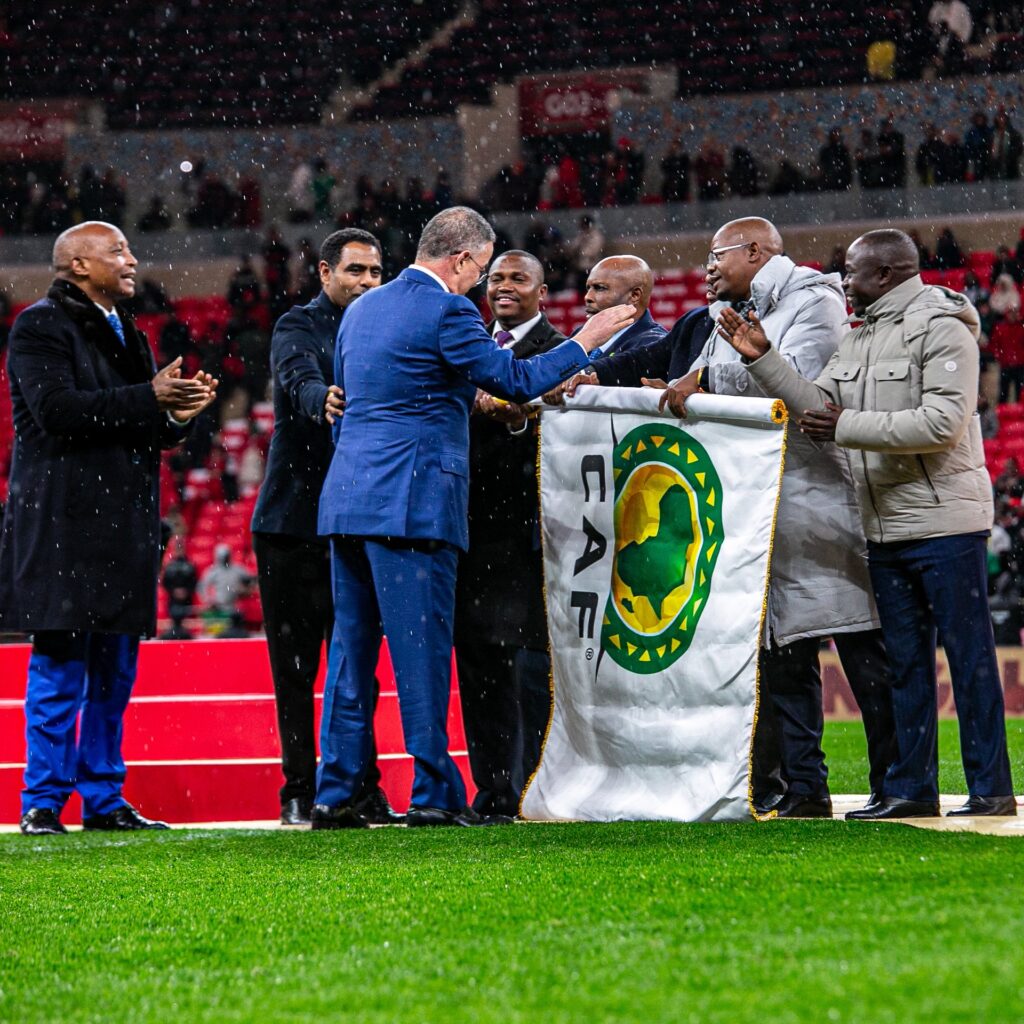
For a man whose tenure has been defined by historic firsts, it was not the long list of achievements that stirred him most. It was the realization that the Africa Cup of Nations (AFCON) would be hosted in Uganda within his lifetime. Uganda won the rights to host the continent’s premier tournament alongside neighbors Kenya and Tanzania under the Pamoja bid in 2023. That night in Rabat, the CAF flag for the 2027 TotalEnergies Africa Cup of Nations was ceremonially handed over to the Pamoja host nations of Kenya, Uganda and Tanzania.

Magogo’s leadership at FUFA has reshaped Ugandan football in ways once thought improbable. Under his stewardship, the Uganda Cranes returned to AFCON after a 40-year absence, qualifying four times in just ten years, while the Crested Cranes made their return to the Africa Women Cup of Nations after 22 years.

Beyond the pitch, Magogo pushed structural reforms that redefined the federation’s capacity. FUFA constructed a federation-owned stadium capable of hosting CAF Category 4 international matches, and launched a satellite television channel and FM radio station—a bold move that ensured the Uganda Premier League remained visible when commercial broadcasters were unwilling to invest.

Ugandan national teams qualified for continental competitions more than 20 times during his tenure. The U20 team reached two continental finals, while the U17 national team delivered stellar performances at Uganda’s first-ever FIFA World Cup, marking a generational breakthrough for youth football.

Magogo also positioned Uganda as a continental host, overseeing the successful staging of the country’s first CAF tournament—CHAN. At the policy level, his influence extended into Parliament, where he personally legislated for direct government funding of national teams and sponsored the Private Member’s Bill that became the National Sports Act of 2023, a landmark in Uganda’s sports governance framework.

Infrastructure became another defining pillar of his legacy. Government, spurred by sustained advocacy, renovated and constructed international-standard stadiums at Namboole, Hoima, and Aki Bua, alongside more than 12 training facilities nationwide. FUFA itself donated 24 acres of land toward the Hoima Stadium project, underscoring institutional commitment beyond rhetoric.

The CAF flag for the 2027 TotalEnergies Africa Cup of Nations was ceremonially handed over to the Pamoja host nations of Kenya, Uganda and Tanzania.

On the human side of the game, Magogo introduced medical insurance for players and referees in the top men’s and women’s leagues—a first in Ugandan football—and stabilized FUFA’s governance structures, bringing an end to long-standing internal conflicts that had stalled development for years.

Yet for all these accomplishments, it was the AFCON dream that lingered deepest in his reflections that January morning.

Hosting Africa’s premier football tournament represents more than sport. It is validation of long-term planning, institutional reform, and belief in Uganda’s place on the continental stage. For Magogo, it is a moment that transcends administration—a legacy milestone for a nation and a region.

REBECCA ALITWALA MUBEZI: The youth lioness with a heart for the forgotten lives in Kamuli

0

On the sun-warmed paths of Kamuli District, where opportunity is often scarce and vulnerability common, Rebecca Alitwala Mubezi has quietly built a movement anchored in compassion, courage, and purpose. Born and raised in this eastern Ugandan community, Mubezi is not just a changemaker, she is living proof that service, when driven by passion, can transform lives far beyond one’s immediate reach.

As the founder of Becky’s Child Foundation, Mubezi has dedicated her young life to standing in the gap for children and women society often overlooks. Her journey into advocacy was inspired and shaped by the example of Rt. Hon. Rebecca Alitwala Kadaga, former Speaker of Parliament of Uganda, and current Woman Member of Parliament for Kamulit district and the First Deputy Prime Minister of Uganda and the Minister for East African Community Affairs, whose mentorship reinforced Mubezi’s belief that leadership must begin with service to the most vulnerable.

Rebecca Alitwala Mubeezi receives the Busoga Beauty Queen Crown from then Speaker of Parliament Rebecca Kadaga

What started as small, community-driven acts of support has grown into an organisation that has touched the lives of over 500 vulnerable children. Through education sponsorship, healthcare access, mentorship, and psychosocial support, Becky’s Child Foundation has restored hope to families facing poverty, neglect, and systemic disadvantage. For many children, the foundation is not just a lifeline, it is a second chance.

Mubezi’s work places particular emphasis on girl-child education and women’s empowerment. In communities where early marriage, school dropouts, and limited opportunities remain pressing challenges, she equips young girls with confidence, skills, and mentorship to dream beyond circumstance and reclaim control over their futures.

Mubezi is not just a changemaker, she is living proof that service, when driven by passion, can transform lives far beyond one’s immediate reach.

Her advocacy extends beyond classrooms. Mubezi has emerged as a strong voice in the fight against kidney disease, championing preventive healthcare through community sensitisation and health camps. Her commitment to public health has earned praise from local authorities, including Kamuli District Health Officer for Maternal and Child Health, Moses Lyagoba, who describes her as “a health gem offering an olive branch amidst the disease burden.”

“She has partnered with us to improve access, availability, and affordability of healthcare services,” Lyagoba notes. “Her preventive approach has significantly stimulated health uptake and contributed to disease reduction.”

Mubezi’s work places particular emphasis on girl-child education and women’s empowerment.

Recognition of Mubezi’s impact has steadily followed. The Kamuli Media Association named her Youth Lioness, honouring her unwavering dedication to mentoring and protecting vulnerable young people while promoting positive parenting values and community cohesion.

Journalist Sam Caleb Opio describes her as a voice for the forgotten. “Through Becky’s Child Foundation, Rebecca has given vulnerable children an ear, a helping hand, and a smile of hope,” he says. In acknowledgment of her tireless work, the association will award her The Lioness Crown on Women’s Day, celebrating her contributions to the rights and wellbeing of children, youth, and marginalized communities.

For social commentator Charles Galimaka, Mubezi’s story is a powerful lesson in redefining impact. “We often think change must come from foreign donors,” he reflects. “But Becky has shown that with small local resources, collaboration, and a large heart, one can create real transformation. Like the biblical miracle of feeding thousands with little bread and fish, her work is driven by passion, sacrifice, and self-belief.”

Mubezi has emerged as a strong voice championing preventive healthcare through community sensitisation and health camps.

Yet beyond awards and accolades, Mubezi remains grounded in her mission. She measures success not in recognition, but in school attendance registers, healed patients, and renewed smiles. Her leadership is quiet but firm—rooted in listening, empathy, and community trust.

As Uganda’s young generation searches for role models who reflect purpose over privilege, Rebecca Alitwala Mubezi stands tall. Her story reminds us that meaningful change does not begin with abundance, but with resolve. In Kamuli and beyond, the Youth Lioness continues to roar—not in noise, but in impact—lighting the path toward a more just, compassionate future.

DIAL AND BANK: How dfcu’s 240# USSD platform is making everyday banking accessible on any phone.

0

As digital finance continues to evolve, access remains uneven. While smartphone apps dominate conversations around modern banking, many Ugandans still rely on basic mobile phones and have limited or inconsistent internet access.

To bridge this gap, dfcu Bank has enhanced its *240# USSD platform, enabling customers to bank easily from any phone, anywhere in the country—without data or airtime.

We spoke to Isaac Bigirwa, Head of Cards & Payments at dfcu Bank, about why USSD banking still matters, what’s new on the platform, and how it’s changing everyday banking for individuals and small businesses.

Many banks are focusing on mobile apps. Why is dfcu still investing heavily in USSD banking?

Not every Ugandan owns a smartphone or has reliable access to the internet, and at dfcu we strongly believe that banking should be inclusive. The *240# USSD service works on any phone, anywhere in the country, without requiring data or airtime.

It allows farmers, traders, teachers, and small business owners to access essential banking services conveniently, regardless of where they live or the type of phone they use.

For readers who may be unfamiliar with it, what exactly is *240#?

*240# is dfcu Bank’s USSD mobile banking service. Customers simply dial *240# on their phone and follow the on-screen prompts. There’s no need to download an app, connect to the internet, or have airtime.

Using *240#, customers can check their balances, send money, pay bills, buy airtime, manage their cards, and even access loans—all from a basic mobile phone.

How does this work in real, everyday life?

A typical customer can dial *240# to check their balance, send money to a family member or supplier, pay electricity or school fees, buy airtime, or move money from mobile money into their dfcu account.

All of this can be done in just a few minutes, without visiting a branch or ATM, which saves both time and transport costs.

dfcu recently upgraded the *240# platform. What’s new?

The upgraded *240# is faster, simpler, and more reliable. We’ve reduced the number of steps in the menu to make it easier to navigate, even for first-time users.

New and enhanced features include self-onboarding using an account number and NIN, self PIN reset, zero-rated access that doesn’t require airtime, and multiple language options including Luganda, Runyakitara, Luo, Lugbara, and English.

Customers can also transfer funds from wallets to bank accounts, send money to other banks, manage their cards by checking balances or blocking them, make cardless withdrawals at agent points, and create or cancel standing instructions, including cross-currency transfers.

In effect, *240# is now a complete banking solution accessible on any phone.

How easy is it for someone to get started?

It’s very straightforward. A customer dials *240#, selects their preferred language, accepts the terms and conditions, enters their account details, and creates a simple five-digit PIN.

Within minutes, they are fully set up and ready to start banking.

Why were zero airtime access and local language options a priority?

Zero airtime access removes a major barrier by allowing customers to bank even when they don’t have airtime on their phone. Local language options help users clearly understand the menus and transact with confidence.

Together, these features make banking simpler, more inclusive, and more accessible for everyone.

Security is always a concern with digital banking. How safe is *240#?

Security is a top priority at dfcu Bank. Every transaction on *240# is protected by a personal PIN, and the platform is supported by strong security systems that monitor and prevent fraud.

Customers can also take control by managing their cards directly on *240#, including blocking a card immediately if necessary.

How does *240# support small businesses and agents?

Small businesses can access affordable digital financing such as the SME Mobiloan of up to UGX 5 million and the Mostock loan of up to UGX 50 million for stockists.

Beyond financing, SMEs can pay bills and taxes, make local transfers, and purchase MTN or Airtel agent float through *240#. This helps business owners save time, improve cash flow, and keep their operations running smoothly

If customers need help, where can they turn?

Support is always available. Customers can reach dfcu through the 24/7 call centre, WhatsApp, email, social media platforms, or by visiting any of dfcu’s 56 branches across the country.

Finally, what message would you like to share with Ugandans about *240#?

I encourage all Ugandans to open a dfcu account and experience convenient everyday banking through *240#. Individuals can send money, pay bills, and manage daily transactions easily, while small businesses can access digital loans and purchase agent float.

All of this is available on any phone, without the limitation of data or airtime.

TOP, TOP, TOP ANALYSIS: The architecture of electoral authoritarianism and how elections are stolen in Uganda

0

By Oweyegha-Afunaduula

This article argues that electoral manipulation in Uganda is not a series of ad hoc irregularities but a predictable outcome of a political system deliberately architected since 1986. The process began with the constitutional dismantling of alternative power centres and the creation of a hyper-presidency, followed by the systematic “bantustanisation” of the political landscape.

The paper categorises the mechanisms of electoral theft into four phases: pre-election structural manipulation, campaign-period violence and intimidation, voting-day fraud, and post-vote judicial and institutional sanction.

 Using Uganda as a primary case study, the analysis demonstrates how incumbent regimes embed electoral advantage into the state’s very fabric, making democracy a managed exercise in regime renewal rather than a contest for power. The impending 2026 elections serve as a prospective case to test this established model.

The Contradiction of Liberation

In January 2026, Ugandans will once again go to the polls in a ritual that has come to define the nation’s politics: a high-stakes electoral contest whose outcome is widely anticipated, not because of its competitiveness, but due to the pervasive understanding of its predetermined nature. The incumbent, President Yoweri Kaguta Museveni, who has held power for nearly four decades, will seek yet another term. This paper posits that his expected victory will not be a product of genuine popular acclaim alone but the inevitable result of a comprehensive, state-managed system of electoral authoritarianism.

This system finds its roots in a foundational contradiction. The National Resistance Movement (NRM) government came to power in 1986 following a protracted guerrilla war, justified in part by the need to restore “electoral democracy” after the disputed 1980 polls.

However, upon assuming power, the movement exhibited a deep-seated distrust of unfettered electoral politics. Having been rejected at the ballot box in 1980 under the banner of the Uganda Patriotic Movement (UPM) and led by cadres who often hailed from exogenous communities outside the constitutionally recognised indigenous groups, the NRM elite prioritised consolidation over competition.

The ensuing decades have seen the construction of a political edifice where elections are held regularly but are systematically engineered to perpetuate the incumbent’s rule. This paper traces the historical genesis of this system, taxonomises its operational mechanisms, and applies this framework to forecast the dynamics of the 2026 elections. It concludes that without a fundamental reconfiguration of the constitutional and institutional order, Ugandan elections will remain instruments of power preservation rather than expressions of popular sovereignty.

Historical Genesis: From Bush War to Constitutional Consolidation of Power

The critical juncture in establishing Uganda’s current electoral architecture was the constitution-making process (1989-1995). President Museveni initially advocated for a “no-party” or “Movement” system, arguing that political parties—blamed for Uganda’s sectarian violence—should remain in abeyance. A gentleman’s agreement was cited to justify this political monopoly.

A Constitutional Commission, chaired by Justice Benjamin Odoki, was tasked with collecting public views. Its findings, however, presented a problem for the new regime. As noted by former commissioner Sam Njuba, a significant majority (reportedly 65%) of Ugandans submitted a preference for a federal system (federo), particularly the powerful kingdom of Buganda. This vision deviated sharply from the NRM’s desire for a centralised, unimpeded executive authority.

The regime’s response was decisive. According to insider accounts, a secretive committee of “eight wise men” was appointed to redraft the commission’s report, systematically excising provisions that threatened centralised control. The resultant 1995 Constitution, promulgated by a Constituent Assembly operating under the NRM’s shadow, became the legal bedrock for perpetual incumbency. Its key features include:

*The Imperial Presidency: It invested overwhelming executive, appointive, and even legislative powers in the office of the President, creating what scholars term a “hyper-presidency”.

*The Neutralisation of Traditional Authority: Article 246 reduced the once-powerful kingdoms and the Busoga chiefdom to mere “cultural institutions”, stripping them of political and administrative power and eliminating potential rival poles of influence.

*Demographic Re-engineering: The controversial insertion of “Banyarwanda” as an indigenous group, a move seen by critics as expanding the regime’s political base, underscored the constitution’s role as a tool for political engineering rather than a reflection of an organic social contract.

This constitutional coup de grâce established the rules of the game: all subsequent electoral contests would be played on a field heavily tilted in favour of the incumbent. The return to multiparty politics in 2005 did not level this field; it merely forced the opposition to compete within a system fundamentally designed for their defeat.

A Taxonomy of Electoral Manipulation in Uganda

The stealing of elections in Uganda is a holistic process, encompassing actions long before and well after polling day. We categorise these mechanisms into four interrelated phases.

A. Pre-Election Structural and Legal Manipulation

This is the most profound layer, determining the playing field itself.

*The Partisan Electoral Commission: The President exclusively appoints the Electoral Commission (EC), ensuring its leadership and staff are NRM cadres. This compromises every subsequent action, from voter registration to final result declaration.

*A Captive Judiciary: The President’s stated policy of appointing “NRM cadres” to the bench to “fight corruption” has, in effect, politicised the judiciary. Judges ruling against the state in sensitive political cases face career marginalisation, ensuring the legal system sanctions electoral theft.

*Candidate Disqualification: The EC and courts routinely use technicalities to disqualify viable opposition candidates, as seen with the blocking of several hopefuls from the 2021 presidential race.

*Gerrymandering and “Bantustanisation”: The continuous creation of new districts (from 33 in 1986 to over 136 today) fragments opposition strongholds, dilutes ethnic cohesion, and creates new constituencies where state patronage can determine outcomes. It is a political strategy disguised as administrative decentralisation.

*Voter Register Manipulation: The perennial issues of ghost voters, the inclusion of minors, and the delayed or opaque release of registers to opposition parties undermine the integrity of the voter roll from the outset.

B. Campaign Period Manipulation: The Militarisation of Politics

The campaign period transforms from a contest of ideas into a demonstration of raw state power and institutional bias.

*The Security Apparatus as a Political Tool: The Uganda People’s Defence Forces (UPDF) and the increasingly militarised Uganda Police Force (UPF) cease to be neutral arbiters. Their central role, as you noted, is to “cause fear to the electorate and to militarise the campaign trails of Opposition candidates.” Opposition rallies are routinely blocked, dispersed with tear gas and live ammunition, or subjected to obstructive and legally ambiguous last-minute “cancellations” by the police.

*Deployment of Intelligence and Administrators: As you highlighted, Resident District Commissioners (RDCs), Internal Security Organisation (ISO) officers, and other local state agents become active political operatives. In areas perceived as opposition strongholds, they harass candidates, intimidate supporters, and create a climate of apprehension that suppresses mobilisation.

*Asymmetric Access to Resources: The state treasury, public media (like UBC), and government logistical assets (vehicles, venues) become extensions of the NRM campaign. The opposition operates with severe financial and logistical constraints, while the incumbent’s campaign is bankrolled by state resources, blurring the line between government and party.

*Information Warfare: This includes biased state media coverage, state-sponsored propaganda, and the strategic use of internet shutdowns or social media throttling—as seen in the 2016 and 2021 elections—to disrupt opposition communication, mobilise their base, and obscure reports of irregularities.

Voting Day Fraud: The Execution of Theft

On polling day, the theoretical opportunity for a free choice is systematically undermined by a range of overt and clandestine actions.

*Ballot Paper Manipulation: This includes vote stuffing in NRM strongholds, pre-ticking ballot papers before distribution, and the establishment of illegal voting stations in security installations or NRM-linked offices where results are fabricated.

*Biometric Voter Machine (BVM) Manipulation: The irregular and opaque introduction of BVMs, without adequate testing or public trust, created new avenues for failure. Machines can “technically fail” in opposition areas, causing long delays and disenfranchisement, while their central servers remain under the exclusive control of the partisan EC.

*Voter Suppression and Confusion: Tactics include deliberately sending voters to wrong polling stations, late opening of polling stations in opposition areas, and the presence of intimidating security personnel at stations. The EC’s last-minute changes to polling station locations add to deliberate confusion.

*Compromised Electoral Officials: As you vividly described, presiding officers and polling assistants engage in miscounting votes (e.g., “throwing opposition votes under their legs”) and illegally altering Declaration of Results (DR) forms. The integrity of the individual citizen’s act of voting is violated at the point of counting.

Post-Voting Manipulation: The Sanction of Theft

The theft is finalised and legitimised after the polls close.

*The “Tally Center Coup”: At the National Tally Centre, the process lacks transparency. Legally required DR forms from polling stations are often disregarded in favour of handwritten, unaudited “summary” sheets brought by EC officials or security agents. This allows for the wholesale changing of results from entire constituencies.

*Ballot Box Interference: The physical exchange of ballot boxes between polling stations and during transit to tally centres remains a persistent risk, especially where security forces escorting the boxes are complicit.

*Judicial Sanction: The judiciary, already compromised, completes the cycle. Election petitions face overwhelming procedural hurdles, the standard of proof is set impossibly high, and key evidence is often dismissed on technicalities. The judiciary’s role becomes one of providing legal finality to a politically determined outcome, as observed in the dismissal of the 2021 presidential election petition. Judges who show independence are sidelined or forced out.

Illustrative Case Studies: The Evolution of a System

*1996 and 2001: Establishing the Template. The first multiparty elections under the 1995 Constitution were held under a de facto “Movement” system, with the opposition legally barred from campaigning as parties. State resources and security forces were fully deployed for the incumbent. The 2001 election saw an escalation, with the main opponent, Dr Kizza Besigye, facing severe intimidation and arbitrary arrest on treason charges after contesting the results.

*2011 and 2016: Refining the Machinery. The return to multipartyism saw the tactics become more sophisticated. The 2011 election was preceded by the “Walk-to-Work” protests and brutal crackdowns, setting a tone of intimidation. The 2016 election was marked by the controversial first use of BVMs, a heavily biased EC, and a state of near-total information blackout on polling day due to an enforced social media shutdown.

*2021: The Apex of Militarised Control. The 2021 election represents the most overt fusion of military and electoral power. The campaign was characterised by unprecedented violence, including the November 2020 massacre in Luweero and the militarised siege of opposition candidate Robert Kyagulanyi’s (Bobi Wine) campaigns. On election day, the internet was completely shut down. The outcome was a foregone conclusion, and the subsequent legal challenge was summarily dismissed by the Supreme Court. The EC’s conduct and the security forces’ role demonstrated the full maturation of the system you have described.

The 2026 Elections: A Forecast Based on Past Patterns

· Structural: The same EC is in place; the judiciary remains unchanged.

· Pre-Election: Intimidation of civil society, potential fresh disqualification threats to candidates, ongoing “bantustanisation” through new administrative units.

· Campaign Period: Expect heightened militarisation of campaigns, especially in the Buganda region and other opposition strongholds.

· Voting Day: Likely repeat of internet interference, BVM “glitches”, and intimidation.

The 2026 Elections: A Forecast Based on Past Patterns

As Uganda approaches the January 15, 2026, general elections, the patterns established over four decades provide a reliable template for forecasting. The mechanisms of electoral authoritarianism are not dormant but are being actively primed within their pre-existing structural channels. An examination of the current pre-electoral environment reveals the system in its preparatory phase.

Pre-Election Structural & Legal Manipulation in Motion:

  The foundational architecture remains intact. The Electoral Commission, chaired by Justice Simon Byabakama, retains public scepticism due to its performance in 2021 and its unchanged composition as a presidential appointee. The judiciary has seen no transformative renewal. Furthermore, the process of “bantustanisation” continues apace. The creation of new cities (e.g., Jinja, Arua, and Gulu) and the ongoing debate over the creation of more districts (like the proposed Terego District) serve to redraw political boundaries, diluting opposition cohesion and creating new arenas for patronage. Voter register audits by opposition parties will likely again reveal anomalies—ghost voters, transfers, and registrations of minors—that the EC will dismiss or address opaquely.

Campaign Period: Prepping the Militarised Landscape:

  The campaign period is anticipated to be the most militarised and violent yet. The state’s response to the 2020/2021 election protests, which saw over 150 people killed by security forces, established a new threshold for repression. Opposition candidates, particularly those from the National Unity Platform (NUP) and the Forum for Democratic Change (FDC), can expect a replay of the 2021 tactics: obstructive permit denials for rallies, violent dispersal of gatherings, and targeted arrests of candidates and agents on charges ranging from incitement to treason. The role of RDCs, ISO, and the newly vigilant Crime Preventers-style structures will be critical in applying localised pressure.

Voting Day: Scripted Irregularities:

The technical and procedural flaws will follow a known script. Internet shutdowns or severe throttling are highly probable, framed as a “national security” measure to prevent the spread of “false information”. The Biometric Voter Verification (BVM) system will remain a point of vulnerability; “technical failures” are likely to be disproportionately reported in opposition strongholds, leading to long queues and effective disenfranchisement. The presence of plain-clothed security personnel in and around polling stations will heighten the climate of fear. Furthermore, the confusion of voter locations—a perennial issue—may be exacerbated by last-minute EC directives.

Post-Voting: The Inevitable Sanction:

  The post-election phase is the most predictable. Any outcome contrary to the incumbent’s victory will be impossible under the current architecture. The National Tally Centre will again operate as a black box. Legally mandated DR forms will be contested, with the EC relying on its own aggregated figures. Should the opposition mount a legal challenge, the judiciary, bound by its own precedents from the 2001, 2006, 2016, and 2021 petitions, will almost certainly affirm the EC’s declared results, citing the high burden of proof and the “sanctity” of the electoral process as administered.

In essence, the 2026 elections are not a pending contest but a ritual of renewal for a system designed for self-preservation. The outcome is predetermined not by a secret plot but by the open, operational logic of the political architecture built since 1995.

Conclusion

Uganda’s case study demonstrates that the most profound form of electoral theft occurs not on polling day, but in the years and decades prior, through the constitutional and institutional capture of the state itself. Elections become expensive, violent ceremonies that authenticate a pre-ordained political order rather than instruments of democratic choice.

The return to multiparty politics in 2005 did not democratise Uganda; it merely forced the authoritarian system to adapt, donning the cloak of pluralism while retaining its monolithic core. The opposition is permitted to exist, but not to win; to participate, but not to alter the fundamental distribution of power. This is the essence of electoral authoritarianism.

For God and My Country

Prof. Oweyegha-Afunaduula is a conservation biologist and the Center for Critical Thinking and Alternative Analysis.